

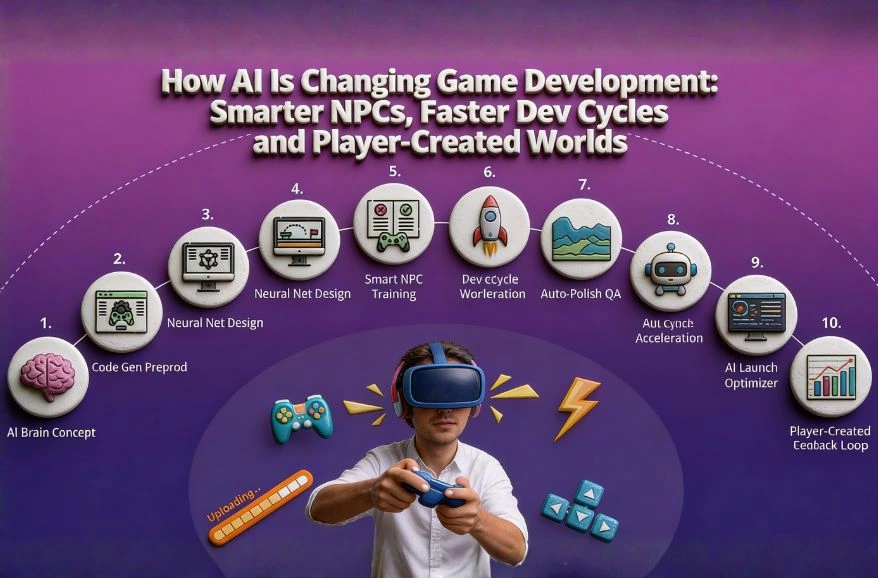
AI in game development has become relevant in game studios to perform complicated tasks that used to require teams months to complete. Beginning with the creation of assets to experimenting with situations, AI helps reduce expenses and enhance creativity, and the market is estimated to reach 11.4 billion dollars by 2032. According to Unity developers, 36% of studios are already using AI in the development of games to either prototype or debug. This foundation position has made sure games run faster and feel like they come alive.
What Is AI in Game Development?
Machine learning, generative models, and reinforcement learning have become the new standards that modern game studios use to develop smarter and more adaptive experiences. AI in game development is capable of not only analyzing the behavior of the players, but also creating an entire game world in real time. It can also help the developers to design and test features more precisely.
How AI Is Used in Games Today
More intelligent NPCs and Adaptive Gameplay: NPCs are no longer going to be on the same script every time, but will be dynamic and use reinforcement learning. This allows them to read what the players are doing and alter their strategies on the fly. This will make the game more immersive and reactive to players. It will build stronger emotional connections as well as will make game more enjoyable to play.
Procedural Content Generation (PCG): Procedural generation is an AI method of generating game worlds (such as maps and tasks) automatically. This allows the developers to define the artistic guidelines and the AI to fill in the rest. Procedural content generation AI increases the variety of game experiences. It speeds up prototype creation, allowing designers to focus on story and aesthetics.
Learning pipelines: AI can be used to accelerate the process of game development and testing by automatically identifying bugs and enhancing performance. This reduces the release delays and the production fatigue, thus a smaller number of people in teams can have shorter development times and more consistent releases.
Player analytics and experience personalization: AI changes jobs and levels of difficulty based on how well a player does based on data collected on the battlefield. This makes each player’s experience unique. This way of looking at data improves retention plans and makes updates more useful, which is why personalization is such an important idea in modern games.
Generative AI and Next-Generation Game Engines: Researchers are developing generative game engines capable of creating worlds and game systems with minimal assistance from humans. This unique method accelerates prototyping while also enabling smaller organizations to compete with big companies in terms of inventiveness.
AI in Graphics, Audio, and Immersive Worlds: AI enhances the sensory components of gaming because AI makes graphics and audio appear more lifelike and alters the way objects respond to the environment. This flexibility results in an experience that is very responsive in gaming, which explains the importance of AI to the present development of games.
Case Scenarios Where PCG Works Best
- In the Assassin’s Creed, Artificial Intelligence was used to create short sentences, which were pronounced by NPCs in reply to certain actions and events. This enabled scriptwriters to concentrate on the major plot.
- FIFA 2025 is AI-powered to conduct in-game analysis, match refereeing, and player scouting.
- MIMESIS is a new horror game with in-game creatures that are driven by AI technology. They replicate all actions and voices of the players, which provides some kind of mystery.
- Mega BREAK is a new action shooter that can use the ACE technology of NVIDIA to provide dynamic NPCs that can be heard with a realistic voice and have natural facial expressions.
- The game InZOI is an innovative game whereby there is the use of advanced AI technology, allowing the player to build in-game objects. Also, allow them to make interactions with characters more realistic.
AI Tools for Game Developers
| Tool | Best For | Pricing Model | Key Strength |
| Unity ML-Agents | AI behavior & learning | Free with Unity | Adaptive NPCs |
| Ludo.ai | Game design & research | Freemium | Market insights |
| GitHub Copilot | Code generation | $10-19/month | Multi-language support |
| Promethean AI | Environment design | Enterprise | Natural language design |
| Scenario | Custom art assets | Freemium | Style consistency |
| Meshy AI | 3D model generation | Subscription | Text-to-3D |
| Luma AI | Quick asset creation | Freemium | Speed & accessibility |
| Rosebud AI | Full game prototyping | Tiered subscription | Unified platform |
| Charisma AI | Interactive NPCs | Project-based | Natural dialogue |
| Modl.ai | Automated testing | Enterprise | Behavior simulation |
AI Agents in Game Development
The software, or AI agents, enhances the game to make it more interactive. Therefore, the players become more interested. The important developments include:
- Responsive NPCs that behave in a manner that is not anticipated based on the actions of a player.
- AI adjusts the game by changing difficulty, story, and interactions based on what each player prefers. It allows gamers to sneak, fight, or explore as they like. Emergent gameplay allows unplanned events to occur, which are influenced by the interaction between players and AI.
This is why each run has a different sequence of occurrences. This changing dynamic between the characters makes the game more exciting to play each time.
Player-Created Worlds Enabled by AI
The most exciting trend is possibly the development of player-created realities. Players are not mere explorers any longer; they are creators of their own game worlds.
- Mods: The lifespan of games is extended through user-created content. The best example of this is Dota. Initially, Dota was a mod of Warcraft 3. However, as its popularity increased, it became a standalone game. Furthermore, it also has a sequel named Dota 2, which is the most-played game on Steam.
- Sandbox games: Games like Roblox or Fortnite Creative give the ability to create, share, and even earn money through their effort.
- Collective creativity: Multiplayer games also become collective spaces where people not only play together but also create together.
Challenges of Using AI in Game Development
Job Displacement Concerns
People are also concerned that the intensive technological change, especially generative AI, can replace the working positions within the video game development. The concerns are also raised by Jess, the Independent Workers’ Union of Great Britain, on negative job changes. Many professionals, however, argue that AI can enhance competencies and automate repetitive activities without replacing developers because it cannot sense emotions or tell stories.
Game Addiction
Since Unity and Unreal Engine AI offer a higher degree of personalization, the games can be more interactive. As it involves, additional amusements of becoming addicted to the game. This, in its turn, may cause social isolation, physical as well as mental stress.
High Upfront Costs
The cost of integration of AI into the development of games is considerable and includes:
- It might be costly to hire AI specialists with the necessary experience, as the salary of such AI engineers is high.
- Special hardware and software (e.g., framework of machine learning in game development, testing tools, etc.) can cost between 75,000 and 250,000.
- Laws and privacy regulations can even be very costly.
Ethical and Design Concerns Around AI in Games
IP Property and Control of the Work:
- Copyright problems: Ownership of AI-generated content (AI, developer, user).
- Originality issues: Making AI original output.
- Attribution: Recognizing AI input.
Data Privacy and Safety:
- Data collection: Player data collections and purposes.
- Consent: Hospitality with the player agreement on the use of the data.
- Security: Preventing data breaches of players.
- Privacy regulations: Regulations like GDPR, CCPA, and transparency must be followed without fail.
Bias, Fairness, and Player Experience
- AI in game development has the potential to reproduce the existing biases in its training data and, therefore, be discriminative in matchmaking and content generation.
- The dynamic difficulty might fail to adjust in a fair manner, and some players might become frustrated.
- Also, AI-generated content should be a reflection of different points of view.
- In order to be fair and fun, it is essential to test and follow the principles of ethics when developing artificial intelligence in gaming.
Future of AI in Game Development
- Generative Game Engines: Interactive Generative Video research proposes models of game engines capable of making content, environments, and game logic by themselves.
- Autonomous Game Design: Generative AI in game design is increasingly being applied to create prototypes of entire mini-games or stories in response to a prompt and script. The future of AI in game design will reduce the amount of time required to come up with an idea.
- AI content created by the player: Studios are giving up on the idea of just giving players content. Instead, they want to let players make their own using a tool that lets them make characters, levels, or settings. This change is supported by research on the pipeline to build assets.
- AI in VR/XR: It has been researched that big language models (LLMs) and procedural systems are being applied in VR environments to enhance story, AI-based NPC behavior in games, and realism.
AI in Indie Games vs AAA Studios
| Feature | AAA Games | Indie Games |
| Budget | $100M+ | Less than $5M |
| Team Size | 500+ developers | 1-50 developers |
| Graphics | High-end 3D animation, photorealistic visuals | 2D or stylized 3D graphics |
| Gameplay | Large open worlds, cinematic storytelling | Unique mechanics, experimental gameplay |
| Marketing | Global promotions, millions spent on ads | Relies on word-of-mouth, social media |
| Platforms | Consoles, PC, Cloud Gaming | PC, Mobile, Consoles, Steam, Itch.io |
Conclusion: AI Is Reshaping How Games Are Built and Played
The use of AI in game development provides smarter NPCs, faster cycles, and player worlds, and transforms into a powerhouse solo dev. Anticipate evolving realities in which games are built to be with you, at the pace of an indie and size of an AAA. Ethical integration will guarantee non-compromising innovation, and this will achieve unending engagement by 2030. Artificial intelligence in gaming have become fun and playable for both creators and players.
FAQs About AI in Game Development
Q1. How is AI changing game development?
AI in game development revolutionizes the process through automation of content development, greater realism, personalization, efficient testing, and efficiency for game developers.
Q2. Will AI speed up game development?
Yes, Artificial Intelligence (AI) is certainly employed by NPCs (Non-Player Characters) in games to regulate the behavior of the NPCs.
Q3. Can AI create AAA games?
No, AI is not capable of producing a full-fledged, finished AAA game at the moment.
Q4. Do NPCs in games use AI?
The use of AI in game development has become easier. It is because it can automate, create and test content more quickly. It can also prototype faster, making the player experience more enjoyable.

Leave a Reply