

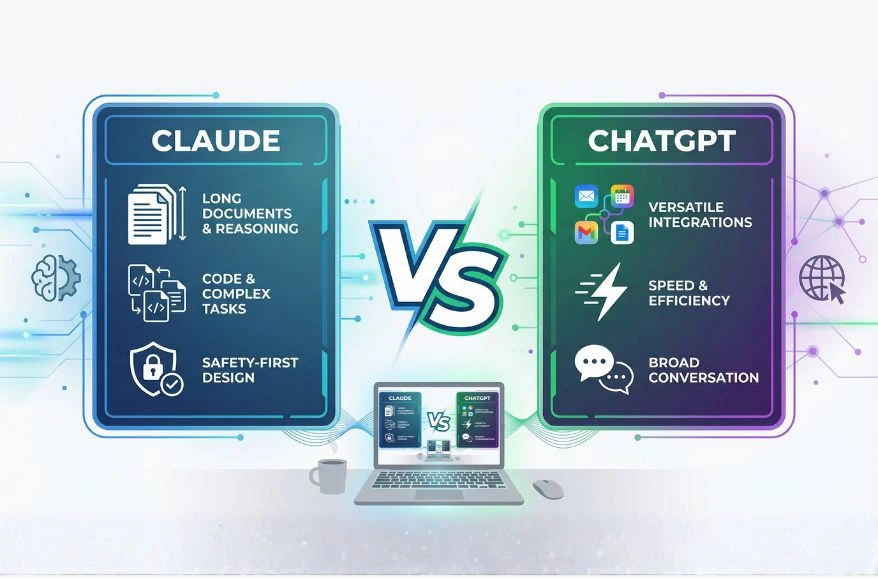
Professionals use AI every day in emails and in code, research and reports. Top competitors in Anthropic Claude vs ChatGPT are leaders in various domains to compete fast in 2025 upgrades. Claude is more focused on safety and depth, whereas ChatGPT can take general features, such as image generation. This guide is a step-by-step list that takes chatgpt vs claude and maps the proper AI to your workflow supported by benchmarks and user experiments.
Overview of Anthropic Claude and ChatGPT
To begin with, it should be mentioned that any given generative AI assistant is potentially complex to compare. It, after all, means that these tools are changing rather fast. As an example, Claude has now enhanced his collaboration skills and abilities among team members, which has happened since the Sonnet 3.5 model was launched.
ChatGPT unblocked some features recently with the release of the o1 models (advanced reasoning). It also offers more options of pricing plans, among which are Enterprise and Team plans along with the new ChatGPT Pro.
Feature-by-Feature Comparison
| Features | ChatGPT | Claude |
| Latest AI models | Sonnet 4, Opus 4 | ChatGPT 4.1, ChatGPT o3 |
| Context window | Sonnet 4: 200,000 tokens (about 150,000 words) Opus 4: 200,000 tokens (about 150,000 words) | 4.1: 1,047,576 tokens (about 786,000 words) o3: 200,000 tokens (about 150,000 words) |
| Maximum output | Sonnet 4: 64,000 tokens (about 48,000 words) Opus 4: 32,000 tokens (about 24,000 words) | 4.1: 32,768 tokens (about 24,600 words) o3: 100,000 tokens (about 75,000 words) |
| Training data cut-off | Sonnet 4: 2025 March Opus 4: 2025 March | 4.1: 2024 June o3: 2024 June |
| Web search | Sonnet 4: Yes Opus 4: Yes | 4.1: Yes o3: Yes |
| Image generation | No | Yes (GPT Image 1) |
| Video generation | No | Yes (Sora) |
| Voice output | Sonnet 4: No Opus 4: No | Yes |
| Input types | Sonnet 4: Text, image Opus 4: Text, image | 4.1: Text, voice, image o3: Text, voice, image |
Safety, Privacy & Ethical Design
With the emergence of AI governance and security, companies need to consider whether AI models are safe or not. Claude AI by Anthropic is unique in its constitutional approach to AI as it conforms to human values and will not often yield to the harmful prompt. Anthropic uses user consent to train models, unlike OpenAI which defaults to training models on user interactions. Although both companies are safety scrupulous, ChatGPT is not consistent with respect to its guardrails. It is worth mentioning that the new o1 models provided by OpenAI demonstrate higher efficiency in preventing jailbreaks, with much higher effectiveness than GPT-4o.
Performance in Real Work Scenarios
1. Creative Writing Tests
The creative writing tests involved tests of different AI models on their skill in creating humorous tales when they were asked to add a teenage boy and a clever dog on an adventure to save a princess. ChatGPT 4.1 gave a story that had some sense of humor but was logically inconsistent with the weak punchline. ChatGPT o3 was darker with more realistic character motivations but without the punchline. Sonnet 4 was a pleasurable story with a decent punchline, whereas Opus 4 contained smart jokes but was affected by logical problems. In general, Sonnet 4 was considered the most appropriate because it is a good write up.
2. Coding Tests
Coding tests determine the quality of AI models in view of their capability to create an interactive webpage based on an e-shop. ChatGPT 4.1 produced a viable React webpage that was well-designed though the sorting had usability problems. ChatGPT o3 was more technical in its HTML answer, but it was not designed. The webpage at Claude Sonnet 4 was the most visually appealing as it has a modern style and interactive capability, whereas the one at Opus 4 had a simpler design, although it involved many clicks to sort. The general impression suggested by Sonnet 4 was a complimented outlook in its refined look and functionality.
3. High-Processing-Function Tests
ChatGPT 4.1 gave a balanced plan, including food, drinks, and an activity budget in the stag party planning test. ChatGPT o3 provided a group of activities and places with a detailed plan with a specific focus on hydration. Sonnet 4 took a huge part of the budget on food and beverages, location of the event in the backyard, whereas Opus 4 had a simpler plan with the emphasis on BBQ and beach events. The Sonnet 4, in general, was observed to be thorough and offered excellent advice to local stores and noise ordinances.
Anthropic Claude vs Chatgpt: Pricing & Usage Plans
| Pricing plans | ChatGPT | Claude |
| Available on free plan: | Currently, there are no free alternatives to ChatGPT’s Sonnet 4 or Opus 4. | 4.1: No o3: No |
| Pricing (user) | Pro – $17/month Max – from $100/month | Plus – $20/month Pro – $200/month |
| Pricing (teams) | Team – $25/user/month if paid annually, $30/user/month if paid monthly, minimum 5 users | Team – $25/user//month if paid annually, $30/user/month if paid monthly, minimum 2 users |
| Pricing (API) | Sonnet 4: $3 per 1M input tokens $0.30 per 1M caching input $15 per 1M output tokens Opus 4: $15 per 1M input tokens $1.50 per 1M caching input $75 per 1M output tokens | 4.1: $2 per 1M input tokens $0.50 per 1M caching input $8 per 1M output tokens o3: $2 per 1M input tokens $0.50 per 1M caching input $8 per 1M output tokens |
API and Integration Capabilities
Anthropic claude offer api backed by a stable and well-documented way. Claude is perfect to implement AI into an app, chatbot, or backend service. It can be very useful in doc generation or schema generation and commenting on code.
ChatGPT allows a wider API and the existence of plug-ins, and can call functions and even access real-time data by using other tools and browsing the web. ChatGPT is meant to be used as a general-purpose AI layer all over your stack, whether it is scheduling meetings or querying databases.
ChatGPT has a relatively robust ecosystem of all AI chatbots and APIs in terms of integration.
Which Platform Supports Custom Workflow Automation Better?
In terms of Claude vs. ChatGPT with regard to integrating AI assistants, both services allow access to the API, as developers can now use AI to integrate into their own applications and workflows. They are, however, divided on a very stark line in terms of ecosystem maturity and philosophy of design.
Here, Claude is the best alternative to ChatGPT in the safety and transparency category. It is the best to use on the businesses that require trust and adherence. ChatGPT, however, is a highly flexible powerhouse that has a digital ecosystem, ideal for creativity and quick-to-deploy cases.
Customization & GPTs
ChatGPT will be a more effective alternative to Claude because it can build personal GPTs and wide-ranging integrations. In the GPT marketplace, the user can share and create very personal experiences.
Although Claude supports certain app integrations and API based bot experiences, it does not directly compete with GPTs.
Neither platform is yet equipped with full autonomous agents, although some alternatives, such as Microsoft Copilot Studio, Vertex AI powered by Gemini 2.0 and Amazon Bedrock Studio offer superior provisions rather than Claude or ChatGPT AI agents.
Limitations: Anthropic Claude vs ChatGPT
ChatGPT Limitations
1. Factual Accuracy: ChatGPT is not completely accurate, as factual information generated can be incorrect or hallucinated, and thus gives factually erroneous answers.
2. Absence of Real-Time Data: ChatGPT lacks real-time and web browsing access and can not offer the most recent information, and its knowledge is based on a fixed dataset.
3. Limited Logic Explanation: It lacks sufficient abilities to explain complicated logic. It would be inclined to give a one-line response to a logical question without getting into the real reasoning.
Claude 2 Limitations
1. Mathematical Competence: Claude 2 is characterized as weaker with complex mathematical questions compared to ChatGPT, which presupposes the possible deficiency in its level of mathematical knowledge.
2. Geographic Availability: Claude can only be accessed by people in the United States and the United Kingdom, which restricts its access by the rest of the users.
3. No Internet Connection: Just like ChatGPT, Claude 2 also does not have equal access to the Internet, meaning that it cannot retrieve real-time information online.
4. Inconsistency: Claude also happens to be stated to have the problem of producing erratic and misleading statements, which can be a setback as far as giving credible and precise information is concerned.
Which AI Should You Choose Based on Your Job Role?
In the case of creative work, Claude is best suited as a sparring partner because of the natural style of writing, strong Artifacts feature facilitating the visualization of code, and the understanding nature, which is appropriate to developers, writers, and analysts. It is good at advanced jobs that involve subtle knowledge.
ChatGPT, on the other hand, is a flexible application since it includes text generation, picture generation, web search, and task management, thus being very useful with both a team and individual users.
To individuals requiring a wide range of AI powers, it is suggested to use both Claude and ChatGPT, depending on their abilities and possible cost to cover the specifics and general versatility, respectively.
Future Outlook: Where Claude & ChatGPT Are Heading
Multimodal Capabilities: ChatGPT and Claude are alternatives to add more multimodal capabilities to handle text, images, audio, and video. ChatGPT combines DALL-E and Sora, with Claude only supporting image understanding and restricting image generation to SVG code.
Agentic Workflows: There is a focus on the development of autonomous chatgpt agent, where Claude Code and Agent SDK are used to create complex code, and OpenAI provides a visual builder that makes a connection between different tools and agents.
Market Specialization: The ChatGPT market is a non-specialized product, which aims at consumers, and the prior consideration is the user experience. Claude targets business market, it is dedicated to massive data processing and ethical applications.
Performance and Competition: The two models are competitive with slight advantage over the benchmarks with both Google Gemini and open-source models competing to bring in innovation.
Hardware and Integration: OpenAI has been developing AI products to substitute smartphones, and Claude is teaming up with cloud providers, such as Google Cloud and Amazon Bedrock, to expand on potential.
Conclusion
Accuracy on work is better with the anthropic Claude as compared to the variety with ChatGPT. It is the core of the argument regarding Anthropic Claude vs ChatGPT. To try them, you can use free tiers and assess both of them for your role. The combination of them in the year 2025 will lead to a rise in production to an exponential level.
FAQs: Claude vs ChatGPT
Is Claude better than ChatGPT?
It relies on your specifications. Claude is better at summarization and editing and works well in long context windows, whereas ChatGPT has more integrations, automatic image creation, and the option to browse and edit.
Is Claude stronger than ChatGPT?
Claude and ChatGPT are both good programs; nevertheless, none is better than the other. Claude is normally preferred in complex writing, coding and critical reasoning due to its larger windows of contexts. ChatGPT, on the other hand, is superior in multimodal tasks (images, videos) and has a large number of apps, as well as provides.
What makes Claude AI different?
Claude AI is characterized by its safety through the method of “Constitutional AI”. This method deals with:
- Large documents through larger context windows
- Better at small-scale conversations
- Involved thinking (and code)
- High-quality data privacy
It also features such as computer use (replicating human interaction) and multimodal inputs (text, audio, visual).

Leave a Reply