

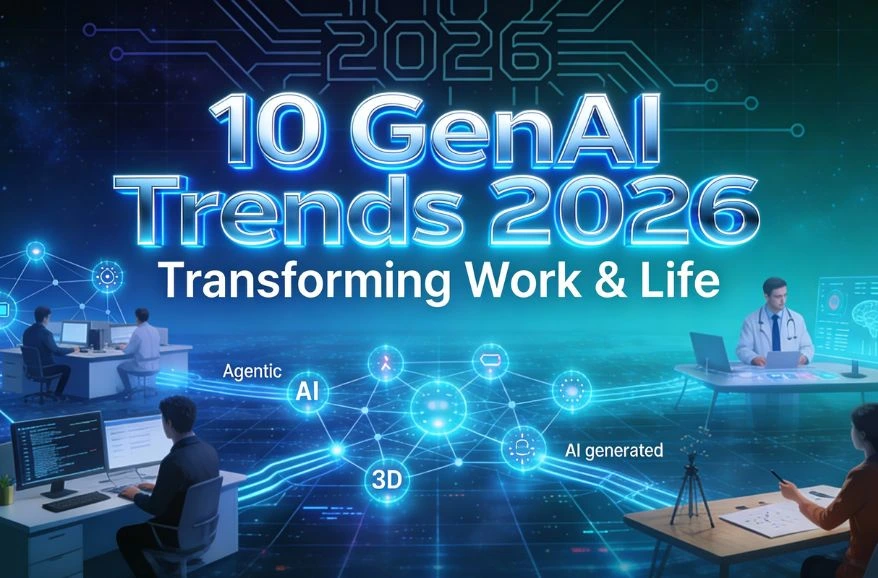
Generative AI will also experience a transformation stage in 2026 that will see it reach full integration in workplaces and with everyday life. The change offers efficiency improvements and comes with several ethical concerns. It transforms the process in which individuals design, cooperate, and innovate. Analysts predict a massive adoption that improves the productivity of industries.
What Is Generative AI?
Generative AI Explained in Simple Terms
Generative AI or GenAI is a subfield of artificial intelligence that deals with the AI content generation, design, or ideas using machine learning algorithms. However, it can create unique and creative output by using large quantities of data. Unlike the traditional AI systems that have fixed rules to follow. Generative AI models can generate realistic images, music, and texts, and so on, by examining patterns and learning from existing ones.
Evolution of Generative AI So Far
- Generative AI emerged in the 1950s as a predecessor to early statistical algorithms.
- GenAI saw significant enhancements in the 1980s.
- A major breakthrough occurred in 2017 with the introduction of the Transformer architecture.
- This was followed by a surge of public interest in 2022 with the release of ChatGPT.
As a result, there has been a rapid proliferation in the creation of text, images, audio, and video,
How Generative AI Works at a High Level
Generative AI applications are neural networks that are used to examine existing data trends and generate novel content. One such major improvement is that they can use unsupervised or semi-supervised learning, allowing organizations to indeed use a lot of unlabeled data to build foundation models.
These best generative AI platforms, including GPT-3 and Stable Diffusion, work as general platforms of AI systems. These apps generate texts and images in response to short textual instructions and requests.
How Generative AI Differs from Traditional AI
| Aspect | Traditional AI | Generative AI |
| Approach and Techniques | Utilizes deterministic, rule-based algorithms designed for specific, structured tasks. | Employs probabilistic methods and deep learning to generate new, often unforeseen outputs from learned data. |
| Applications and Use Cases | – Automation: Used in robotic assembly lines for manufacturing.- Diagnostic Systems: Powers healthcare systems to diagnose diseases based on symptoms. | – Media and Entertainment: Creates new music, art, and scriptwriting.- Simulations: Generates realistic simulations for training and research in various fields. |
| Learning Mechanisms | Involves direct programming of specific algorithms for tasks like classification and clustering. | Utilizes advanced techniques like reinforcement learning and deep neural networks to learn from data autonomously. |
| Advantages | Provides predictable, reliable results and excels in environments where rules and outcomes need consistency. | Enhances creative capabilities, offering potential revolutionary applications in design, art, and data synthesis. |
| Limitations and Challenges | Limited to applications with clear rules and often lacks flexibility in handling new, undefined scenarios. | Raises ethical and practical concerns, such as the potential for misuse in creating realistic fake content. |
Trend 1. Generative Video Breakthroughs
In 2023, Netflix used generative AI on the Argentinian series El Eternauta, which saved Netflix a large portion of time and money in its creation. By 2026, generating AI in high-budget TV and film is likely to be a standard practice.
Trend 2. The Authenticity of Content
In the growing popularity of generative AI content, the perceived authenticity will rise. The necessity to pursue deeper attachment will necessitate brands and performers to focus on the real-life experiences as a means of standing out among the AI-created content.
Trend 3. Copyright Issues
The discussion on whether to teach creative AI using the protected content or not will become tougher. Artists and other creators are worried that their work is being abused, with no payments being made to the creators. That can lead to legal and regulatory inquiries to integrate the new ideas and intellectual property rights.
Trend 4. Chatbot Evolution
It’s becoming more and more common for chatbots to just answer questions, rather than being able to plan and act ahead of time to reach long-term goals. As of 2026, new apps like the ChatGPT Agent Mode will have made it possible for these apps to talk to each other and do complex jobs on their own.
Trend 5. Privacy and Generative AI
Generative AI will keep raising concerns related to privacy. The top of the list of companies will be occupied by privacy-conscious AI models, with Apple at the head. The issue is that this movement is likely to influence other developers in 2026.
Trend 6. Generative AI within the Gaming Industry
Within the next few years, generative AI will be used in video games to create changeable plots and characters that look and act like real people. The best example is GTA 6, they have used AI in NPCs for interaction and react with the player. This will render players more interested and reduce the cost of production, and will result in new game experiences by 2026.
Trend 7. Application of Synthetic Data
Generative AI will be applied increasingly to create fake data to use in simulations and analytics. This will allow business enterprises such as banks and healthcare to operate without jeopardizing actual data privacy. The trend will assist in improving decision-making tools.
Trend 8. Monetization of Generative Search
Generative AI is transforming online search, and thus, the monetization of Generative Search will affect companies that depend on the old-fashioned search traffic. By 2026, the big companies such as Google and Microsoft Bing will alter their way of advertising to incorporate creative search.
Trend 9. Research breakthroughs
Generative AI has already made a promise in science by assisting in the discovery of new drugs and in other crucial aspects. This is bound to accelerate, and by 2026, the world will witness the application of AI to help address some of the largest problems facing the world.
Trend 10. New Jobs
Generative AI can also eliminate certain jobs, although it will create new ones, such as prompt programmers and AI ethicists. In the year 2026, it will be simpler to determine the level of the demand for these jobs, which is an indication of the importance of having human beings and AI collaborate.
Benefits of Generative AI for Individuals and Organisations
- Boosting Creativity: Many industries implement generative ai for content creation process. Especially advertising, where it can independently generate the text of adverts, images, and videos, serving to promote innovation and reduce manual labor. Experts predict that generative AI will be used in a significant amount of online content in the future.
- Time and Cost Savings: Generative AI saves a lot of time and operational costs since it automates operations. AI may be used in architecture to quickly create building designs that meet standards. It can also be utilized to do market research and offer new product concepts.
- Hyper-Personalization: GenAI makes the customer experience better by suggesting products, automating voice replies when handling customer service, and making the interaction between the customer and the robot more engaging and human-like than the interaction before the introduction.
- Efficiency and Productivity: With the help of generative AI in business, they can simplify the intricate processes, streamline procedures, and enhance resource distribution. The application of AI in manufacturing will help develop efficient production timetables, whereas in contact centers, it will assist the agents with context-relevant recommendations.
- Data Synthesis in Generative AI: AI is the best at synthesizing big data to give insights. Especially in the field of finance, where it evaluates trends and behaviour to inform investment decisions, which gives organizations an edge.
- Realistic Simulations: The technology allows one to create realistic simulations to train and research. This includes the automotive industry, where it assists in testing autonomous cars safely and effectively.
Challenges and Limitations of Generative AI
- Cost of Compute Infrastructure: Generative AI models containing billions of parameters require significant capital or technical skill. The model training models depend on large-scale computing hardware, such as hundreds of GPUs, to train the models on millions or billions of images.
- Speed of Sampling: Generative model latency is a weakness, particularly in interactive applications such as chatbots and AI voice assistants, where response speed and accuracy are essential. Diffusion models achieve high-quality results, yet their slow sampling rates are an obvious disadvantage due to their popularity.
- Absence of High-quality Data: Generative AI is usually supposed to generate artificial data; nevertheless, not all the data that is generated worldwide can be used to train. The data should be of high quality and without bias, and some of the areas, like 3D assets, do not have enough data. Thus, development becomes expensive and resource-intensive.
- Data Licenses: Indicative organizations often struggle to commercially license existing datasets or make custom datasets, to further complicate training generative models and restrict their performance.
How to Prepare for Generative AI in 2026
Step 1: Have an introverted familiarity with generative AI.
Master generative AI fundamentals. Generative AI is a technology that creates new text, images, voice, code, or video using a trend that it has learned through the analysis of large datasets. Learn about its application in such common devices as chatbots, artificial writing assistants, and coding bots. You can get a basic understanding of the topic and learn how to work with more complex ideas by taking an introductory training like the Generative AI Foundation Certification.
Step 2: Master the use of generative AI tools.
Enhanced AI tools should be used at all times to learn well. Begin with text-based applications that can be used to compose emails and summarize documents, and explore image and video creators when creative work is required. The experimentation with various tools will assist you in deciding which ones are more effective in your process. Enhance your performance by ensuring your prompts are clear and specific.
Step 3: Gain experience by working on real-world examples of generative AI.
Discover the areas where generative AI can reduce work and time and otherwise achieve accuracy to transition to the useful use of AI rather than the casual use. Coca-Cola and Unilever are successful examples of companies that employed generative AI to demonstrate that it can be applied to streamline the processes. Record yourself as you are learning to track the progress.
Step 4: Master critical thinking of how AI works.
Be sure to consider AI-generated answers, which should be accurate, useful, safe, and ethical. Individuals capable of assessing the capabilities of AI products will be un- unemployed by 2026, since critical thinking is a way of creating trust and quality.
Step 5: Research generative AI development.
After understanding the tools, you can find out more about the mechanism of generative AI, such as concepts like Large Language Models (LLMs) and rapid engineering. These are more advanced topics that can be mastered with the help of structured curriculum.
Step 6: Development of small projects.
To establish your reputation, make micro-ventures, such as chatbots or content generators, which demonstrate your abilities. To create a good portfolio, write down your actions and findings.
Step 7: Understand how to apply AI responsibly and ethically.
Discover why it is necessary to implement AI ethically, with consideration to such aspects as fairness, privacy, safety, and openness. One should remember that AI has its limitations and strive to reduce bias because only by doing this can one use AI responsibly.
Step 8: Become a professional with generative AI.
Finally, receive accepted certifications to demonstrate that you are an expert. The GSDC Generative AI Expert Certification is a program built upon advanced concepts and presented on how to apply these concepts to real life. This will equip you better to compete in the world of AI in jobs.
Conclusion: Why Generative AI Will Redefine the Way We Work and Live
By 2026, generative AI will be seamlessly embedded in the workplace and the everyday life of people, transforming the design, collaboration, and innovation and increasing productivity in all sectors. Ethical obstacles such as privacy, copyright, and bias do not affect its advantages as creativity, efficiency, hyper-personalization, and synthetic data can eliminate the difficulties when prepared correctly. Through tools, ethical practices, and critical thinking, one can manage this transformative force in a responsible manner, effectively unlocking undiscovered opportunities.
FAQs About Generative AI
Q1. Which is the most important skill in 2026?
As future engineers learn AI, data, cloud, and cybersecurity skills in 2026.
Q2. What will 2026+ bring in terms of AI development?
After 2026, AI development will shift to the less hype and more practical side, focusing on the Agentic AIs on autonomous work and the multimodal integration. This change will enhance business process automation, health, and human-AI interaction, with open-weight and closed models becoming more common. AI will become an invisible coworker that handles complex tasks and makes physical things more intuitive.
Q3. What will be the most in-demand skills in 2026 if AI continues growing this fast?
In 2026, higher levels of technical proficiency in AI and machine learning, including Generative AI, NLP, cybersecurity, cloud computing, and data science, will be in demand.
Q4. Which is the most popular course for AI?
DeepLearning.AI’s “AI for Everyone” is the most popular AI course.

Leave a Reply