

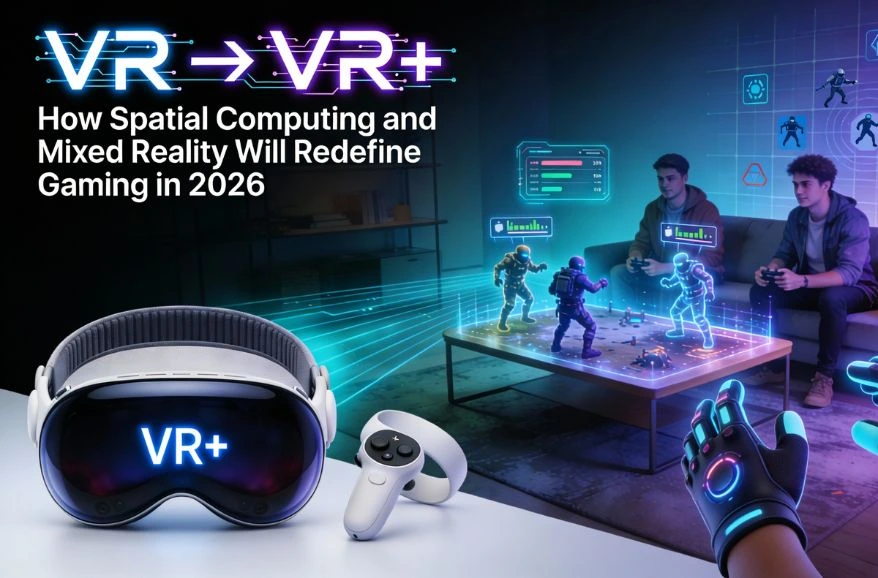
The VR+ switch is a turning point in the development of gaming. In contrast to traditional VR, which kept its users confined to all digital worlds, VR plus enables the application of mixed reality and spatial computing in gaming. There will be lighter headsets, AI-powered interactions, and room-scale experiences that will put 2026 to the year when gaming is no longer a screen-based phenomenon. Such a VR to VR + jump will provide a better level of immersion, interpersonal connectedness, and play customization. It results in a huge number of people entering the same digital-physical worlds.
What Does “VR to VR+” Mean?
VR to VR+ is a technology and entertainment-visual brand word coined by one person, entrepreneurship consultant Jason Wang, to describe how virtual reality has expanded, become more accessible, and might be a potential business.
Evolution of VR to MR
Traditional VR relied on headsets like Oculus Quest, fully immersing users in simulated worlds. Mixed reality, core to VR+, passthrough cameras show your real surroundings while digital overlays appear. From VR to VR+, this evolution eliminates the “put on goggles and disappear” feel, replacing it with blended worlds. Games now use real objects as props, making sessions more intuitive and less isolating.
Core Technologies Powering the Shift from VR to VR+
- Machine Learning Models: AI can learn through data. Thus, the machine learning models can analyze VR and AR trends in 2026, make predictions, and get better as time goes on. These models in VR+ are adjusted to user interaction to make it more fluid.
- Computer Vision: Computer vision recognizes objects, spaces, images, and the integration of VR with the real world; without this, the use of VR would be impossible.
- Natural Language Processing (NLP): NLP allows AI to interpret and react to human speech, support voice command Alex and natural dialogues in VR, and improve the quality of interactions.
- AI-Powered Motion Tracking: To track movement in VR, the AI processes sensor data in real time and predicts movement. It also reduces lag, so that movement in the game corresponds to real-life movement.
- Haptic Feedback Systems: Haptic feedback takes the immersion to the next level by creating the sensation of physical touch in VR, where AI can adjust the vibrations and the level of force to reflect the virtual reality, such as recoil in a gun or raindrops.
- Procedural Content Generation: AI traditionally generates dynamic virtual worlds and game levels to provide unique experiences that fill in the design gaps, not necessarily being based on manual development.
- Smart NPC Systems: AI improves how the NPCs learn and respond to the actions of the players so that NPCs become more natural and less scripted.
- Predictive Analytics: This technology forecasts the future based on the trends of data, optimal VR performance through reduction of lag and real-time adjustment of experiences.
VR+ and Mixed Reality Experiences in Gaming
| Aspect | Impact |
| Increased Immersion | Players feel physically present in the gaming environment. |
| Greater Interactivity | Games become more interactive and engaging with motion tracking and voice commands. |
| Personalized Experiences | AI-driven VR and MR games adapt to user behavior. |
| New Revenue Streams | Virtual goods, in-game advertising, and MR-based brand collaborations. |
How VR+ Is Changing Gaming Mechanics
True Free-Roam Immersion
Free-roam VR+ will enter into an entirely new dimension. Consider light, wireless headsets and advanced tracking. You will physically traverse huge virtual worlds with unmatched liberty and increased presence, feeling each step, impact and texture.
The Interactive Storytelling on the Next Level.
Hybrid AI and state-of-the-art graphics will shortly open up wide-screen storytelling. You can look forward to responsive plots that respond to your decisions, truly intelligent non-player characters, and evolving environments that keep you guessing. The experiences will not be played. They’ll be living.
Emergence of New Genres
There will be a huge increase in VR-native experiences and more modern platform games that can be played in VR. VR’s makers will use the unique features of the technology to make new types of interactive entertainment, like puzzles that will make you think and big stories that require a lot of teamwork.
Social Play Redefined
The concept of multiplayer games and co-existence in the virtual world is going to be even more popular and attractive in the future. Imagine meeting friends without any trouble in the virtual worlds, working on a quest together, and then a virtual event happens live, and everybody knows it is beautiful.
Immersive Gaming Technology Behind VR+
- AR makes the game more real space, whereas VR engrosses the player in the game world.
- VR transforms the gaming because it is more realistic, allows physical interactions, and creates new genres.
- VR is growing into competitive e- sports, training simulators, and creative tools, combining gaming efficiency with real-world applications.
Best Mixed Reality Headsets With VR+ In 2026
- Apple Vision Pro 2: It has both Apple Intelligence and spatial computing built in, and it has an M5 chip. In order to connect with users every day, Apple wants to make new apps and features that use AI. Also, a headset that is easy to use and costs less may be in the works to make it more available to people.
- Valve Index 2 (Deckard): Valve is expected to launch its next-generation headset with an independent design, which will allow it to do away with a powerful PC. It is predicted to come with a high-resolution display and a broad field of view, coupled with the ability to play games on the Steam Deck. Improved controllers and premium specifications would revolutionize VR.
- Meta Quest Pro 2: Specializing in professional applications of AR and VR, this headset is bound to be a significant improvement over the first generation with improved resolution, tracking, and processing capabilities. The approach of the strategy of the software ecosystem of Meta focuses on productivity, collaboration, and AI improvements.
- Google & Samsung XR Headset: Samsung and Google have joined hands to develop an XR headset that will be based on an Android-specific operating system. It will target mainstream consumer desire, using AI and hardware to experience AR/VR, and pay special attention to the interoperability of their ecosystems.
- Sony XR Headset: Sony’s next XR headset will be based on PlayStation VR, as it boasts high-resolution screens and advanced haptic feedback. It will be compatible with the PlayStation ecosystem. The comfort and ergonomic design of the product must be aimed for prolonged activity during gaming and working in a virtual team.
VR+ Beyond Gaming: Expanding Use Cases
- Education: VR technology trends will reinvent learning in 2026. Imagine that students will visit historical places and complete virtual science experiments!
- Healthcare: VR is set to be a critical component of the therapeutic process, pain treatment, training of surgeons, and educating patients in safe and realistic scenarios.
- Remote Work: Virtual offices and 3D meeting rooms will be more prevalent. It will allow collaborating comfortably and saving on physical transportation.
Challenges Slowing the Adoption of VR+
- Hardware Hurdles: The hardware is getting better, but it is still a serious engineering challenge to make really light, powerful, and wireless headsets available at affordable prices, which would have an effect on at-home gameplay.
- Content Gap: You still cannot get an avalanche of AAA games. It is not cost-effective to make actually immersive content. The existing market in the VR industry is not large enough to make most of the studios happy with such huge amounts of money.
- User Experience & Nausea: Even with the existing VR headsets, some may experience motion sickness, eye strain and general discomfort after long-term VR+ use.
How Developers Are Adapting to the VR+ Era
- Greater intelligence: Artificial intelligence will develop extremely dynamic spaces, very lifelike NPCs, and even a virtual reality of the next generation, which will be really personal. GTA 6 is the best example of this.
- Next-Level Realism: Hyper-realistic graphics, haptic feedback on physical sensations, and natural means of interaction in virtual worlds are to be expected.
- Increasing Genres of Games: More platformers are coming to the VR platform, such as Moss on Meta Quest and Astrobot Rescue Mission on PSVR, prompting developers to create games compatible with these platforms.
What VR+ Means for Gamers
- The VR headsets are growing lighter, cheaper, and have better graphics, which makes gamers enjoy their games.
- The game can be touched physically, with natural gestures and movements used in games such as Half-Life: Alyx and Beat Saber.
- The emotional involvement is increased as players become closer to the plot of the game.
- It adds social interaction in which gamers interact, host contests, and gather within common virtual settings.
The Future of Virtual Reality After VR+
- Lightweight, wireless headsets: The future of the VR business is likely to be the form of devices that are much lighter, more comfortable, fully wireless and have longer battery run time.
- Improved Immersion: The screens in the new ones will have higher resolutions, larger fields of views, and motions that are better tracked in order to make the experiences more fluid.
- Mixed Reality Convergence: Mixed reality devices, which combine real and virtual worlds are in the future.
Conclusion: Why VR+ Is the Next Leap in Gaming Evolution
The VR+ experience by 2026 transforms gaming into a physical-digital symphony. The boundaries between space and reality are torn down, and play becomes social, flexible, and realistic. There are challenges, but falling prices and developer momentum all indicate VR+ capturing the attention of billions of people. This is not development; it is revolution, establishing metaverse paths forward.
FAQs About VR to VR+
Q1. What are some facts about VR?
The other lesser-known fact about VR is its initial introduction, which was in 1987.
Q2. What is the longest someone has stayed in VR?
The record in VR of the longest time spent consuming media is 55 hours, by Lauren Cass in April 2025.
Q3. Does VR improve learning?
Yes, Virtual Reality (VR) is a major boost in learning.
Q4. What is needed to use virtual reality VR?
To experience Virtual Reality (VR), you must have a VR headset, whether an all-in-one (standalone, unaffiliated) or a PC/console-tethered one, controllers, and space to move around.

Leave a Reply