

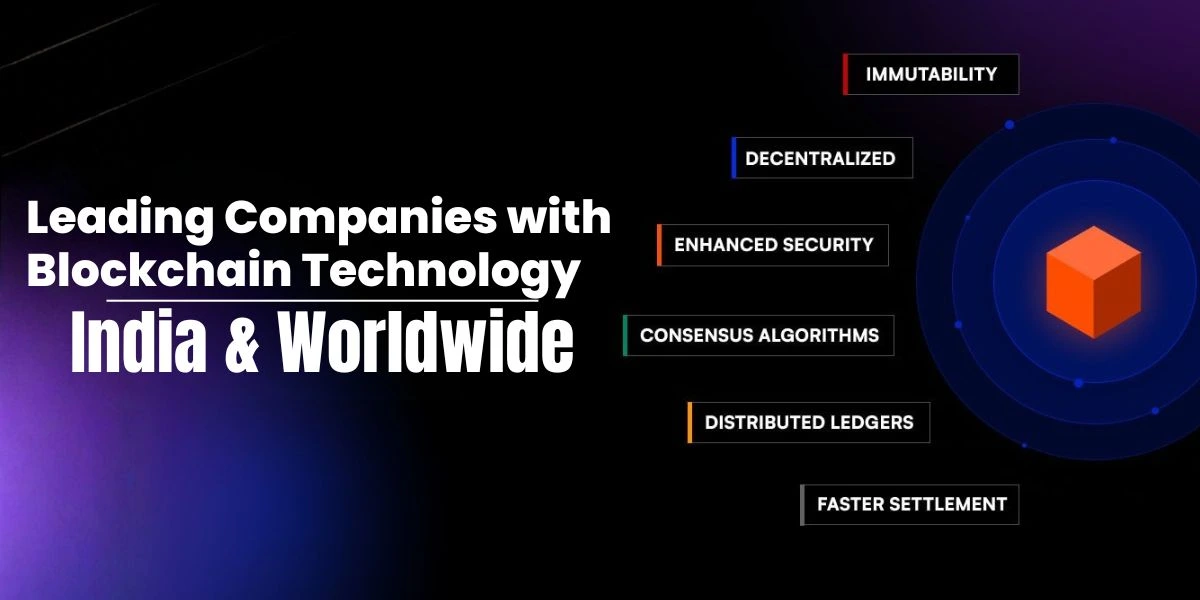
Businesses all over the world (including those in India) are progressively adopting blockchain technology because of its peerless security, effectiveness, and transparency. Such a shift assists companies with blockchain technology in reducing expenses, creating trust, and automating operations in a digital-first world.
Why Companies Adopt Blockchain Rapidly
Companies are rapidly adopting blockchain technology to improve transparency, security, and efficiency, which will reduce costs and build stakeholder trust. The technology is no longer restricted to cryptocurrency applications. But companies with blockchain technology can also help solve fundamental business problems in any industry.
What Makes Blockchain Valuable
Increased Security and Data Integrity: Blockchain is the safest method because it is immutable, meaning that data that has been written to the blockchain cannot be changed or erased. This feature is very important in any field where the accuracy of the data is very important, like healthcare, banking, or supply chain management.
Transparency and Trust: Blockchain enhances transparency as transactions are documented on a public register, which enables all the people in the network to check transactions. This is because this non-trustful environment makes there less reliance on intermediaries whereby trust among parties increases, and the risks of fraud diminish.
Decentralization and Disintermediation: The use of blockchain eliminates centralized power, thereby reducing bottlenecks and one-point failures. This form of decentralization is useful because it lowers the chances of being manipulated. In banking, for example, it allows people to go around middlemen, which lowers costs.
Cost and Time Efficiency: Because of manual checks, traditional processes of transactions may be slow and costly. Smart contracts are an automated system of blockchain, which speeds up the operations and lowers the operational costs, thereby making it an attractive solution to businesses.
A Catalyst of Innovation: Blockchain is driving new technologies in many areas, like healthcare and supply chain management. This changes the way these sectors do business, making it easier to track, join in, and ensure authenticity while also increasing efficiency.
Top Global Companies with Blockchain Technology
IBM
IBM is one of the companies with blockchain technology; its IBM Blockchain platform is aimed at improving supply chain visibility and safe data transfers. Companies widely use their Hyperledger Fabric platform. Its collaboration with businesses such as Walmart demonstrates how blockchain can transform industries. It transforms specifically in food traceability through projects like IBM Food Trust.
Microsoft
Microsoft has incorporated blockchain as part of its Azure Blockchain Service, where companies can build the decentralized apps and automate the workflow through the smart contracts. Among the most notable products is the work with the B3i Consortium to work in the insurance sector, making Microsoft one of the leaders in improving the level of data protection and scalability provided to enterprises with its powerful Azure system.
Deloitte
Deloitte has also been ranked among the top 10 blockchain companies in 2025, thus beginning its blockchain adventure in 2014. The firm has more than 1,000 blockchain experts and has managed to execute substantial projects in India. Their products include creating custom apps and software, developing smart contracts, and blockchain consultations. Deloitte is one of the best options available to people who want to get high-quality blockchain solutions in India.
Capgemini India Pvt Ltd
Capgemini is a company that was founded in 1967 by Serge Kampf as an information processing and management company. It has, over the years, evolved into one of the most powerful Multinational companies offering consulting, technology, professional, and outsourced services in more than fifty countries. Capgemini is reputed to be excellent in Cloud Services, AI. As a result, the company is a vital provider of innovative solutions, including SAP Solutions, Blockchain Solutions, and App Development Services, to meet the requirements of its clients.
Top Companies With Blockchain Technology in India
Tata Consultancy Services Limited
Tata Consultancy Services (TCS) is a prominent multinational IT services and consulting company with its headquarters in Mumbai, India, and a major member of the Tata Group. TCS is a global leader that was founded in 1968 by Faquir Chand Kohli and J. R. D. Tata and has since expanded into 149 locations in 46 countries. The company has a reputation for having a massive portfolio of services, which include mobile applications, enterprise solutions, IoT, blockchain technology, cloud solutions, automation, and artificial intelligence. TCS has advanced its technological solution to build the image of one of the best IT service providers in the world.
Infosys
Infosys Limited is a company that does IT work, business advice, and outsourcing. It was started in Pune, India, on July 2, 1981, by N. R. Narayana Murthy and a few others. Infosys is the second biggest Indian IT company, coming in after TCS. It is well-known around the world, with 82 sales and marketing offices and 123 development centers in many different countries. The business is thought to be one of India’s biggest blockchain development companies, which shows that it has a lot of experience giving people difficult IT answers.
Reliance Industries
In 2019, Mukesh Ambani declared the intentions of Reliance to use blockchain technology (mainly with Reliance Jio, which, through its network, has launched a noteworthy blockchain network). Ambani stressed that blockchain would improve the security, trust, automation, and efficiency of the transaction. Jio has registered many patents, such as the Quantum Blockchain Network Technology, and has a 5.56% interest in Vakt Holdings Ltd, a UK-based blockchain company, suggesting its strategic involvement in blockchain technology. Reliance Industries is considered to be one of the best companies with blockchain technology in India.
Blockchain Use Cases Across Industries
Supply Chain Management
Blockchain technology enhances supply chain management by providing clear control and unalterable data monitoring. Companies that use different materials and labor need this to keep detailed records and source ethically. Examples of companies that took advantage of blockchain technology are Maersk and Fr8. These companies with Blockchain Technology have successfully implemented blockchain to automate their logistical operations and enhance transparency, and consequently minimize inefficiencies and any possible bottlenecks.
Banking and Finance
In banking and finance, the decentralized structure of blockchain can be very helpful because it protects data and makes transactions more open. By automating workflows and keeping detailed records of transactions, financial institutions can improve the speed and safety of their transaction tracking. Using blockchain as a new technology could change the way traditional banking works, making it quicker and more able to adapt to changes in the market.
Cryptocurrencies
Cryptocurrencies are perceived as a source of threat to the existing banking industry. It can, in reality, be used by financial institutions to add value to their offerings. When banks start to accept cryptocurrencies as valid financial tools, they may gain blockchain technology advantages to facilitate digital investments and become innovative in their services. The growing use of cryptocurrencies in banking shows how blockchain technology may change financial settings and expand investment and development opportunities.
How Companies Implement Blockchain
- Name of Use Case: Cracker of a joint trusted registry could be helpful indeed to eliminate wastage in current processes (e.g., goods tracking, data verification)
- Feasibility & Business Case: It is done to conclude that blockchain is the correct solution, with the clear purpose of knowing what goals, resources needed, and KPIs must be.
- Proof of Concept (PoC): A small-scale test is constructed to illustrate the technology and the idea, often on a test network.
- Design the Solution: Select the type of blockchain (allowed to be controlled or decentralized to be open), architecture, and consensus model (e.g., PoW, PoS).
- Select Platform and Tech Stack: Select the blockchain (e.g., Ethereum, Hyperledger Fabric) and development tools.
- Write Smart Contracts: Auto-executable code of agreements and rules. Code among parties to automate rules and agreements.
- Build and Test: Construct the solution and then test it fully before fully deploying it.
- Integrate and Implementation: Attach the blockchain with the existing systems (ERP, CRM) and roll out the network.
- Ecosystem Building: Are regulations and incentives for everyone in the network (suppliers, partners) to join and use the network.
- Continuous Support: Provide ongoing support, updates, and revisions of the solution where necessary.
Challenges in Adoption of Blockchain Technology in a Company
Challenge 1: Lack of Trust Among Users
The lack of trust among the users is one of the biggest barriers to blockchain adoption, and 45% of the organizations mentioned this problem. The security of the technology is one issue of concern, as well as the credibility of other members of the network. This trust gap is also aggravated by regulatory uncertainty.
Challenge 2: Lack of Financial Resources
Financial resources are a problem in the implementation of blockchains in many organizations, which were shaken in 2020.
Challenge 3: High Energy Consumption
The reason why blockchain technology has been criticized as energy-consumptive is its use of the Proof of Work (PoW) consensus mechanism, which is resource-intensive (high-processing power and energy).
Challenge 4: Poor Scalability
Scalability is one of the biggest problems for companies with blockchain technology. Particularly public networks, which cannot match with the transaction speeds of traditional systems like Visa. Bitcoin and Ethereum are significantly slower in terms of transactions per second.
Future of Blockchain in Enterprises
DeFi: Decentralized finance (also known as DeFi) is a field of finance that supplements trading, lending, and borrowing. This approach extends finance beyond traditional institutions by using automated financial protocols that leverage blockchain and smart contracts. It is done to execute and settle transactions.
Real-Time Tracking: Linking blockchain with IoT sensors will allow for the delivery of real-time information regarding the status of the shipments, which will increase the reliability of perishable goods.
Digital Identity: Companies with blockchain technology facilitate decentralized digital identities (DI), which are more secure, have better ownership, and are cross-border without local intermediaries.
Tokenized Economy: Real-world assets are represented on the blockchain as digital tokens, making it easier to buy and sell them. It allows more people to invest and enables smart contracts to automatically carry out functions related to those assets.
Identifying Responsible Blockchain Use
- Blockchain technology benefits in solving certain inefficiencies like a lack of trust or security problems that traditional systems cannot address (e.g., food traceability).
- Select the right type of blockchain (public, private, hybrid, consortium) depending on the application.
- Own blockchains will meet the enterprise requirements to have privacy of data; public blockchains will encourage openness.
- Have an inspiring governance model that defines rule-making, resolution of disputes, and mistake liability.
- Companies with blockchain technology must keep data safe and private, and handle vulnerable information responsibly, such as the GDPR.
Conclusion
Companies with blockchain technology provide an opportunity to succeed in the context of digital disruption. Since India boasts of agile developers and the world leaders such as IBM, the adopted operations develop resilience. With challenges decreasing, trust and efficiency will become more integrated. Companies that do not pay due attention to it face the threat of being left behind and should do it responsibly today.
FAQs for companies with blockchain technology
Which is the number one blockchain company in India?
There is no number one in company with blockchain technology. It is reliant on metrics (revenue, projects, innovation), but making it among the top leaders in blockchain work in India is Tech Mahindra and Wipro, both of which are established giants.
What are the 4 types of Blockchain technology?
Four primary categories of blockchain networks are Public, Private, Consortium, and Hybrid.
Who are the big four of blockchain technology?
The Big Four blockchain technology companies often represent the major accounting/consulting companies, which are:
- Deloitte
- PwC
- EY (Ernst and Young)
- KPMG
How blockchain technology works?
Blockchain is a decentralized, distributed, shared, shortened, and cryptographically protected digital register of transactions in blocks in a chain, where each block is related to the preceding one and hard to replicate.

Leave a Reply