


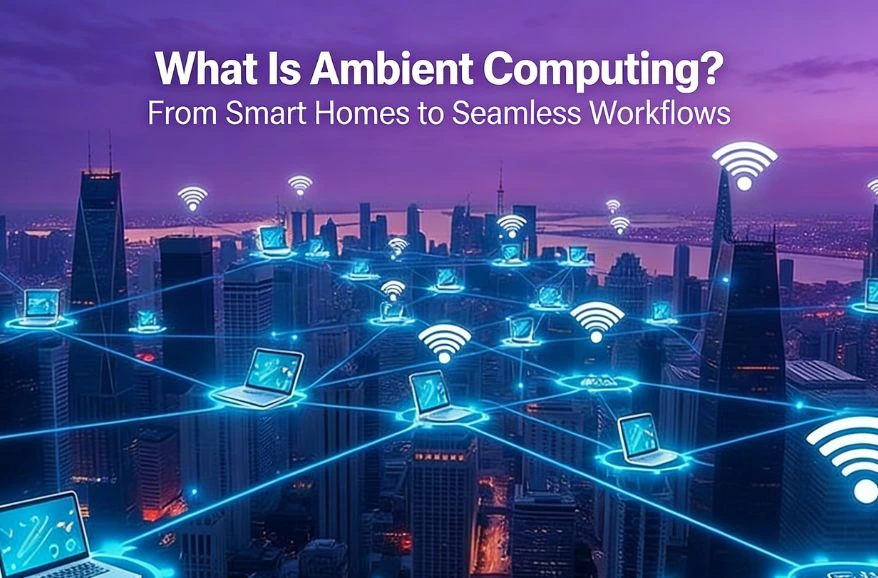
Technology continues to change in order to simplify our lives, and ambient computing is taking center stage by becoming part of the environment, without any splendor. It transforms ordinary places into intelligent assistants that even anticipate what should be done and behave silently. This transition will lead to reduced screen time and more natural communication as devices are more directly related and already transform homes and offices today.
What Is Ambient Computing?
Ambient computing is an abstract, though imprecisely defined, term referring to the same thing as ubiquitous, intelligent, and unobtrusive human interaction with technology.
It is described as a system where gadgets and sensors run in the background, predicting the needs of the user without necessarily having to provide direct instructions. In theory, computing enables a seamless digital experience by intertwining technology into our environment, including smart homes, wearables, and AI. This paradigm envisions a future in which interconnected devices continuously automate and support people’s daily tasks, rendering technology invisible.
Evolution of Ambient Computing
From Desktop Computing to Mobile and Wearables
The origin of computing began with the huge desktops attached to a single point, which required full attention. Mobiles liberated us from carrying power, and wearables, such as smartwatches, enabled individual tracking.
This development enabled the devices to become smaller and smarter, hence the ubiquitous nature of ambient computing.
Ubiquitous Computing as the Foundation
Computer scientist Mark Weiser first proposed it in the 1990s. This vision of the future is one in which devices (such as computers) constantly connect to automate tasks and support their activities.
How AI and IoT Accelerated Ambient Systems
Advanced IoT platforms are now adding AI to the creation process using their Model Context Protocol (MCP). This enables developers to write an exposition of the application of the IoT in regular languages, as AI handles the technical components. Documents such as the MCP demonstrate how developers can leverage AI to conveniently build advanced IoT solutions. It produces platform-specific code that adheres to best practices and interoperates with existing systems.
Core Principles of Ambient Computing
1. IoT Devices: The basis of ambient systems; consists of smart bulbs, thermostats, fitness wearables, and connected appliances that collect data about temperature, movement, noise, and emotional conditions.
2. Artificial Intelligence and Machine Learning: The point of intelligence of ambient systems; it interprets behavioral and environmental patterns and makes intelligent predictions and independent decisions, but it gets better as time goes on with historical data and user interventions.
3. Sensors and Actuators: Sensors pick up input such as movement and light; actuators transform this input into output, such as turning on lights or opening doors, which constitutes the tactile infrastructure of ambient systems.
4. Cloud and Edge computing: Cloud provides large storage and central processing. Edge computing delivers quick responses by processing data closer to the device, allowing for fast reactions in surrounding systems.
5. Natural Interfaces: Getting rid of screens and computers in favor of zero UI interfaces that allow natural ways of interacting, like voice commands, gestures, and even brain-computer interfaces that could allow people to control devices with their thoughts in the future.
Ambient Computers and Smart Environments
What Are Ambient Computers?
Ambient computers are smart devices that work quietly in the background. They predict user needs and integrate digital services into everyday life without needing commands.
Smart Environments That Adapt Automatically
Smart spaces are networked environments that have the devices and AI that adjust to the needs of users automatically. They use context-sensitive technologies to track such parameters as occupancy and time, as well as, optimize energy use and comfort without human interventions.
Examples of Ambient Intelligence in Daily Life
Ambient Computing in Smart Homes
Ambient Intelligence is a concept being adopted by cities to enhance the life in cities across the globe. Technology is modifying cities into more efficient and sustainable platforms. Some of the ways include:
- Smart traffic management systems
- Intelligent street lighting
- Waste management systems
Ambient Computing in the Workplace
Ambient computing is useful in business to optimize activities in the business, e.g., automatically booking a room or making environmental changes depending on the occupancy rate. Smart conference rooms, equipped with audio-visual systems, enable virtual meetings to take place automatically without manual setup.
Ambient Systems in Hybrid and Remote Work
Hybrid and remote work use ambient systems based on IOT sensors, AI, and pervasive computing to design adaptive, invisible, and physically and digitally combined work settings.
Ambient Computing in Healthcare and Wellbeing
Healthcare environment wearables and ambient sensors constantly check the vital signs of patients and transmit the real-time information about them to healthcare specialists. This preventive measure improves the treatment of patients and enables an early diagnosis in case of anomalies.
Consumer vs Enterprise Ambient Computing
| Aspect | Consumer Systems | Enterprise Systems |
| Goal | Enhance individual convenience and home automation. | Increase productivity, reduce operational costs, and secure infrastructure. |
| Privacy & Data | Handle personal daily habits. | Handle sensitive company data; require stringent security and compliance to protect intellectual property. |
| Reliability & Tolerance | Users tolerate minor errors or devices misinterpreting context. | Zero tolerance for failure; errors can disrupt production or cause financial loss. |
| Context | User-centric (mood, daily schedule). | Process-centric (workflow, machine status, asset management). |
| Adoption | Widespread via smart home tech. | Rapidly advancing as a new “operating model” for automation. |
Ambient Computing vs Related Technologies
| Aspect | Ambient Computing | Smart Devices | Contextual Automation | Traditional AI Assistants |
| Core Definition | Seamless, invisible integration of computing into environments for proactive, environment-aware experiences. | Standalone hardware (e.g., smart speakers, thermostats) with app-controlled features. | Rule-based automation triggered by specific contexts (e.g., IFTTT applets). | Voice/text-based reactive helpers (e.g., Siri, Alexa) responding to explicit commands. |
| User Interaction | Passive; anticipates needs without input (e.g., lights adjust via biometrics). | Active; requires app/voice activation. | Semi-passive; predefined triggers (e.g., location-based actions). | Explicit queries; conversational but user-initiated. |
| Intelligence Level | Predictive, multi-sensor fusion for holistic awareness. | Basic sensors; limited to device ecosystem. | Contextual rules; no deep learning. | NLP-driven; lacks environmental fusion. |
| Examples | Smart homes with AR overlays, IoT ecosystems predicting user routines. | Echo Dot, Nest Thermostat. | Zapier workflows, geofencing alerts. | Google Assistant, ChatGPT interfaces. |
| Scalability | Ecosystem-wide (edge-to-cloud). | Device-specific silos. | Platform-limited integrations. | App-centric; no ambient pervasiveness. |
| Future in B2B | Revolutionizes CRM with intent-aware marketing automation. | Enhances remote monitoring. | Streamlines workflows. | Boosts customer support chats. |
Benefits of Ambient Computing
Enhanced Efficiency
Ambient computing frees employees to work on more value-added activities by automating most of the routine tasks, as well as improving the allocation of resources. This will contribute to faster decision-making, lower operational costs, and greater agility, which are very significant in the fast-paced modern business world.
Better Employee Experience
A work environment that is accommodating to a person will promote job satisfaction and interest. When they feel free and encouraged, they are more efficient and less likely to experience burnout.
Data-Driven Insights
Ongoing data gathering and the analytics supported by AI can deliver the insights to the leaders in an actionable form. Ambient computing transforms raw data into a competitive edge, whether it is used to pinpoint bottlenecks in a process or to forecast future demand.
Sustainability
Waste minimization and smart use of energy can help achieve sustainability. Organizations can also minimize their impacts on the environment by overseeing and managing the use of resources in real time.
Challenges and Risks of Ambient Computing
Privacy and surveillance
Surveillance and privacy in ambient computing will create important issues on the ownership of data, awareness of users. It may enable opt-out functionality without compromising functionality. It is also essential to create a framework of transparency, consent, and data ownership to build trust in such ecosystems.
The autonomy and overdependence
This is of concern as there is a greater proactivity in the systems. There is also a chance that people will ignore automated ideas and make hasty and bad choices about AI. There may even be times when the choices made by humans and the choices made by algorithms don’t agree. In design, it is necessary to retain human control.
Interoperability
Interoperability is significant to ambient systems, which are based on efficient communication between the devices of different manufacturers. Lack of standardization may lead to the creation of fragmented and unreliable user experiences.
Most of the infrastructure and connectivity
Ambient computing depends on infrastructure and connectivity, which require a steady internet connection and low-latency communication. There might be no infrastructure required in rural and underserved regions, which worsens digital inequality.
Inclusive design and ethics
There is an urgent need to fight biases in AI code, marginalized groups, and various limitations, as well as the abuse by totalitarian regimes. The use of rules and designs should be tailored to include fairness, inclusiveness, and the protection of human rights.
Role of AI in Ambient Computing
The AI is the brain of ambient computing that uses real-time devices without direct instructions to gain an understanding of human needs and their understanding and react. The AI can look at data from IoT sensors to create a smart, data-driven environment that works in the background. This can be used in smart homes, healthcare settings, and workplaces, making things more efficient and personalized while reducing the need for human contact.
Real-World Examples of Ambient Computing Today
Big Tech
- Microsoft is incorporating ambient IoT and contextual services into the Azure cloud computing platform, with an aim to serve industrial needs.
- Amazon is extending the Alexa ecosystem beyond the home into wearables, vehicles, and the enterprise.
- Google Project Soli employs radar sensors to capture micro-gestures, and Nest products can form the foundation of context-aware AI environments.
- Privacy-oriented ambient intelligence is something that Apple is capitalizing on with the support of HealthKit, Siri, and spatial computing.
- In its factories, Siemens applies AIoT for predictive maintenance, which is said to reduce downtime by up to 30% and maintenance costs by 20%.
- Honeywell is using ambient computing to test air quality and occupancy in commercial buildings to enhance the tenants’ safety and comfort.
Startups and Research Labs
- MIT Media Lab is the first to innovate responsive materials and emotion-sensitive environments. Furthermore, they also develop adaptable interfaces that determine the state of the user and respond accordingly.
- Ambient.ai integrates video analytics with AI to recognize real-time threats.
- CarePredict is an ambient intelligence system used to track the behavior and health of older citizens.
Future of Ambient Computing (2025–2030)
1. The ambient computing will not just be smart machines and devices, but a smart platform ingrained with billions of devices in the IoT.
2. Users will experience the virtual world of Virtual Reality (VR), communicate using their avatars, which changes the real world.
3. Computing in the future will be less dependent on the actual devices, but it may be deviceless and can be used in any location of any type.
4. Integrated gadgets will act as entry points to an intelligent cloud and will improve and streamline the online lives of users at home and office, as well as in their social locations.
5. Statista reported that in 2027, the total smart home market across the world will have reached beyond $231 billion.
Common Myths About Ambient Computing
Myth 1: Cloud Seems Less Trustworthy.
Reality: Large cloud vendors spend a lot of money on security, and they tend to outperform on-prem providers in terms of capabilities. The model of shared responsibility would enable internal teams to concentrate on other priorities.
Myth 2: Cloud Is More Costly.
Reality: Initial costs may seem higher. The total cost of ownership is actually much lower. This is because you can scale up or down as needed you only pay for what you use and maintenance costs are lower. This is compared to having your, on-premises data centres.
Myth 3: The Cloud Is Less Reliable.
Reality: Cloud services are usually more reliable, having the best industry SLAs and high-availability infrastructure, such as geographical redundancy and proactive monitoring.
Myth 4: Cloud Service is not the right fit in the Regulated Industry.
Reality: The most popular cloud providers offer compliance certifications and solutions to assist regulated industries with compliance. The compliance they provide is usually more effective than what conventional on-premises architectures can deliver.
Conclusion: Ambient Computing as the Future of Human-Tech Interaction
Ambient computing transforms technology into a silent companion that enriches life without disrupting it. It provides efficiency and customization without effort, at home and in hospitals. In the wave of adoption before 2030, the ability to innovate while balancing privacy will be the key to success. This will lead to smooth human-technology coexistence.
FAQs About Ambient Computing
Q1. What is ambient computing in simple terms?
Ambient computing is a technology trend that involves the combination of devices and artificial intelligence (AI) within your own environment. It silently works in the background, predicting your needs and responding to them without necessarily addressing them face-on.
Q2. How is ambient computing different from IoT?
With the help of AI, ambient computing tries to hide technology and make it smart and relevant to the situation. The Internet of Things (IoT), on the other hand, wants to connect things to the internet so that they can be managed from afar or gather data. IoT is the things (sensors and gadgets), and ambient computing is the intelligence that makes these things act even when the user isn’t there.
Q3. Is ambient computing safe for privacy?
The issue of ambient computing poses serious privacy risks. It involves the use of around-the-clock microphones, cameras, and sensors to monitor behaviour, habits, and health-related information.
Q4. Where is ambient computing used today?
Currently, ambient computing is applied to form invisible and proactive technology experiences in the form of smart home technology, smart wearables, and voice assistants.
Q5. Will ambient computing replace apps and screens?
In the next 10 years, ambient computing will replace the current way of using apps, which is to use them actively and on a screen, with experiences that don’t require a screen.

Leave a Reply