

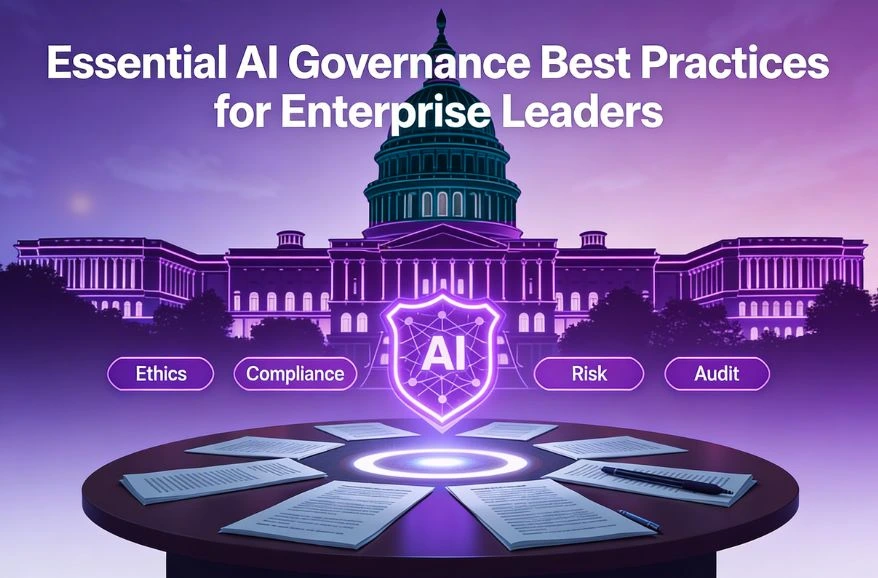
An AI enterprise governance medium can protect organizations against biases, data breaches, and fines, and will also allow AI to fulfill its full potential. It should be a priority of boards since uncontrolled AI may cause a reputational loss as the example of biased hiring tools (millions of dollars). By 2026, when regulations such as the EU AI Act are enforced, there will be control to ensure that there is ethical deployment in operations. It builds trust, drives ROI, and competitiveness of enterprises in an AI-driven economy. The active AI enterprise governance transforms the possible traps into the strategic benefits of sustainable development.
What Is AI Enterprise Governance?
AI Enterprise Governance Meaning Explained Simply
AI enterprise governance encompasses AI system design, deployment, and monitoring, along with policies, processes, and frameworks. It aims to ensure that AI is implemented responsibly, fairly, and transparently to meet business goals and regulatory frameworks.
How AI Governance Differs from Traditional IT Governance
| Feature | Traditional IT Governance | AI Governance |
| Focus | Infrastructure, security, compliance, and reliability | Model performance, fairness, safety, and ethics |
| System Nature | Static, rule-based, predictable, and deterministic | Dynamic, evolving, self-learning, and probabilistic |
| Monitoring | Periodic audits and scheduled, controlled changes | Real-time monitoring and continuous model updates |
| Key Risks | Data breaches, system downtime, unauthorized access | Bias, hallucinations, model drift, and lack of transparency |
| Documentation | System specs, access logs, and process documentation | Model lineage, training data lineage, and decision logs |
| Regulations | GDPR, HIPAA, SOX (established frameworks) | EU AI Act, NIST AI RMF, ISO 42001 (emerging/evolving) |
| Decision-Making | Human-in-the-loop or deterministic automation | Often autonomous or semi-autonomous decision-making |
| Goal | Efficient, secure IT operations | Responsible and trustworthy AI outcomes |
Governance vs AI Ethics vs AI Compliance
| Feature | AI Ethics | AI Compliance | AI Governance |
| Focus | Moral principles & values | Legal obligations & rules | Oversight, policy, & process |
| Goal | Fair, beneficial AI | Avoiding penalties | Responsible, safe AI |
| Question | “What should we do?” | “What must we do?” | “How do we do it?” |
| Nature | Theoretical/Philosophical | Legal/Regulatory | Operational/Structural |
Why Enterprises Need a Formal AI Governance Framework
- The AI governance can add value to the organization by eliminating risks, building trust, and promoting responsible innovation. It deals with regulatory issues such as the EU AI Act that require compliance and risk management across the entire AI lifecycle to avoid fines and data breaches.
- By defining governance procedures, organizations can achieve traceability and responsible use of data and AI models, thereby generating customer trust and regulatory confidence.
- Good governance facilitates safe innovation by enabling systematic review, allowing teams to implement AI technologies safely without causing ethical issues.
- It also defines the responsibility of each team, enhances productivity and adherence to rules through joint responsibility in AI projects.
Core Pillars of AI Enterprise Governance
Implement a Well-planned Governance Model.
Determine a well-structured framework specifying roles and responsibilities, and decision rights throughout the AI lifecycle. The current risk, compliance, and IT security structures need to be consistent with AI governance in order to guarantee continuity and scalability.
Embed Governance Early
Embark on governance checkpoints in data collection, design of models, deployment and monitoring. Time to intervention is beneficial in creating bias, compliance chances and ethical issues to be realized before they become entrenched in production systems.
Adopt a Cross-Functional Governance Council.
Ensure that the governance is technically and business-needs-oriented, unite IT, data science, legal, compliance, and business operations stakeholders. This council leads to an organizational acceptance and prioritization of risks, as well as encourages responsibility.
Put Policies into Practice by using Automation and Technology.
By turning a policy into executed processes, like model approval, model testing, or model audit, you can cut down on human mistakes and administrative work. You can do this with a governance tool, dashboards, and AI model management apps.
Ensure that you measure, monitor, and continuously improve.
To constantly enhance the governance policies and remember about innovation and organizational risk, evaluate the metrics of compliance, performance deviation, and new legislation.
Enterprise AI Governance Frameworks in Practice
Enterprise-Grade AI Safety and Governance Tools
- Reco: Reco is a platform for AI governance and security that is made to work with SaaS environments. It can easily recognize generated AI features and show how data flows. It protects against unauthorized access and data leakage with policy-based controls, making it a good choice for big, complex organizations that use a lot of SaaS. Prices are based on quotes.
- Credo AI: This is an AI governance, model risk management, and compliance automation platform that serves internal and third-party AI systems. It follows frames such as the EU AI Act and its artifacts are audit-ready, so it is appropriate to regulated industries. Pricing is contract-based.
- Arthur AI: Arthur is a platform offering full AI performance monitoring and governance, and is compatible with both traditional and generative AI models. It’s mostly about evaluating models and being fair, and it has an open-source real-time evaluating system. Teams that are interested in how well the plan works will do better. You can get a free pass.
- Holistic AI: This is an end-to-end system of governance that manages risk and compliance monitoring throughout the AI lifecycle. It determines AI systems, enforces guardrails, and aligns initiatives with business goals, and is therefore appropriate in the companies that are interested in scalable governance. There is no publicly listed pricing.
- Fiddler AI: Fiddler is a machine-learning system monitoring and explanation system that provides real-time bias detection and observability to LLMs. It is transparent and reliable in its models. It suits those organizations that require great explainability. Pricing is plan-based, based on data volume and models.
Leadership and Ownership in AI Governance
Role of the Board and Executive Leadership
The Board of Directors governs, provides strategic direction, and also protects the shareholders’ interests. Good AI governance leadership leads to board success in the long run.
- Chairperson: Chairs meetings and promotes teamwork.
- Independent Directors: They give objective information and industry experience.
- Employees, Executive Directors: Bridge day-to-day operations with board strategy.
- Committee Members: Specialize in such areas as audit, risk or governance.
The Executive Team ensures the daily operations run smoothly and that the Board’s vision is realized. The selection of the appropriate executives would make strategic plans well into action. The bottom are mentioned executive team’s roles:
- CEO: Head of corporate strategy and business direction.
- CFO: Financial health and risk mitigation.
- COO: manages operations to be efficient and scalable.
- CMO: Manages positioning and marketing of brands.
- CTO: Provides technology and innovation to sustain a competitive edge.
- CPO: comes up with products that meet the needs and objectives of the business.
AI Governance Standards and Industry Guidelines
- India AI Governance Guidelines (2025-2026): These guidelines follow the format of seven principles:
- Trust
- People First
- Innovation
- Fairness
- Accountability
- Understandable by Design
- Safety
It focuses on a light-touch, pro-innovation philosophy as opposed to coercion. Such important points as the creation of an AI Governance Group (AIGG) and a national incident database are noteworthy.
- ISO/IEC 42001:2023: The most popular international AI governance standards medium offers a framework that is used as an Artificial Intelligence Management System (AIMS). It allows organizations to control the risks and show due diligence in AI creation.
- EU AI Act (2025/2026): The risk-based approach placing AI systems in categories (minimal, limited, high, and unacceptable) with their respective obligations, including transparency requirements and a complete ban on particular uses.
Guidelines and Best Practices in the Industry.
- Risk Management: Organizations should make AI systems risk assessments, specifically on high-risk applications in such areas as health and finance.
- Responsibility and Ethics: It is important to introduce governance practices extending to the highest-level management, uphold AI ethics boards, and human supervision to deploy AI responsibly.
- Transparency & Data Governance: Making disclosures (particularly in the case of generative AI) and following the standards of privacy and quality of data.
- Regulatory Sandboxes: Sandboxes are suggested to be used in the high-risk areas to pursue controlled experiments.
Improving AI Governance Maturity in Large Organisations
An AI governance model includes a maturity model that helps assess how well an organization governs AI. It has different stages of AI development, listed below:
- Ad-hoc – is informal governance where the decisions are made on a case-by-case basis and without standardized policies.
- Developing – The first processes and policies are presented, and they are partly supervised and implemented throughout the enterprise.
- Defined Roles – Governance roles, rul,es and responsibilities are defined, document,ed and implemented.
- Management – This entails active monitoring and continuous optimization of AI projects.
- Strategic AI – Governance is very much entrenched in business strategy, and is constantly being refined and multi-functional leadership.
Common AI Enterprise Governance Challenges
Challenge 1. Regulatory Complexities
Since AI rules are changing and being added to all over the place, it’s possible that generic frameworks will be created that are quickly out of date and leave open the possibility of not following the rules and possible fines.
Solution
Create a registry to match AI use cases with risk tiers (Low, Medium, High) and link each tier to necessary documents like datasheets and impact assessments. Use human-in-the-loop protocols to keep AI models updated with changing regulations.
Challenge 2. Model Explainability
Complex AI models generally lack transparency. Thus, it is challenging to comprehend how they arrive at the decisions. This makes it essential in aspects such as pricing and access.
Solution
Domesticate model documents by developing summarized model cards of every model of production. Use high-risk model Explainable AI (XAI) tools and decision logs and make them visible in model pipelines and model dashboards.
Challenge 3. Organizational Silos and Ownership
The lack of roles in AI governance may cause the occurrence of conflicting rules and postponed project approvals.
Solution
Have an AI governance board that is cross-functional and has defined roles in policy ownership, approvals on the project, and monitoring. Moving away on email-based approvals to a process, such as standardized intake forms and automated risk reviews.
AI Enterprise Governance Use Cases by Industry
Information Technology
Some of the measures implemented in the context of AI security include encryption and compliance checks to ensure compliance with the requirements and standards of AI systems. AI systems deployment and scaling should be controlled in a range of environments and ensure continuity of operations. Model validation and testing also play a paramount part in AI accuracy and governance systems monitor model behavior and recalibrate accordingly. The process of bias identification and mitigation ensures that AI models are fair, whereas extensive documentation and auditing guarantee transparency and compliance.
Finance
AI governance brings improvement in fraud detection by leveraging transaction data at the outset. It develops dynamic credit scoring systems to make the risk assessment more effective and facilitates the algorithmic trading by crunching large datasets to forecast the market developments. Individualized banking can be enhanced with AI-based virtual assistants, and compliance with the regulations can be minimized through extracting and monitoring data automatically. Robotic Process Automation (RPA) also contributes to the efficiency as it is a method of automating repetitive tasks.
Healthcare
The disease diagnosis is revolutionized by AI which provides an analysis of imaging to help in the early detection and subsequent treatment choice. It enables faster drug discovery through large datasets analysis, resulting in faster development of treatments. The analysis of genetic data is developed in the field of personalized medicine, where the treatment is adapted to the specific patient.
Retail
AI provides tailored marketing where marketing data is analyzed to make personalized advertisements and in-the-moment replies. It assists in forecasting the demand and inventory control to enable the retailers to maximize the stocks. Moreover, AI simplifies the work of supply chains, improving the efficiency and logistics of supply chains using automation.
AI Enterprise Governance Trends for 2025–2026
AI portfolio management
The services offered by the portfolio management industry will experience an unimaginable growth with the integration of AI in the process. In this case, AI systems and ML models would be employed in order to enhance the process of handling investment portfolios. In this field, an effective AI governance framework would be applicable in risk assessment, rebalancing portfolios, and automatic asset allocation.
Minimum viable governance
The main concern of minimum viable governance is on how to establish the leanest policies of governance necessary to provide transparency and risk management. This is achieved and is still economical without taxing the organization, and at the same time, ethical standards are not compromised. In the next several years, more organizations can adjust the governance practices to reach such a balance.
Centers for agents
This is in regard to agentic AI. The companies are expected to establish agent-specialized centers in the future, where they will create and operate their own agents without the reliance on vendors.
Conclusion: From AI Experimentation to Trustworthy Enterprise AI
The need to switch AI pilots to enterprise scale requires strong AI enterprise governance. By keeping structures in mind, leaders will evade traps, be proactive, and use AI to develop. By 2026, the governance between leaders and laggards is detached under regulations such as the EU AI Act. Give primary focus on cross-functional councils, lifecycle tools and maturity roadmaps. In exchange, you will acquire trusted AI that leads to innovation, efficiency, and stakeholder trust. Companies adopting AI enterprise governance in the near future create the resilient operations of tomorrow, transforming the experimentation into the permanent value.
FAQs on AI Enterprise Governance
Q1. What is AI enterprise governance in simple terms?
Simply put, AI enterprise governance is the rule book and referee on how Artificial Intelligence is to be used in a company.
Q2. Is AI governance mandatory for enterprises?
Admittedly, AI regulation is a necessity for businesses, and it is largely due to the rapid enactment of legally binding policies globally and the necessity to cope with extreme operational, legal, and reputational risks.
Q3. How does AI governance impact innovation speed?
The AI governance not only does not slow down the innovation rate but also accelerates it by offering a systematic framework that lowers the expenses of rework, minimizes risks, and simplifies implementation.
Q4. What tools support enterprise AI governance?
The tools that facilitate the governance of AI in the enterprise are Bifrost by Maxim AI and Credo AI Holistic AI.
Q5. Who should lead AI governance in an organisation?
The cross-functional AI governance team must be led by a Chief AI Officer (CAIO), Chief Risk Officer (CRO), or an AI steering committee. Lastly, they must be accountable to the CEO and the Board.

Leave a Reply