

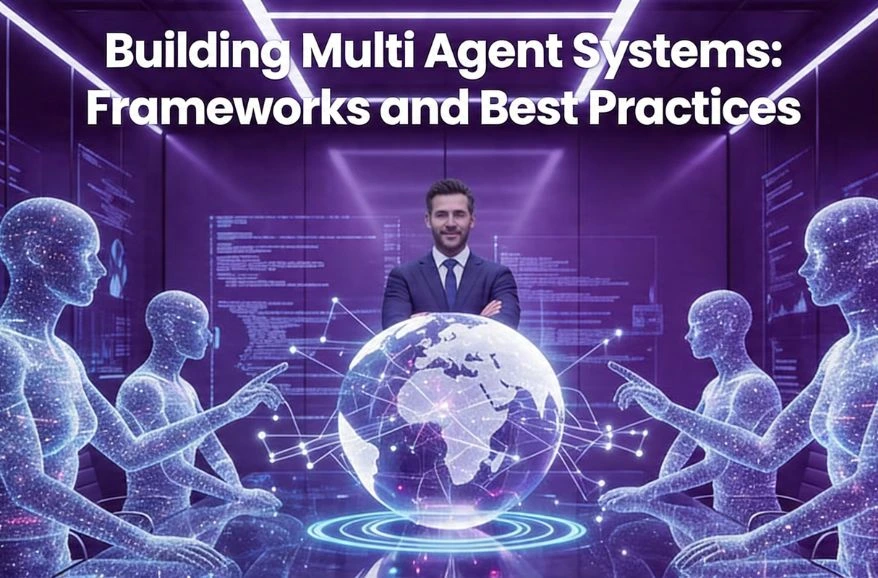
Multi agent systems combine multiple AI agents to solve complex tasks that a single model cannot handle. They are transforming the industries by making the teamwork smarter just like in human beings.
It transforms in real time, improving efficiency in supply chains and customer service, among other areas. Multi-agent configurations are more modular and more resilient compared to single agents as businesses grow in size and scale AI. This change drives the automation of enterprises, and frameworks simplify the creation of production-ready systems.
What Is a Multi Agent System?
Essentially, a Multi-Agent System (MAS) is a group of autonomous agents operating within a common environment, or sometimes competing with each other. MAS allows multiple agents to work together or compete as they strive towards their respective or collective goals. Whereas single-agent systems have a single AI model handle everything.
Multi Agent Meaning in AI and Software Systems
The state of systems, when humans minimally direct the agents, is called agentic artificial intelligence. These agents can act, make decisions, and understand things independently.
How Multi Agent Systems Differ from Single-Agent AI
| Aspect | Single-Agent Systems | Multi-Agent Systems (MAS) |
| Architecture & Control | Autonomous in simple cases. | Decentralized or hierarchical interaction between two or more agents. |
| Complexity Management | Can get overwhelmed by complex tasks; better for simple tasks. | Breaks down complex tasks into smaller, manageable sizes handled by specialized agents. |
| Collaboration | Individual agents operate alone. | Agents communicate, negotiate, or compete to achieve shared or personal objectives. |
| Scalability & Robustness | Agent failure causes the entire workflow to crash. | More scalable and robust; system continues working if one agent fails. |
| Development/Cost | Easier to monitor, audit, and develop. | Higher development costs due to coordination complexity. |
When a Multi-Agent Approach Makes Sense
Multi agent systems perform well on problems that are clearly defined, involve low external interaction, and are centralized, as in recommendation engines or fraud detection. They can be developed frequently, their maintenance costs are lower, and their results can be predicted.
Evolution of Multi Agent Systems
Large-scale artificial intelligence (AI) systems were not suited as the complexity of real-life problems grew, and Multi-Agent Systems (MAS) emerged in the industries.
The MAS has a history of developing simulations of bird flocks and has since advanced to advanced applications in warehousing, smart cities, and autonomous vehicles.
An interesting case is the drone AI agent swarm at TU Delft, intended to search and rescue after disasters. These drones are autonomous, move within their surroundings without central control or GPS, and communicate with nearby drones to exchange information.
This system lets them map the environment together and adjust quickly, making them more responsive and effective in fast-paced, high-risk situations. MAS has consequently emerged as an essential AI paradigm for a range of applications.
Core Components of Multi Agent Systems
Several simple components of any MAS determine its operation:
- Agents: Free will individuals who can act and choose.
- Environment: The agents of the common area work and communicate.
- State: Statuses of the surroundings and the state of the agent.
- Actions: Actions are actions that agents are qualified to perform.
- Notes: Carriers of information choose the surroundings.
How Multi Agent Systems Work
- A MAS receives an activity and breaks it down into activities (typically a high-level orchestration agent).
- The subtasks and steps are assigned to the AI agent based on its capabilities and access rights.
- After the assignments, AI agents can coordinate their tasks and execute them.
- Agents exchange the intermediate results, status updates, or notifications.
- MAS tracks shared tasks and role boundaries and provides outputs to hold agents accountable for their assigned tasks.
- Agents may also form temporary swarms in high-load or critical situations and reassign themselves based on changing workloads or system state (e.g., identified anomalies, queueing, performance problems, or latency issues).
- Once it is completed, MAS harmonizes the outcomes and examines abnormalities (such as conflicting goals or results, system faults, and so on).
- MAS can back off, re-allocate, or re-run tasks with various settings, or de-escalate to human experts.
- The system enhances precision within a given time frame through feedback functions, shared data repositories, human review with marking of various outcomes, and policy revisions.
Multi Agent Architectures Explained
Centralised Multi Agent Architecture
A single hub transmits all of the messages. It is an easy way, but a risky one; and when this fails, all goes by.
Decentralised and Peer-to-Peer Models
Agents communicate directly with one another. This method is harder to manage, but it is more scalable and stronger.
Hierarchical Agent Systems
Hierarchical agents are artificial intelligence (AI) agents that collaborate within a tiered multi-agent system to complete complicated tasks. Agents at the higher level of a hierarchical system have wider responsibilities and assign specific subtasks to those at the lower level. The AI agents within the system interact vertically and sometimes horizontally to ensure that the whole system is on track.
Hybrid Multi Agent Architectures
Hybrid multi-agent systems (HMAS) consist of agents/architectures of various types to address complex problems that demand a variety of approaches. At their core, these systems combine agents that make decisions in different ways, such as reactive agents (which act right away when something happens in their environment) and deliberative agents (which think about what they should do before acting). Because these tactics work together, HMAS can adapt to changes in both short-term and long-term plans. This is what makes them dynamic.
Role of LLMs in Multi Agent Systems
Multi-agent frameworks split the task between specialized agents, and the multi agent llm systems operate based on a single model to perform an end-to-end task. Multi-agent systems involve the use of several LLMs to accomplish complicated tasks within a distributed setting.
Such a decentralized structure is the secret to handling multi-step workflows. Agents may act in parallel or sequentially to coordinate their efforts and work towards a more effective solution. Multi-agent systems are more flexible and intelligent because they leverage diverse agents, competencies, and perspectives.
As an example, an agent-single agent customer support chatbot could respond to general questions, but a multi-agent support platform would have:
- Triage agent to categorize queries,
- A troubleshooting technical agent,
- A literature agent to obtain documents,
- An agent of human-in-the-loop.
- They also play a different role in achieving high-quality service.
Multi Agent Frameworks and Tools
Frameworks ease the development of multi-agent systems using orchestration and tools.
Overview of Popular Multi Agent Frameworks
- Agno: It features an in-built agent UI, deployment features and is compatible with many applications due to its compatibility with AWS.
- CrewAI: It has the features of extensibility, monitoring of agents and pre-trained materials and so is ideal to automate businesses.
- Autogen: It supports cross language development, local agents and asynchronous messaging, which promotes flexibility.
- LangGraph: This is an open source and free framework that has streaming capability and can be easily scaled to an enterprise.
With the help of these models, software developers are able to develop strong multi-agentic AI systems according to the needs.
Choosing the Right Framework for Your Use Case
Step 1. Complexity: Select an AI agent platform according to the knowledge of your team. There are low-code options for non-tech users to use AI agents, or more advanced options that require coding in advanced languages.
Step 2. Data Privacy and Security: Ensure the framework includes effective encryption, access management, and regulatory compliance (e.g., GDPR, HIPAA). Evaluate data processing approaches (on-premises and cloud) for sensitive information management.
Step 3. Ease of Use: Choose the frameworks with easy-to-use interfaces, well-documented, and community-based to develop fast and minimize the time spent onboarding.
Step 4. Smooth Task: Choose a multi agent framework that integrates easily with other tools (e.g., Salesforce, Slack) to optimize operations and save engineering time.
Step 5. Performance and Scalability: Choose a framework that can scale easily to accommodate the needs of more users and carry out complex tasks comfortably and when the load is heavy.
Open-Source vs Enterprise-Grade Frameworks
| Category | Open-Source | Enterprise-Grade |
| Security & Compliance | Minimal compliance features; no audit logs or SSO | SOC 2 Type II, GDPR, audit logs, SSO, RBAC |
| Deployment | Fully self-hosted; high setup effort | On-premise / private cloud with managed support |
| Customization | Plugin-based; requires developer effort | SDKs & APIs with white-labeling and extensive customization options |
| Scalability | May slow under heavy load; limited team support | Built for large-scale operations and multi-team use |
| Support & Maintenance | Community support only | Dedicated CSM, training, and SLAs |
| Cost | No licensing cost; higher developer overhead | Licensing cost; lower long-term maintenance |
| Time-to-Value | Requires setup, testing, and custom workflows | Faster deployment and adoption for enterprise teams |
Integration with Cloud and AI Platforms
AI models can be trained and put to use quickly and on a large scale when used with cloud systems like AWS, Azure, and GCP. It lets you quickly set up GPUs, ready-made AI services, and automated data pipelines with iPaaS tools, which speeds up time to market and lowers running costs. The tools make it easier to make AI bots, do predictive analytics, and process data quickly and safely.
Multi Agent Reinforcement Learning
Multi-agent reinforcement learning, or MAL, is a part of AI where many agents work together in a shared space to learn how to make decisions that improve their own or group outcomes. It adopts single-agent RL and implements it in complex dynamic systems. Game theory is commonly applied to regulate the manner in which individuals cooperate, compete, and coordinate.
Enterprise Use Cases for Multi Agent Systems
Logistics Industry
MAS can improve the process of choosing cargo providers by automating the process. It also enables dynamism in the perception of different aspects of selection, such as price and reliability.
Energy Industry
MAS is applied in energy optimization to coordinate agents that control hybrid systems to optimize energy dispatch and minimise waste.
Field of finance
In financial forecasting, MAS combines a central fund management agent and specialized workflows of various types of assets, where the coordinated trading is a responsibility of LLMs.
Healthcare Industry
In the healthcare sector, MAS in Azure AI Foundry delegates duties to the specialized agent. It is done to handle patients and diagnose them better than human cooperation to identify diseases.
Multi Agent Systems in AI Product Development
MAS in AI product development entails a process of multiple autonomous, specialized AI agents. They work together to address complex tasks, providing excellent scalability, accuracy, and fault tolerance compared to monolithic models. Through the division of labor among the agents in the form of research, analysis and coding. These systems can support powerful, flexible applications, especially in software engineering, financial and logistical engagements.
Benefits of Multi Agent Systems
- Improved Accuracy: MAS brings about specialization of agents in certain domains of business intelligence, which leads to an increase in the accuracy by 37.6% over generalist AI agents, according to a study done in 2025.
- Scaleability Design: MAS will be able to grow and develop with the major disturbances, and specialized agents are able to interact with other systems with ease, enhancing functionality.
- Easy Maintenance: Since MAS is modular, it allows localized testing and debugging, thus upgrading or retraining a specific agent without disrupting an overall system.
- Fault Tolerance: Agent independence will keep the system running with the failure of one part without the failure of the entire system, as witnessed in Smart grid management.
- Less Oversight Costs: MAS needs much less human oversight, and validation and correction time is reduced by 61.2%, which could save enterprises approximately $1.94 million a year.
- High Throughput: MAS can execute its tasks asynchronously and in parallel with a dynamic framework that is 33% faster in terms of execution time, as outlined in the 2025 DynTaskMAS engineering paper.
Challenges and Risks in Multi Agent Design
- Unexpected Outcomes: Multi-agent systems (MAS) are prone to unpredictable agents, leading to incorrect inferences. AI thinking is different from human thinking, thus programmed constraints and human monitoring are needed to assure task accuracy.
- Coordination Problems: There might be duplication of effort, freezing, or a lack of tasks due the poor coordination among the agents. Cooperative multi-agent reinforcement learning can be used to invest in the improvement of the protocols of negotiations and task management.
- Communication Overhead: The volume of messaging increases exponentially as more agents are incorporated in a system, especially when the process of transferring large quantities of data takes place. Summarization based on LLM and variable message size can reduce the cost of communication.
- Issue of Interoperability: Data exchange can also be an issue in an enterprise whereby different vendors have different technology stacks. Standardized frameworks are in development including A2A and MCP that require negotiation and effective securing.
- Security Threats: Agent individuals are putting forth new vulnerabilities, and prevalent models may result in system internal vulnerability. The most important part of the provision of privacy and safety of the data is to minimize the risks such as API issues and input injection.
Best Practices for Building Multi Agent Systems
- Multi-agent architectures should be used when tasks are independent and truly parallel. Otherwise, the advantages will be less than the coordination cost.
- Break down to specialize, not to innovate. Narrow-scope focused agents diminish hallucinations and enhance reliability.
- Context should be considered delicate and costly. Prune aggressively and use the retrieval-based memory rather than making agents pass long histories between them.
- Do not pack everything in advance. Only the tools required in a particular step are dynamically surfaced to avoid tool confusion.
- Write-heavy workflows should be handled with care. Multi-agent systems are most effective in read-intensive activity and are fragmented by common state changes.
- Select architecture purposefully. Centralized designs are more focused on consistency, whereas decentralized designs focus on resilience.
- Layers of design orchestration are to be removable. As base models improve, you ought to reduce agents to simpler systems without rewriting business logic.
- Do not measure model metrics; measure outcomes. Monitor the work on tasks and the quality of the choice of tools to identify actual failure modes.
Multi Agent Systems vs Autonomous AI Agents
| Criteria | Autonomous AI Agent | Multi-agent system (MAS) |
| Definition | An autonomous program designed to perform specific tasks based on defined goals. It can interact with its environment and make decisions. | A coordinated ecosystem of multiple specialized agents working together to achieve a shared goal, creating a form of “collective intelligence” greater than the sum of its parts. |
| Challenges addressed | Repetitive, time-consuming tasksNeed for hyper-personalized customer interactionsDifficulty accessing targeted informationLimited human resources for specialized tasks | Multidimensional problemsCoordinating complex actions in shared environmentsSiloed processesConflict resolution and negotiation |
| Use cases | Personal assistant for information retrievalSpecialized customer service chatbotAdministrative task automation | Supply chain optimization(e.g., DHL: -15% fuel costs)Multi-criteria financial analysis(e.g., JPMorgan DeepX)Robotic warehouse orchestration(e.g., Ocado: +50% efficiency)Predictive quality monitoringAdvanced risk and anomaly detection |
| Key benefits | Easy to implement and deployWide range of frameworks availableFocused excellence in a specific domainPredictable and controllable outcomes | Dynamically adapts to changeSolves both simple and complex problemsScalable solutionsModular and specializedEmerging standards (e.g., A2A) |
| Limitations/Challenges | Limited capabilitiesStruggles with complex, multidimensional tasksLimited scalabilityOften isolated from broader ecosystems | Complex to implement and orchestrateRequires monitoring of agent interactionsConflict management between autonomous agentsSecurity and risk of compromiseRequires technical expertiseIntegration with existing infrastructure |
Security, Governance, and Trust in Multi Agent AI
AI agent governance refers to the systems and structures that help autonomous AI agents operate safely and responsibly over time. It includes policies, rules, monitoring, and other oversight parts to ensure that systems meant to work independently, as per business goals, legal needs, and societal expectations, are maintained.
Future of Multi Agent Systems
- Better Agent Autonomy: Giving agents more autonomy as they make their own decisions and reduce their reliance on centralized authority.
- State-of-the-Art Communication Protocols: Designing reliable and effective agent communication protocols.
- Scalability Solutions: Multi agent enhances the performance to accommodate more complex and larger systems.
- Combination with AI Technologies: Multi-agentic AI is used together with machine learning and natural language processing to develop more powerful solutions.
FAQs About Multi Agent Systems
Q1. What is a multi agent system in simple terms?
A multi-agent system (MAS) is a model in which a group of autonomous AI agents cooperates or competes to achieve the solution of a complex task, like a team.
Q2. How many agents should a system have?
It relies on the complexity of the tasks. Generally, one agent is used at the beginning. But more specialized agents are used when the workload demands more coordination, specialized skills, or resilience.
Q3. Are multi agent systems expensive to run?
Indeed, multi-agent systems (MAS) are usually costly to operate.
Q4. Do multi agent systems replace human teams?
Multi-agent systems (MAS) are not necessarily designed to substitute human teams wholesale. But they are considered to be the digital co-workers that automate the routine and increase productivity.
Q5. Which industries benefit most from multi agent AI?
Multi-agent AI is more beneficial for supply chain, finance, healthcare, manufacturing, and banking.

Leave a Reply