

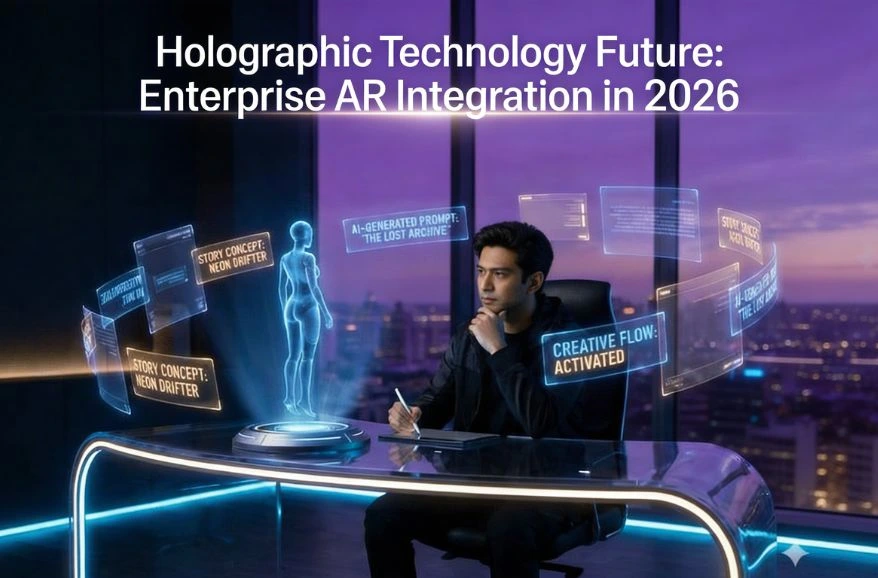
The future of technology is now, and it is changing the way companies use augmented reality to collaborate and visualize. By 2026, companies will use real holographic technology to create 3D images, saving money on training and design and helping people make better decisions. The holographic technology future is going to be worth a lot of money. Companies that use augmented reality will be the ones to make it happen, especially in fields like manufacturing and healthcare. Companies that get in on this technology early will have an advantage over others. It is important for companies that want to be ahead of the game to use it now.
What Is Holographic Technology?
Holographic Technology Explained in Simple Terms
A hologram is a three-dimensional picture that looks like it is really there in the room with you. It does not need any glasses or screens to see it. It is made using light to show a picture that looks real. You can walk around it to see it from different sides.
The way hologram technology works is that it takes a picture of the light that is bouncing off an object. Then it makes a copy of that light so it looks like the real thing. This is different from a picture that you can hang on the wall. A regular picture only shows how bright or dark something is. A hologram also shows how deep something is and how it looks as you move your head from side to side. A hologram shows all the details of something in space.
How Holograms Are Created Using Light and Depth
Holograms work by splitting laser light into two parts: the object beam and the reference beam. This creates patterns that can be recorded on light field displays. When a laser is used to rebuild these patterns, we can see images that appear three-dimensional.
The reason we see depth in these images is the way the light waves are reconstructed. It is similar to how real objects are lit up. These volumentric videos are used with AR headsets that combine the virtual and real worlds.
Difference Between 2D Projections and True Holograms
| Feature | 2D Projection | True Hologram |
| Dimensionality | Flat 2D image projected on a plane | 3D image with real volume and depth |
| Viewing Angle | Limited; looks flat from any angle | Full 360-degree viewing (can walk around) |
| Depth Perception | No real depth (illusion only) | Genuine parallax and depth |
| Light Source | Standard light/LED projection | Laser light (usually) + Diffraction |
| Surface | Requires a screen or wall | Projects in mid-air/free space |
| Focus Mechanism | Eyes focus on the screen surface | Eyes focus naturally at different depths |
| Technology Type | Conventional Display | Light field reconstruction |
| Common Use Cases | Movies, presentations, signage | Museums, high-end medical/tech, security |
Evolution of Holographic Technology
The story of technology started in 1947 with Dennis Gabor’s important work. He wanted to make electron microscopes. At first, things did not go very far because the holograms made with mercury arc lamps were not very good.
Then lasers came along in the 1960s. Completely changed everything. Lasers gave us the type of light we needed to make holographic technology.
Some important things happened, like Theodore Maiman developing a kind of laser in 1960 that could take pictures of fast-moving objects.
Emmett Leith and Juris Upatnieks created holograms capable of being transferred elsewhere in 1962. Around this period, Yuri Denisyuk discovered how to create holograms that reflected light.
Later in 1968, Stephen Benton developed rainbow holograms.
Holographic art began appearing in the 1960s. Scientists succeeded with technology, while artists took longer to adapt to holographic technology.
Types of Holographic Display Technology
1. Laser Plasma holographic display
It employs a powerful laser to create holograms in the air without screens. But the quality of the image is poor and cannot be used in high-resolution applications.
2. Full-Parallax Displays
It provides 3D pictures that can be seen from all angles. It involves the display of optical information in horizontal and vertical planes; it needs high processing power.
3. Horizontal/Vertical-Only Parallax
Compromise features that sacrifice processing power but restrict viewing angles; horizontal-only is more user-friendly with natural eye alignment.
4. Micro-Magnetic Piston Displays
Uses MEMS technology and microscopic pistons to develop image pixels to produce 3D holograms by reflections of light.
5. Holographic Displays that are touch sensitive
Use haptic technology, where it is possible to touch the holograms; it is a phenomenon since the science fiction, like in the Star Wars.
These types fuel the holographic technology future, with enterprises favoring digital for AR scalability.
The Future of Holographic Technology
- Real-Time Holographic Communication: Cisco and Meta holographic calls (5G) are the best examples. They create life-size holograms.
- Consumer-Friendly Home Holograms: In the future, holographic devices can be made small and cheap, looking like the ones used in the pop culture.
- Fully Interactive Holographic Retail: Retailers can introduce interactive holograms that engage customers, and the can create virtual try-ons with life-size hologram models.
- Holographic Education and Telepresence: Holographic classrooms would enable a teacher to deliver instruction to an entire classroom in real time, with interactive access.
Enterprise Applications of Holographic Technology
1. Engineering & Manufacturing: Virtual prototyping with the help of holography can help in better visualization of the 3D models to be inspected and undergo quality checks.
2. Healthcare: Surgeons utilize MRI/CT scan holograms to plan better surgery and train.
3. Retail and Advertising: Companies prepare interesting 3D displays of their merchandise where customers can see the products from any angle.
4. Remote Collaboration: Individuals with 5G technology can hold a realistic meeting with others over the internet using 3D holograms to improve conversation and cut down on travel costs.
5. Education & Training: Interactive holographic displays provide extensive interactivity in the manipulation of 3D objects as well as complex topics.
6. Security & Authentication: Holograms are applied to authoritative documents and products in order to avoid copying.
Holographic Technology in Communication
In communication, holographic technology entails taking live or recorded images with the use of cameras or depth sensors and then converting them into holographic data. The person who receives this information will have it decoded and shown on their device as a 3D image. They can interact with it in real time, just like normal people.
Holographic Communication vs Video Conferencing
| Feature | Video Conferencing (2D) | Holographic Communication (3D) |
| Dimension | 2D (Flat) screen | 3D Volumetric / Spatial |
| Presence | Remote (Pixelated) | “In-the-room” feel |
| Eye Contact | Difficult to maintain | Natural and aligned |
| Hardware | Webcam, Laptop, Phone | Specialized 3D Cameras, Projectors/Pods/AR Glasses |
| Latency | Low (negligible in 5G) | Very low (Requires near-zero latency for immersion) |
| Bandwidth | Standard | Extremely high (6G is key) |
| Fatigue | High (“Zoom fatigue”) | Low (closer to in-person interaction) |
Real-Time 3D Presence and Spatial Audio
The technology can be combined with spatial audio, haptic feedback, and gesture recognition to make the virtual world more lifelike. Users can have a tactile experience with haptic feedback, such as feeling the texture of fabric or the weight of items.
Holographic Advertising and Brand Experiences
The other one is the use of holographic presentation in the retail sector, like the spinning LED fan projectors. It project the image of a product (such as a sneaker or a logo) as a floating 3D image. Such holographic devices have already been put into use to capture customer attention at the stores and at trade shows.
The displays may be networked across multiple units to form larger, more intricate holographic images. It allows brands to present dynamic content the changes with various viewing angles, which can be highly useful in busy locations.
The two instances demonstrate that hologram technology has the potential to integrate dynamic, lifelike images into the real world.
Consumer Holograms – How Close Are We?
Consumer holograms are quickly moving from science fiction to science fact. The years 2025 and 2026 will be key to getting mainstream and high-end consumers to accept them. AI, 5G, and volumetric displays have made it possible to make lifelike 3D, interactive holograms in the entertainment, retail, and specialized expert sectors. However, we still don’t have mass-produced, affordable, and easier-to-reach free-floating holograms like in Star Wars in every home.
Holographic Technology vs AR, VR, and Mixed Reality
| Feature | Holographic Display | Augmented Reality (AR) | Virtual Reality (VR) | Mixed Reality (MR) |
| Core Concept | Light in air, “naked-eye” 3D | Overlays digital info on the real world | Fully immersive digital simulation | Blends real & virtual; Interaction |
| Environment | Real world (shared) | Real world | Totally virtual | Hybrid (Physical + Digital) |
| Hardware | Holographic display screens/projection | Smartphone, tablet, or smart glasses | Headset (Tethered/Standalone) | Advanced Headset/Holographic Computer |
| Interaction | Generally passive (viewing) | Limited interaction with objects | High, within virtual world | High, interaction with both |
| Depth/Space | True 3D depth and parallax | Digital 2D/3D overlay, often flat | Immersive 360-degree view | 3D, digital objects “anchored” to reality |
| Realism | Highly realistic (light-based) | Varies (mostly 2D graphic overlays) | Extremely high (simulation) | Highly realistic, context-aware |
| Primary Use | Shared, public, collaborative | Gaming (Pokémon GO), Navigation, Retail | Gaming, Training, Education | Product Design, Remote Work, Surgery |
Technical Challenges Slowing Holographic Adoption
1. Hardware Limitations:
- Demand strong and high-resolution projectors and calculating units.
- Need smaller, energy-efficient, consumer-friendly equipment.
2. Content Creation Hurdles:
- Requirement of new expertise and computer tools to create interactive 3D effects.
- There is a need for standardized platforms and easy-to-use authoring tools to create content.
3. Societal and Ethical Reasonings:
- The problem of digital clutter and the attention economy is emerging with the spread of digital information.
- The threats of misinformation and deepfakes in hologram formats require the development of norms and regulations.
- Significance of formulating ethical laws to regulate the holographic technology.
Role of AI in the Future of Holographic Technology
The artificial intelligence (AI) enhances the process of hologram creation by optimizing the hologram design, creation, and reconstruction. AI can be used to analyze complex patterns of light-interference and to make detailed hologram models by generating them automatically. It is also capable of improving computational holography which allows real-time processing of complicated wavefronts to create dynamic 3D displays.
In the holographic technology future, AI will speed up the process of making holograms from very large data sets, such as those used in medical images or immersive entertainment. The fact that it can speed up work means that holography could become more widespread.
Industry-Specific Use Cases of Holographic Technology
1. Entertainment & Music
Holographic technology has really changed the way we see shows. We can see artists who have passed away, like Tupac Shakur, on stage again. This is like a dream come true for fans who never got to see them perform live. They can now experience something that they thought was impossible. Even artists who are still alive, like the band ABBA, are using projections of real people to perform at shows without actually being there in person. Holographic technology is allowing artists, like ABBA, to do things that were not possible before.
2. Corporate Events & Conferences
Holographic keynote speakers are becoming increasingly popular at events around the world. For example, you can have a hologram that looks just like a real person at a trade show. Thanks to its artificial intelligence, this hologram can communicate with viewers and provide talk show hosts a feel of what the products are all about. Holographic keynote speakers, like this, can really make an event special.
3. Retail & Marketing
The companies are exploring holographic displays to display products in an interactive 3D format. Think about what it’s like to walk by a store window and feel like the sneaker in the window is flying and spinning in the air, but it’s not heavy. This could help with both a nice, modern look and feel for the brand and a smooth launch of a new product. Brand reps may use a big, rotating 3D model of a product during presentations. This makes it easy to see from any angle, even in large rooms.
4. Healthcare
Holographic technology is being integrated in healthcare to develop immersive learning. Health care applies holographic technology to explain students’ anatomy with the help of a hologram of a human body. Medical imaging is another field where holograms have become very popular: multiple-dimensional holograms of human organs make healthcare providers obtain a deeper insight into the state of the patient.
5. Education and training
Education is not an exception: creative applications of hologram technology are also being experimented with, e.g., allowing visitors the opportunity to become immersed in actual historical events. At certain museums, 3D holograms of historical figures are displayed alongside real artefacts in reconstructions, creating a unique experience between the past and the present.
Holographic Technology Roadmap (2025–2030)
In the holographic technology future, the holographic display market is estimated to rise from USD 4.3 billion in 2025 to USD 40.3 billion in 2035 with a CAGR of 25.2%.
2025-2030: Medium-Term Commercial Viability
Market Value: It is projected that the market value will increase between USD 4.3 billion and USD 13.1 billion in 2030.
Drivers: First use in high-value market segments such as consumer electronics, automotive infotainment, and advertising.
First Mover: There is a desire among the first adopters of premium applications to gain novelty and differentiation.
2030-2035: Long-Term Vision of Holographic Computing
Market Value: The forecasted increase is between USD 16.4 billion and USD 40.3 billion.
Cost-Effectiveness: The reduction of the cost of manufacturing, the growing availability of the products, and the incorporation into mainstream applications.
Standardization: The business begins using holographic screens as interactive interfaces, for three-dimensional visualization, and for digital signage.
Adoption Lifecycle: A shift between niche experimentation and mainstream adoption can be observed, where early majority users provide the market with momentum, which is supported by network effects and interoperability, resulting in the eventual market maturation by 2035.
Common Myths About the Future of Holographic Technology
| Myth | Reality |
| Holograms hover in free, open air. | True holograms (light fields) or illusions require a physical medium, such as specialized screens, glass, or fans, to reflect or refract light. |
| Sci-Fi “Princess Leia” projection is imminent. | The free-floating, photorealistic projections seen in movies are currently physically impossible; light requires a surface to interact with. |
| All 3D projections are holograms. | Many “holograms” (e.g., concerts) use “Pepper’s Ghost,” a 19th-century trick with mirrors and 2D reflections, not true 3D volumetric recording. |
| Holograms can be physically touched. | Holograms are light, not solid matter. While haptic feedback (ultrasonic waves) can simulate touch, you cannot hold a physical object that is purely holographic. |
| Holograms will replace all flat screens. | Holographic displays are specialized for 3D visualization. For standard 2D content, traditional screens are more efficient and cost-effective. |
| Holography is a brand-new technology. | Holography was invented in the 1940s. The future lies in enhancing its computational speed and display quality, not in its invention. |
| Holograms are “always-on” like television. | True holographic recording requires precise, often high-power laser sources and controlled, low-light environments to be clearly visible. |
| Holograms will always be too expensive. | While high-end tech is pricey, 3D holographic fans and display boxes are already becoming accessible for commercial and consumer use. |
Conclusion: Is Holographic Technology the Next Computing Platform?
Holographic technology will be the foundation of augmented reality for companies in 2026. Holographic technology’s future will transform the way people work by understanding 3D objects.
The industries that start using technology now will be the ones that lead the way, and the ones that do not will be left behind. We can expect to see holograms used every day to improve our reality, not replace it. This will make the world more aware of this technology. Holographic technology and augmented reality will be part of our daily lives, and companies that use them will be the ones that make it happen.
FAQs on Holographic Technology Future
Q1. What is the future of holographic technology?
The future of holographic technology is changing to immersive, glasses-free 3D, with AI and haptic feedback to achieve realistic and interactive 3D and tactile virtual objects.
Q2. Are real holographic displays already available?
Now, there are already actual holographic displays, but real holographic displays typically are not of the free-floating, Star Wars-style science fiction.
Q3. How is holographic technology different from AR and VR?
The main difference between holographic technology and AR and VR is that holographic technology shows 3D light-field pictures in real space; also, headsets are not needed because anyone can see the images with regular glasses.
Q4. When will consumer holograms become mainstream?
Holograms of consumers will shift from specialized business use to the mass consumer market between 2030 and 2035.
Q5. Which industries will adopt holography first?
According to the existing industry trends, the key adopters of holography are:
- Healthcare
- Retail
- Advertising
- Gaming
- Automotive

Leave a Reply