

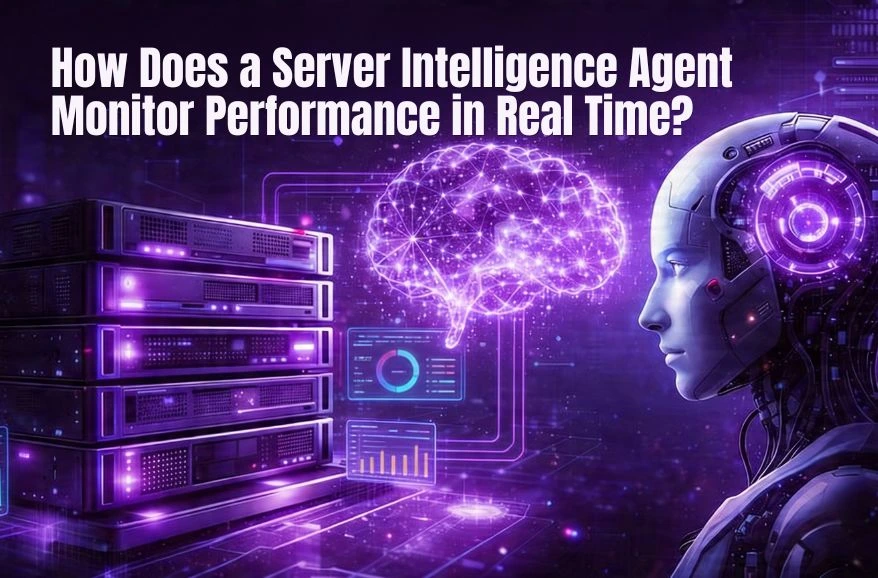
Server performance is a key issue in the digital age for businesses that are subscribing to cloud services and data centers. A Server intelligence agent is a highly developed software that keeps an eye on server health. They analyze the data in real-time using AI to predict other possible problems. It is also necessary to control e-commerce and financial systems, whereas it can automatically react to issues as opposed to a simple monitor. It can gather such metrics as CPU usage or network traffic, which can be used to minimize downtime and maximize resources. This real-time end-of-life monitoring is more reliable and efficient, and enables IT teams to focus on innovation instead of troubleshooting.
Why Real-Time Server Monitoring Is Critical for Modern IT Infrastructure
The servers play a vital role in business operations, user authentication, data storage, and critical applications. According to Gartner, the cost of IT downtime per minute is an average of $5,600. The revenue loss and negative publicity as a result of a server crash can be crippling. Proper AI server monitoring can be taken as the early warning system to avoid these problems. Moreover, among the most vulnerable targets of cyberattacks are servers, which can be compromised to enable unauthorized access and data loss. It helps monitor for suspicious activity, like unusual resource use or configuration changes, which could indicate a security threat, protecting the company from serious risks.
What Is a Server Intelligence Agent?
Server Intelligence Agent Explained in Simple Terms
A Server Intelligence Agent (SIA) is a software service that serves as a site manager of enterprise software environments. Primarily, it focuses on SAP BusinessObjects Business Intelligence (BI) systems.
Role of Server Intelligence Agent in IT Infrastructure
Monitoring servers is a very important aspect of an IT infrastructure. It is important to ensure that there is availability and the health of the servers. These are critical to the provision of viable digital services. A software development department will use this exposure to debug problems in a very short period. Any lag or breakdown in the server may result in distrust of customers, damaged reputation, and loss of money. Server monitoring systems assist admins to monitor metrics, troubleshoot, corrupt files, and security problems, and understand response times. This information allows these systems to implement proactive measures and mitigate possible issues, which in turn helps limit unforeseen downtimes and improve user experience.
Difference Between Traditional Monitoring Tools and Intelligent Agents
| Aspect | Traditional Monitoring Tools | Intelligent Agents |
| Functionality | Passive data collection and alerting | Active system management and optimization |
| Intelligence | Rule-based static thresholds | Machine learning and adaptive algorithms |
| Scalability | Requires manual configuration for growth | Self-adjusting to environmental changes |
| Insights | Surface-level metrics and logs | Deep contextual understanding with predictions |
How a Server Intelligence Agent Works
1. Data Collection Methods
- Agent-Based Monitoring: This is where software agents are installed on a server to retrieve detailed performance metrics and system information. It provides complete visibility, but it requires maintenance on both systems.
- Agentless Monitoring: Only uses network protocols (e.g., SNMP, WMI, SSH) to collect data on the remote end, which is less resource-intensive but does not necessarily provide as detailed information.
- Hybrid Solutions: Use both strategies, i.e., with critical servers, agents work, and agentless methods elaborate health checks.
2. Real-Time Analysis and Alerting
Fine-grained modern systems analyze data on a per-request basis and raise server anomaly detection through a variety of channels. It uses machine learning to improve accuracy and minimize false positives.
Key Features of a Server Intelligence Agent
Real-Time Performance Monitoring
One of the most significant features is the ability to monitor the performance of the servers in real-time. This will keep you informed immediately when any critical thresholds are violated, so that you can respond immediately.
Integration with Cloud and Hybrid Environments
Recently, more companies have moved to cloud and hybrid cloud deployments. This has made it crucial to select a server monitoring tool that can effectively monitor on-premises, cloud-based servers, and resources.
Customizable Alerts
Custom alerts can be configured for particular conditions. It could be that RAID disk space is low, or CPU utilization is at 90, or network lag is peaking: the ability to make customized alert rules will make sure that you are only alerted on the events you care about.
Analytics and Data (Historical Data)
It is priceless when it comes to the capability of evaluating historical performance records. Through historical analysis, you are able to detect trends, make forecasts on the future requirements of the server, and make resource allocation efficient. Find tools that have powerful analytics and reporting functions.
Benefits of Using a Server Intelligence Agent
- Efficiency and Productivity: Agents increase work output and efficiency by breaking down work. It enables multiple tasks to be done simultaneously and automates repetitive work, allowing humans to focus on creativity.
- Better Decision-Making: Collaborating agents gain greater power in decision-making through debate and learning. They can change strategies as they see fit, and weapons improve thinking by having feedback on their reasoning.
- Increased Capabilities: Agents are skilled in solving problems, communicating, using tools, and learning from experience to improve.
- Social Interaction and Simulation: The agents may simulate the behaviors of real societies, which results in the emergent behaviors of a couple of agents, improving their fitting of the relationships of humans.
Role of AIOps Platform in Server Intelligence
What Is an AIOps Platform?
AIOps stands for an artificial Intelligence application for IT operations (AIOps). It uses AI methods to improve IT operations by automating tasks such as performance monitoring and data backups.
How AIOps Enhances Server Intelligence Agents
AIOps uses machine learning and natural language processing to improve operations. It provides real-time insights and analyzes data from various sources for better IT management.
Benefits of Combining AI with IT Operations
- Increased efficiency and faster process: AI automation accelerates daily activities, simplifying the operations through flexibility, by presenting real-time responses and making decisions.
- Cost Savings: Efficient operating systems save on costs, and AI helps to save resources to limit waste.
- Increased Accuracy and Reliability: AI algorithms are precise and will result in a reduced number of mistakes and the increased regularity of the results.
- Proactive Issue Resolution: Predictive capabilities allow detecting problems early enough, and they reduce downtime.
- Resource Optimization: The use of artificial intelligence will optimize the usage patterns to enhance resource allocation, therefore, enhancing performance and scalability.
Server Intelligence Agent vs Traditional Monitoring Tools
Manual Monitoring vs AI-Driven Monitoring
Although manual monitoring relies on human operators and may be subject to numerous errors. AI leverages sophisticated technologies such as computer vision and machine learning. These technologies analyze real-time data, helping improve traffic flow, minimize delays, and enhance safety.
Reactive vs Predictive IT Operations
Reactive models trained teams on how to react in a pressurized situation, usually during the night. Proactive solutions enhanced that rhythm by assisting teams in planning ahead. Predictive IT operations are the second step to predict.
Use Cases of Server Intelligence Agents Across Industries
IT and Cloud Infrastructure Management
Common IT problems, including password resets, software access requests, and device provisioning, are addressed automatically by AI-powered helpdesk agents. They screen tickets, non-stops, and forward complex issues to the right experts. They can give their answers in real-time by searching through the knowledge bases and the previous tickets. The approvals, provisioning, and setup are automatically performed by the agent when employees require new software or hardware.
E-commerce and High-Traffic Websites
High-traffic websites and e-commerce are beginning to use AI to improve customer service and optimize their operations. AI in customer support sorts issues and resolves common ones quickly, while the RMA and returns process is automated, generating return labels, tracking packages, and communicating with customers. Enrichment of the catalog can be used to maintain uniformity through consistent product names, descriptions, and other characteristics used in product listings. AI also has the benefit of streamlining pricing and advertising since it automatically increases and decreases bids, performance monitoring, and profit margins. A delivery identifying watchdog aspect is an order-issue watchdog that is proactive.
Financial Services and Data Security Systems
Financial AI agents may process invoices to get information that is matched against purchase orders and contracts, and raise any discrepancies prior to payment. They sift through expense reports to detect policy breaches, duplicate costs, and abnormal spending patterns that human users may overlook. Once anomalies raise their heads, the agent prepares an email in which he or she requests clarification, but escalates if it is essential.
Common Challenges Without Intelligent Server Monitoring
Alert Fatigue
There are so many alerts that it overloads the IT team, resulting in important issues not being noticed. Fight this through setting alert limits, applying intelligent grouping, and acting on meaningful alerts instead of information clutter.
Tool Sprawl
Companies tend to have numerous monitoring systems that are not well-integrated. This generates blind spots and adds complexity. Think about integrated platforms that will give you visibility over all of your infrastructure.
Complexity of Clouds and Hybrids
The on-premise data centers, public clouds, and hybrid environments are all considered modern infrastructures. Make sure that your monitoring strategy has every deployment model and offers equal visibility irrespective of the location of your servers.
How to Choose the Right Server Intelligence Agent Solution
- Governance alignment: Inbuilt governance will help reduce regulatory risk and months of tailored development.
- Level of integration: A complex-looking monitoring platform is useless without the ability to be integrated with your existing infrastructure, security architecture, and operational procedures.
- Scalability: Proofs of concept do not forecast reality in production. Predict 10x expansion. Does the platform support expansions without significant architectural modifications? Otherwise, this is not the right decision.
- Skills needed: There are platforms whose architecture is tailored to them and demand specialized skills (such as sustained engineering expertise), which you might lack.
Best Practices for Implementing Server Intelligence Agents
- Modular Design: Prompts and models can be updated and versioned separately; a modular prompt design ensures that AI interactions are modular enough to do this. This allows quick reversal of changes in case of a drop in performance and monitoring of changes.
- Caching Strategies: Engineer semantic caching, retrieval caching, and regular web caching to accelerate them and save money. When data changes, make sure that caches are invalidated and that you don’t make the same API calls over and over again.
- API Resilience: API calls should be more resilient with retry policies, circuit breakers, rate limitation, and graceful degradation to ensure that when an API call fails, core functionality is not lost.
- AI Guardrails: Set clear standards to ensure the AI product uses accurate data, removes false information, and uses tools to maintain high answer quality.
- Cost Optimization: Track the number of tokens you spend, batch operations, and make your way to better vector databases, reducing costs without impacting efficiency.
Future Trends in Server Intelligence and AI Monitoring
Growth of AI-Driven IT Operations
Log management, alerts, and service restarts have been automated. It is because human system administrators have been replaced by AI. AI does what humans can’t: it runs continuously handle logs, alerts, and service restarts. With Intelligent IT, operations can save money. It also frees IT professionals to do strategic work. AIOps can automatically resolve approximately 70% of typical incidents, but human supervision is vital to make critical decisions.
Predictive analytics
Predictive analytics enable AI to identify issues prior to their happening, which allows organizations to perform maintenance ahead of an issue and minimizes unplanned downtime. Autonomous server management can also identify problems before they occur, which organizations such as IBM say can save a lot of money in this manner.
Evolution of Self-Healing Systems
AI also helps to improve the reliability of the system by providing self-healing features, decreasing the mean time to recovery (MTTR), and providing higher service availability during peak loads.
Conclusion
Implementing a server intelligence agent is a game-changer in terms of real-time monitoring of performance, which incorporates AI to achieve unprecedented efficiency. It enables IT professionals to be on the leading edge, whether it is detecting anomalies or predicting fixes. Increasingly complex infrastructures are resilient to these agents, reducing costs and innovating. Adopt this technology to have a future-proof IT ecosystem, and your business will be grateful.
FAQs About Server Intelligence Agent
Q1. What is a server intelligence agent?
A Server Intelligence Agent (SIA) is the initial background service on SAP BusinessObjects BI systems. It employs servers that manage server nodes, maintain server status, and automatically restart failed servers.
Q2. How does an AI agent monitor server performance?
AI agents do not work in the same manner. They consider situations, consider alternatives, and decide according to the real-time inputs and environmental conditions. Due to the non-determinism of agent behavior, effective monitoring requires signals of observability, i.e., reasoning traces, context, and tool-call paths.
Q3. What is the difference between AIOps and traditional monitoring?
AIOps (Artificial Intelligence on IT Operations) is not just a usual monitoring, but shifts the reactive rule-based alert to a proactive, automated intelligence.
Q4. Can server intelligence agents prevent downtime?
Yes, server intelligence agents (sometimes also known as AI-powered agents or AIOps) can efficiently prevent, reduce, and fix server downtime.
Q5. Are AI-based monitoring tools secure?
Technologies based on AI make sure that only authorized users can access sensitive systems and data, which increases the level of security.

Leave a Reply