

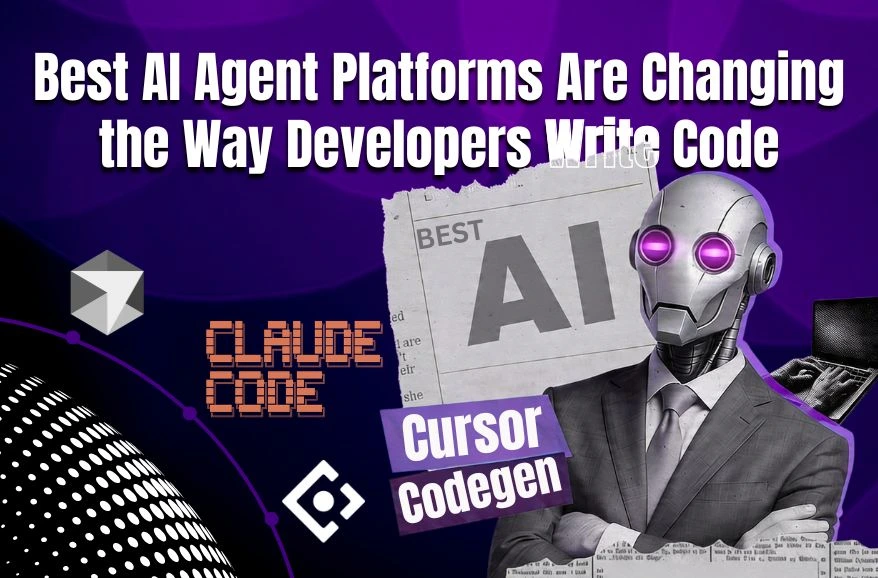
By 2026, the best AI agent platforms will transform the way developers write code to a great extent. The best AI platforms for code, such as Cursor, Claude Code, and Codegen, are designed as autonomous partners. They are capable of planning, coding, debugging, and deploying this type of system, saving development time. The transformation will help the developers to shed the monotonous tasks and concentrate on innovative solutions. The AI tools communicate with the IDEs, comprehend full codebases, and do what humans can do when faced with complex problems. This, added with advances in agentic AI, enhances innovation and speed to market, revolutionizing the coding world on a scale.
Why AI Agents Are Transforming Modern Software Development?
The AI-based agents can do complicated, multi-step jobs by communicating with their surroundings and gathering and processing data with little or no help from humans. And rather than being bound to a set of rules, they are able to subdivide tasks and to critically analyze them.
What Is an AI Agent?
Understanding AI Agents in Simple Terms
An AI agent is a computer program that can understand its surroundings, look at data, and take action to reach its goals without any help from a person. In contrast to traditional software, the AI bots follow set rules, but they change based on the information they receive and learn by doing.
Difference Between AI Agents and Traditional AI Tools
| Dimension | AI Agents | Traditional Dev Tools |
| Who drives the workflow? | Consistent, deterministic patterns, when paired with generators, enable agents to refactor across repositories. | Human developers manually orchestrate every step. |
| Speed of initial development | Fast: minutes/hours to generate a functional base app. | Slow: days/weeks to scaffold full-stack apps. |
| Handling of boilerplate (CRUD, forms, migrations) | Automated: generated from schema + intent extraction. | Manual, repetitive, error-prone. |
| Code quality consistency | Consistent, deterministic patterns when paired with generators; agents refactor across repos. | Depends on developer’s skill; style drift happens over time. |
| Cross-file reasoning | Agents read the entire repo, search relationships, and apply systematic changes. | Developer must mentally track everything; easy to miss details. |
| Refactoring | Agents excel at mechanical, wide-scope refactors using type systems & tests. | Tedious, risky on large codebases. |
| Debugging | Autonomous loops: run tests → read errors → attempt fixes. | Manual log reading, trial/error, stepping through code. |
| Integration with tools (Git, Docker, CI/CD) | Agents call tools directly, edit configs, and re-run pipelines. | Developer executes commands, configures pipelines manually. |
| Creating new features | Agent generates changes across layers from a single instruction. | Requires the developer to update models, controllers, UI, tests, and infra. |
| Architecture decisions | Weak: agents follow patterns but still rely on humans for architectural choices. | Strong, human-led; requires deep context and domain understanding. |
| Understanding business logic | Limited: agents need explicit instructions; prone to semantic gaps. | Strong: humans interpret domain needs, edge cases, and constraints. |
| Error handling & edge cases | Agents handle common cases; domain-specific cases still require humans. | Developer responsibility; often added late. |
| Security & compliance | Agents can implement known patterns but require strict guardrails & review. | Humans ensure secure patterns; audits are needed. |
| Learning curve/onboarding | Agents instantly search, summarize, and navigate entire repos. | New devs need time to understand the codebase. |
| Scalability of team output | Leverages compounding: agents + humans scale output disproportionately. | Linear: add more engineers → more output (until coordination slows). |
| Predictability of output | Medium-fast but requires verification, tests, and human review. | High-code is deterministic but slow to produce. |
| Best use cases | CRUD-heavy apps, internal tools, SaaS scaffolding, refactoring, repetitive tasks. | Complex architectures, critical logic, performance-sensitive systems. |
| Overall value proposition | Maximum velocity requires guardrails. | Maximum control, slower speed. |
How AI Agents Work in Coding Environments
AI coding Agents are advanced systems capable of planning and performing multi-step tasks independently. They are able to write and run code, monitor the results, and make a decision on further actions based on the results, without close supervision. All that the user has to do is outline what they want to accomplish and leave it to the agent to decide the most suitable path towards their goal. This is even more advanced than the old methods of autocomplete, and it can be used to get a higher degree of functionality.
What Makes the Best AI Agent in 2026?
- Autonomous Task Performing: AI agent platforms perform tasks autonomously with little human interaction. They possess the capabilities to self-plan tasks, decompose problems, perform automatic error correction, and operate continuously. They can work and make intelligent decisions within a given parameter.
- Decision-Making Skills: AI agents are shown to be able to make complex choices in real time, weighing the pros and cons of each option, picking the best one, setting priorities, and changing their minds based on new information, just like human professionals.
- Contextual Understanding: The AI tools that do the best coding are those that are good at recognizing the user intent, situational context, contexts of talk, background knowledge in the domain, and domain knowledge, therefore providing a better and smaller relevant answer.
- Dynamic Learning: AI agents possess powerful learning capabilities and can learn through interaction with users. Through the process of identifying trends, adapting to new circumstances, optimizing strategy, and acquiring new knowledge. This makes it more efficient in the long run.
- Multi-album Abilities: They can process multiple types of input, such as text, images, voice, numerical information, and documents, and thus are multi-purpose tools that can be used in a wide variety of applications.
- Real-Time Adaptation: When things go wrong, AI agents can handle it by re-prioritizing work on the fly, adapting processes, reassigning resources, and improving performance.
Best AI Agent Platforms for Developers in 2026
| Tool | Key Features | Ideal For | Notable Users / Integration |
| LangGraph | – Stateful agent orchestration- Multi-agent workflows (single, hierarchical, sequential)- LangSmith integration for monitoring- Human-in-the-loop workflows- Streaming capabilities- Long-term memory support | Teams building robust, context-aware agents for extended interactions | Klarna (80% reduction in support resolution time) |
| AutoGen | – Multi-agent conversation framework- Event-driven architecture- LLM-agnostic- Strong documentation and educational tools- Scalable for complex workflows | Enterprise and academic environments needing collaboration between agents | Novo Nordisk (data science pipelines) |
| CrewAI | – Role-based agent structure- Simple setup with minimal code- Framework-agnostic- Fast deployment for collaborative workflows | Customer service, marketing, and teams seeking lightweight orchestration | Widely adopted for service automation |
| Smolagents | – Code-first architecture- Lightweight- Model-agnostic- Sandboxed execution | Developers seeking a simple, debuggable, and efficient framework | Hugging Face ecosystem |
| OpenAI Agents SDK | – Lightweight multi-agent design- Provider-agnostic (100+ LLMs)- Integrated tracing and debugging- Built-in guardrails for safe execution- Easy for Python developers | Developers needing customizable workflows with safety and flexibility | Seamless with OpenAI services |
| Google Agent Dev Kit (ADK) | – Native Gemini and Vertex AI integration- Modular, component-based architecture- Hierarchical agent compositions- Efficient with under 100 lines of code- Custom tool development support | Organizations using the Google Cloud ecosystem for AI deployment | Powering Google’s internal Agentspace platform |
Best AI for Coding – How AI Agents Improve Developer Productivity
- Context-Sensitive Code Suggestions: Intelligent Code Suggestions Google Duet AI and XenonStack AI are platforms that work without getting in the way and offer intelligent design, business logic, and history-driven code suggestions. For example, they can automatically create secure container settings in Kubernetes applications.
- Automated Documentation and Test Creation: XenonStack Developer Agents go further in supporting the maintenance of code by automatically generating documentation records, unit and execution tests, and then updating those outputs with applications, like Notion and Git.
- AI-Enhanced Debugging and Live Pairing: Solutions, like GitHub Copilot Chat, allow users of computers to query software in the form of natural language queries, see execution traces, and fuzz consequences before making the software available.
- Free CI/CD and DevSecOps: AWS CodeWhisperer and XenonStack CI/CD Agents both have pipelines that are automatically updated, playbooks that let you install agent templates, compliance checks, and suggestions for how to fix your code.
- Agents and Secure Coding: XenonStack Secure Agents and Google Duet AI are intelligent reviews that offer vulnerability scans and architectural refactor suggestions.
- Smart Onboarding and Knowledge Transfer: Create a unique experience, interactive codebase tours, and question-answering intelligent bots to speed up onboarding.
AI Coding Agents vs Traditional Coding Tools
| Characteristic | Traditional AI | Agentic AI |
| Examples | Spam filters, image classifiers, recommendation engines | AI assistants, autonomous developer agents, multi-agent LLM orchestrations |
| Execution model | Batch or synchronous | Asynchronous, event-driven, and goal-driven |
| Autonomy | Limited; often requires human or external orchestration | High; acts independently with adaptive strategies |
| Reactivity | Reactive to input data | Reactive and proactive; anticipates and initiates actions |
| Proactivity | Rare | Core attribute; drives goal-directed behavior |
| Communication | Minimal; usually standalone or API-bound | Rich multi-agent and human-in-the-loop interaction |
| Decision-making | Model inference only (classification, prediction, and so on) | Contextual, goal-based, dynamic reasoning (often LLM-enhanced) |
| Delegated intent | No; performs tasks defined directly by user | Yes; acts with delegated goals, often across services, users, or systems |
| Learning and adaptation | Often model-centric (for example., ML training) | Embedded learning, memory, or reasoning (for example, feedback, self-correction) |
| Agency | None; tools for humans | Explicit; operates with purpose, goals, and self-direction |
| Context awareness | Low; stateless or snapshot-based | High; uses memory, situational context, and environment models |
| Infrastructure role | Embedded in apps or analytics pipelines | Composable agent mesh integrated with cloud, serverless, or edge systems |
Real-World Use Cases of AI Agents in Development
- HR: Conversational agents that are linked to your ATS send candidates comments, set up interviews, and look over their resumes.
- Finance: Bank reconciliation, Automated generation of reports, automatic categorization of expenses, and indicating financial anomalies.
- Customer Support: Fully automated response to tickets, intelligent routing, and feedback on actions taken on customers.
Benefits of Using the Best AI Agent Platforms
- Increased productivity: They replace people with repetitive tasks, freeing the to focus on big-picture projects, problem-solving, and even innovation, increasing overall efficiency.
- Savings on costs: Automation of operations necessitates less manpower, decreases the cost of operations, and enables companies to achieve more with less.
- Eliminate human error: These AI code assistants are used to check the facts twice, ease the decision-making process, with high accuracy.
- Better decision-making: They process the masses of information in real-time, which provides crucial insights that help businesses to make decisions faster and better.
- Scalability and flexibility: They are easily scalable to handle increased workloads or are flexible to changing business requirements without compromising the performance.
- Information-based intuitions: The best AI coding assistant helps a company make sound decisions, improve its strategy, and beat the competition by making a habit of analyzing the trends and patterns.
How to Choose the Best AI Agent for Your Needs
1. It’s important to know how to automate a process because firms generally fail when they use AI on workflows that aren’t clearly defined. Before putting the plan into action, it’s important to map out the workflow and find the most important steps.
2. Select AI agents that are capable of learning and adaptation rather than those limited to deterministic decision trees. Over time, the smart automation gets better. For example, some apps in HR and customer service are now more willing to handle requests without first checking them.
3. Consolidate with existing systems (such as CRM and ERP) to be a priority. Good AI orchestration can make various agents and systems collaborate without any issues, thus eliminating silos.
4. Investigate the level of independence of AI agents. They are better since those able to reason in large models on the context can reason in edge cases and do not need to be monitored constantly.
5. Make sure that the process of automation is designed with governance in mind. Close monitoring, performance indicators, and audit trails are required to ensure that certain rules, such as ISO and GDPR, are adhered to.
Common Challenges When Using AI Agents
Mistake 1: Compatibility/Quality issues in the data.
Minimizes AI performance by using fragmented, inconsistent, and low-quality data in siloed systems.
How to Avoid Them
Enact powerful governance concepts of data, and integrate data through data platforms to centralize and clean data. Give more attention to the attachment to clean data sources of trust.
Mistake 2: Complexity in Integration
Lack of a desire to deal with the complexity of integrating disparate systems leads to protracted development cycles and fragile connections.
How to Avoid Them
Standardize API platforms with common chip interactions, Integration Platform as a Service (iPaaS) to communicate and unify internal calls to simplify connections.
Mistake 3: Scalability Issues
Lack of planning to handle large data volumes and users’ needs may cause low performance and congestion of the system.
How to Avoid Them
Place host applications on a scalable cloud, support non-critical services in an asynchronous manner, maintain proper API rate limits, and cache to enhance performance.
Mistake 4. Challenges in making AI do things to automate.
Failure to continuously maintain tool integrations can cause failure that remains silent and is security-related.
How to Avoid Them
Standardize using standard API platforms and framework tooling and introduce monitoring and contract testing to quickly learn about API changes.
Future of AI Agents in Software Development
Software development will also be bright, as AI agents will increasingly cooperate with humans, allowing developers to spend more time on more complex tasks. Such agents may be addressed using AI to assist developers in going through repetitive code development (i.e., debugging and boilerplate code). This transformation motivates them to mentor, oversee, and check the quality of AI work. Consequently, developers would have the ability to focus on more high-impact work, like system architecture and strategic innovation. This would eventually transform the services of full-stack development and create a more efficient and creative industry environment.
Why Businesses Are Investing in AI Agent Tools
- Simplify work processes: AI agents can automate routine operations and organize workflows, giving your team the chance to prevent bottlenecks and prioritize more valuable activities.
- Enhance experiences: Use AI agents to offer consumers quicker and more personalized services and release human labor to find answers or opportunities to harder questions or opportunities.
- Create new value: Research how AI agents can help replicate the influential role of traditional cost centers, including customer service, into revenue generators by helping staff to make smart recommendations and tailored upsell selections.
Conclusion
The best AI agent platforms, such as Cursor, Claude Code, and Codegen in 2026, are not tools; rather, they are teammates that can speed up coding, debugging, and deployment. Agents reduce drudgery in developers and save businesses costs, and innovation skyrockets. Some obstacles, such as the cost issues, remain, but these are less significant than the advantages in forward-thinking teams. Select according to requirements. With the rise of agentic AI, fully autonomous processes that re-establish roles to high-level strategy should be expected. Say goodbye to the best AI agent today and keep ahead of your codebase (and sanity will bask in it). The future will be agent-driven coding.
FAQs About Best AI Agents
Q1. What is the best AI agent for coding in 2026?
The best AI coding tools in 2026 are Claude Code and Gemini CLI.
Q2. How do AI agents help developers write code faster?
AI agents will assist the developers in writing code more quickly by automating basic tasks. The remote or asynchronous work environment is easier for developers to adapt to.
Q3. Are AI coding agents better than traditional tools?
The best AI agent executes live programs to plan, execute, authenticate, and remedy chores, which quicken monotonous duties. They are great at scaffolding, CRUD, refactoring, and making changes across files. However, people are better at architecture and security control. The end result is real speed gains: base apps can be made in minutes or hours instead of days or weeks with standard toolchains.
Q4. Can AI agents replace developers?
No, AI Agents cannot take the place of developers.
Q5. Which AI agent platform is best for beginners?
The most beginner-friendly AI agent platform is Dify.

Leave a Reply