

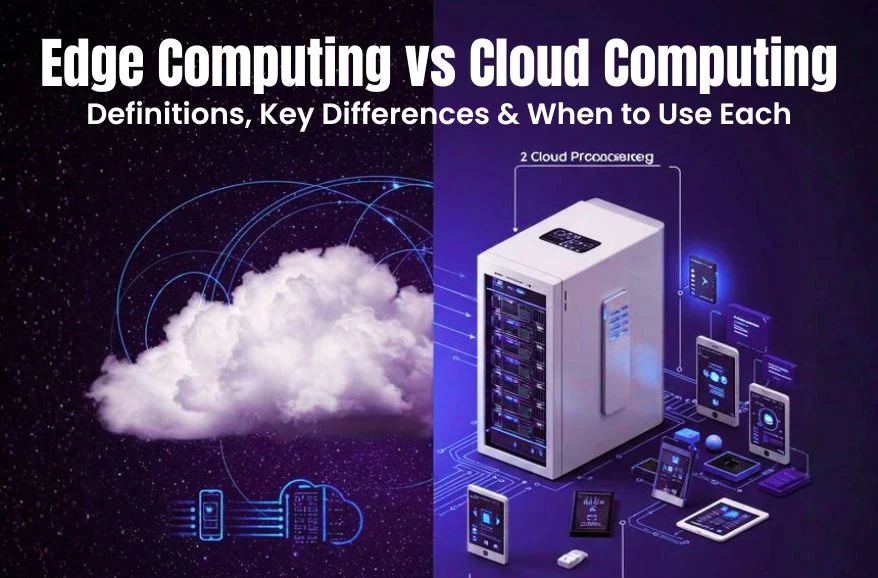
In the current digital and hectic world, companies are undergoing difficult decisions in data management. The most prominent solutions are edge computing and cloud computing, which have their own advantages. The concepts of edge computing vs cloud computing are used to make a choice based on your needs. This blog simplifies it down to definitions, differences, and practical applications. In any field of IoT, AI, or basic IT, being knowledgeable of the edge computing vs cloud computing dynamics can improve efficiency and reduce costs. We will discuss how these technologies drive the operations in the modern era. Furthermore, which technology is more efficient than the other.
What Is Edge Computing?
Edge Computing Definition in Simple Terms
Edge Computing is a distributed computing architecture that brings computing and data storage nearer to the data source. The data is processed at the network edge, close to the device that created it, rather than in the middle, like in a data center.
How Edge Computing Works in Real-World Systems
The principle of edge computing solutions lies in the fact that the information is processed on the edge (sensors, machines, devices) or directly at the source. Instead of being transferred to a centralized cloud. Moving computing power nearer to the end-user or source of data reduces latency significantly and reduces bandwidth requirements. It offers real-time responsiveness to valuable applications, including autonomous vehicles, industrial automation, and smart city infrastructure.
Key Features of an Edge Computing Platform
- Shorter Latency: Edge computing lowers latency by handling data closer to where it is stored. This means that pages load and responses happen faster, which is important in fields like healthcare and banking that use real-time data.
- Improved Data Security: Edge computing improves data security by locating a central server where data is sent, thus minimizing data security. This eliminates any risk that could occur during transmission of data, like interception and unauthorized access, but it also has the ability to encrypt data during transmission.
- Higher Scalability: Edge computing is scalable since it makes it possible to allocate distributed computing across diverse devices and locations. Organizational applications can be quickly scaled on demand. Also, a node can be added to the network where needed.
- Greater Flexibility of Deployment: Edge computing provides a versatile way to run applications across many devices, including IoT and embedded systems. This flexibility also enables organizations to use the available hardware, which saves them the cost of new infrastructure.
What Is Cloud In Cloud Computing?
Cloud Computing Definition Explained
Cloud Computing refers to a model of information technology delivery in the form of the internet. The users are now able to access and utilize common pools of reconfigurable computing resources, such as servers, storage, databases, OS, and applications. It is done without concern about maintaining the underlying infrastructure.
Types of Cloud Computing Platforms
Cloud services are specified into deployment models (they are hosted) and service models (what services they provide). The main ones are:
- It can be found on public platforms like AWS and Azure.
- Special, internal work is done over private platforms.
- A combination of both is made to use hybrid platforms by combining public and private.
Service types include:
- IaaS is like virtual infrastructure.
- PaaS for application developers.
- SaaS is like ready-to-use applications.
How Cloud Technology Powers Modern Businesses
Cloud technology is essential for modern enterprises, offering scalable, cost-effective infrastructure that facilitates remote work, fosters innovation, and enhances data security. Migrating from physical servers to on-demand digital resources can significantly lower IT expenses. In the process of decision-making, use artificial intelligence, machine learning, and real-time analytics to enhance the process.
Edge Computing vs Cloud Computing: Key Differences
| Parameter | Edge Computing | Cloud Computing |
| Definition | Edge Computing is a distributed computing architecture that brings computing and data storage closer to the source of data. | Cloud Computing is a model for delivering information technology services over the internet. |
| Location of Processing | Processing is done at the edge of the network, near the device that generates the data. | Data Analysis and Processing are done at a central location, such as a data center. |
| Bandwidth Requirements | Low bandwidth is required, as data is processed near the source. | Higher bandwidth is required as compared to edge computing, as data must be transmitted over the network to a central location for processing. |
| Costs | Edge Computing is more expensive, as specialized hardware and software may be required at the edge. | Cloud Computing is less expensive, as users only pay for the resources they actually use. |
| Scalability | Scalability for Edge Computing can be more challenging, as additional computing resources may need to be added at the edge. | Easier, as users can quickly and easily scale up or down their computing resources based on their needs. |
| Use Cases | Applications that require low latency and real-time decision-making, such as IoT devices, autonomous vehicles, and AR/VR systems. | Applications that do not have strict latency requirements, such as web applications, email, and file storage. |
| Data Security | Data security can be improved, as data is processed near the source and is not transmitted over the network. | Data Security is more challenging, as data is transmitted over the network to a central location for processing. |
| Security and compliance | Cloud providers offer built-in security and compliance features | Sensitive data can be kept local, reducing exposure and aiding data sovereignty |
| Latency and performance | Higher latency due to network hops to the cloud | Lower latency with faster response times for local processing |
Advantages of Edge Computing
- Decreased Latency: Edge Computing enables faster processing and analysis at the source, reducing the time required to transport data to the cloud and back. This is ideal for real-time decision-making systems such as robotics, industrial automation, and autonomous cars because of the significant latency reduction.
- Better Security: Edge computing may help boost security by processing and analyzing data close to the source, reducing the volume of data that must be transmitted to the cloud. As a result, the system will be more difficult to compromise by hackers as the attack surface and potential vulnerabilities will be reduced.
- Increased Bandwidth Efficiency: Edge computing will minimize the data that will have to be transmitted to the cloud by processing and analyzing data onsite.
Disadvantages of Edge Computing
- Low Processing Power: Compared to cloud computing infrastructure, edge computing devices can have less processing power and storage capacity. This may limit the kind of apps that can be installed on the edge devices.
- Increased Complexity: Edge computing implementations can be more complex than standard cloud computing approaches. The reason is that processing and storage resources must be located close to the source. To execute this, edge computing can become difficult to maintain and manage.
- Higher Costs: Edge computing can be more expensive than cloud computing when it comes to hardware and maintenance expenses. This is because Edge computing involves the deployment of processing and storage functions at various points, which may be expensive to deploy and maintain.

Advantages of Cloud Computing
- Scalability: Cloud computing can easily enable businesses to scale their computing capacity up or down without incurring the high costs of purchasing hardware. This enhances the responsiveness of an organization and enables it to adjust to the changes in business quickly.
- Cost-Effectiveness: Cloud computing may be less costly than conventional methods of computer utilization, particularly to a small or medium-sized organization. This is because with economies of scale, cloud companies can deliver computing power at a reduced cost.
- High Availability: Cloud computing can be used to achieve high availability, and most cloud providers will guarantee uptime of a certain standard. This ensures it is ideal to be used in applications that require high availability, like online shops or banking.
Disadvantages of Cloud Computing
- Security Threats: There can be new security threats in cloud computing, especially when security measures enforced by the cloud provider are moderate. This involves information infiltrations, unauthorized access, and other cyberattacks.
- Dependent Internet connectivity: In cloud computing, you need to be connected to the internet to access the data and computer tools. This could be a problem if the internet connection isn’t stable and fast, because it could mean less work getting done or the end of the service.
- Limited Control: Cloud computing can limit the control rate of companies over their computing resources and data. Since they depend on cloud service providers to service and manage their computer infrastructure, businesses cannot be in full control of personalizing and upgrading their systems.
When to Use Edge Computing vs Cloud Computing
Use Cases Where Edge Computing Is the Better Choice
Real-time decision-making: Edge computing is best applicable in systems with low latency requirements (autonomous vehicles, smart cameras, and industrial automation).
IoT and sensor networks: Edge filters do the data processing near the source, especially in cases of a limited bandwidth or remote location of devices.
Use Cases Where Cloud Computing Works Best
Massive web applications and API: Cloud computing is also well-suited to applications that require scaling with demand, SaaS applications, and marketplaces, or mobile back-ends.
Big data analytics and machine learning: Cloud systems offer storage, commodity calculation, and tools to train models, analyze logs, and work with enormous volumes of data. Global distribution and content delivery: It instantly delivers content with low latency everywhere in the world. They do it with the use of cloud-based CDNs and edge services.
Hybrid Approach: Combining Edge and Cloud Computing
The edge-to-cloud architecture guarantees smooth data movement between the edges, clouds, data centers, and users in a broad range of work-related places and settings. It is an intermediate strategy that enables companies to make use of both paradigms’ strong sides.
Edge Computing vs Cloud Computing for IoT and AI Applications
| Aspect | Edge Computing | Cloud Computing |
| Core Definition | Processes data locally on devices or nearby, minimizing latency for real-time decisions. | Centralized storage and processing of data from remote servers. |
| IoT Integration | Commonly paired with IoT in industrial settings for on-device processing; devices interact directly (e.g., home automation). IoT devices can work standalone without cloud. | Handles IoT data from physical devices with little human input; interconnected but can operate independently. |
| Key Benefits | Reduces latency, bandwidth use; only sends pertinent data (ideal for AI apps needing instant responses). | Scalable storage/processing for large IoT datasets. |
| Examples | – Satellite image analysis on International Space Station (transmits only key data to Earth).- Industrial IoT for real-time decisions. | IoT sensors sending raw data for centralized analysis (no local compute needed). |
| Interoperability | Can function without cloud; computes locally. | Can integrate with edge/IoT but relies on connectivity for data flow. |
Edge Computing Platforms vs Cloud Computing Platforms
Edge computing platforms compute locally around the source (devices/sensors) to achieve ultra-low latency, real-time operations, and less bandwidth.
AWS IoT Greengrass, Microsoft Azure IoT Edge, Akamai Intelligent Edge Platform, FogHorn Systems, and ClearBlade are edge platforms.
Cloud computing systems offer centralized storage, huge amounts of computer power, and the ability to analyze large amounts of data that are not time-sensitive and to store them for a long time.
Amazon Web Services (AWS), Microsoft Azure, Google Cloud Platform (GCP), and IBM Cloud are cloud platforms.
Security Comparison: Edge vs Cloud Computing
Cloud service providers provide security structures of the highest level, with built-in encryption, identity and access management, and firewalls, in compliance with GDPR and HIPAA. You enjoy enterprise-level security without the hassle of having to create the entire deployment.
The edge computing transfers that burden. When data is processed locally on edge devices or servers, security depends on the level of protection provided to those distributed endpoints. It entails the control of all the physical access and updates of firmware, as well as safe interaction between the cloud and the edge.
Which Is More Secure for Your Business Needs?
Edge computing tends to be safer in situations of sensitive and real-time data since the information remains at the edge, limiting the amount of exposure to the dangers of the web.
Cloud computing provides a better and centralized security architecture and professional management of large data sets.
Future of Edge and Cloud Computing
Emerging Technologies
Edge computing supports emerging technologies such as 5G, AI, and AR. As it allows businesses to execute responsive applications by processing the data immediately.
Poaching Cloud Infrastructure
It is a way to augment Cloud Infrastructure that deals with real-time data processing at the edge devices and big-scale computations and storage on the cloud, which reduces the cost and boosts performance.
Scalability and Resilience
Edge computing with cloud design spreads out data processing by making sure that things keep running even if cloud copies aren’t available. Companies can use it well because it makes local networks less quick and allows for scaling for processes that use a lot of resources.
AI at the Edge
Edge implementation of AI is essential to real-time decision-making because it enables algorithms to process data in proximity to the input of real-world data, improving applications such as predictive maintenance by facilitating rapid actions in response to a possible problem.
Key Takeaways: Edge Computing vs Cloud Computing
Edge computing processes data close to the source (sensors/devices) to enable real-time action and reduce latency. Cloud solutions utilize centralized remote data centers that store large amounts of data and provide high-level analytics. The important differences revolve around speed, security, and connectivity.
Conclusion
The decision between edge computing vs cloud computing focuses on your priorities. Edge computing is faster and places greater emphasis on privacy in real-time applications. Whereas the cloud computing can manage massive scale without difficulty. A lot of people choose hybrids, combining them to achieve the best outcomes. With the IoT and AI boom, it is necessary to understand the role of edge computing versus cloud computing in driving innovation. These can develop businesses in Mumbai or even the world over. Consider latency, costs, and security to make a good choice. The future is more in favor of integrated approaches, which would be more efficient than ever before. Take a deep dive into edge computing vs cloud computing today to future-proof your tech stack.
FAQs
Q1. What is the main difference between edge computing and cloud computing?
Location and latency are the primary distinctions between edge computing and cloud computing.
Q2. Which is better: edge computing or cloud computing?
Edge is fast, private, and has poor connectivity. Whereas, cloud is heavy in analysis and large data storage.
Q3. What is edge computing used for?
You can use edge computing for autonomous vehicles, industrial automation (IIoT), healthcare patient monitoring, and cloud gaming. Furthermore, it is also used for smart city traffic management.
Q4. What is cloud computing in simple terms?
When you use cloud computing, you rent computers, servers, and storage space from someone or something else over the internet instead of buying and keeping your own.
Q5. Can edge computing replace cloud computing?
No, edge computing is not able to entirely replace cloud computing.

Leave a Reply