

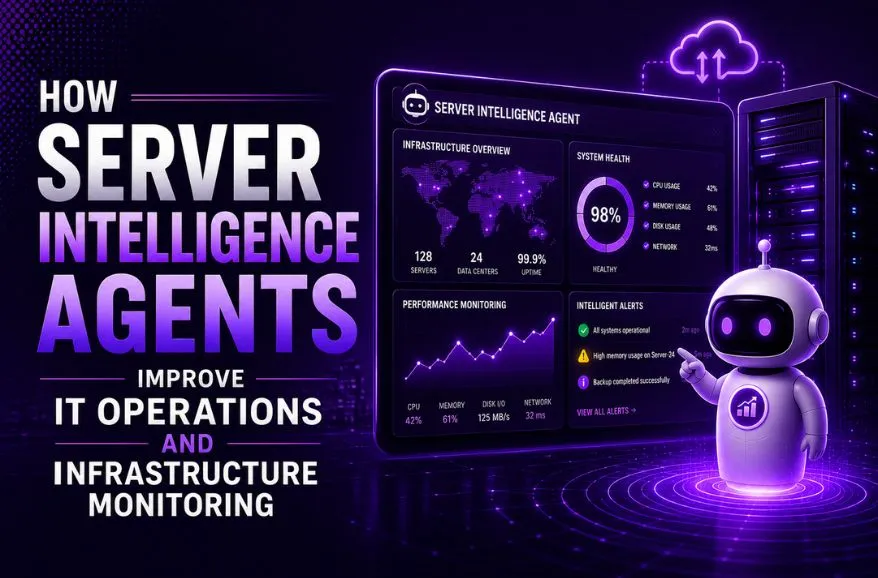
Nowadays, IT departments need to contend with hybrid cloud environments, legacy tech, microservices, and escalating user expectations, on a timeline with fewer IT personnel available. Introducing a server intelligence agent imposes structure, automation, and proactive, holistic insight into this chaotic system. It enables IT teams to abandon firefighting mode and establish data-driven, centralized management of systems. Intelligent observation, AIOps-driven evaluation, and integrated automatic incident response lead to the reduction of unplanned system downtime, improved user experience. It also empowers IT engineers to address more significant initiatives instead.
What Is a Server Intelligence Agent?
A Server Intelligence Agent (SIA) has the role of a site manager for an enterprise software landscape. More often, it is the site manager of an SAP BusinessObjects Business Intelligence (BI) environment.
Defining the Role of a Server Intelligence Agent
Monitoring servers are extremely important for IT. Server environments must be available at all times and perform well. IT organizations require that both of these conditions be in place to guarantee acceptable digital services. This way a software development organization finds errors with in minimal time.
A lack of performance by a servers may, unfortunately create a distrust from the clientele and also the overall reputation and money loss. Through monitoring it fixes any security problems encountered. It can be server time responses, admins identifying the problem, trace several indicators, and resolve corrupt files.
As an advantage, this exposure of the response times gives us sufficient information so we can act in pro active manner, thus helping in avoiding server downtimes.
Evolution From Traditional Monitoring to Intelligent Systems
Manual vs AI monitoring
Human operators make many more mistakes with a lot more manual monitoring. However, the AI monitors using computer vision, AI, and machine learning analyze the real-time feed. It ensure you can increase traffic speeds, decrease downtime, and promote safety.
Reactive vs Predictive IT Operations
The reactionary model prepares teams how to perform in a crisis, usually overnight. The pro-active models improve that cycle, in order to prepare the teams with prior notice to plan for the day. Predictive IT operations build upon step two predicting ahead, by predicting what to expect.
Core Functions in Modern IT Environments
The four pillars of the IT environment include hardware, software, networks, and data.
- Hardware includes things like servers which store data; storage devices which hold data; and individual’s end-user devices like their phones.
- Software consists of the operating systems which run hardware; applications for the operating systems; and middleware which connect things together.
- Networks, of course, are the systems that help things talk to each other. They involve everything from Ethernet to WI-FI and can also include virtual networks like cloud environments or software-defined networking.
- Data is what businesses run on. It can be an incalculable part of a company’s value. But only if it’s stored, processed, and protected correctly with compliance and regulations like HIPAA and GDPR.
All four work together to create a seamless functioning IT environment.
Why Businesses Are Adopting Intelligent Monitoring Solutions
Enterprises have implemented smart monitoring, so they will not be involved in an endless cycle of firefighting. Real-time data monitoring utilizing artificial intelligence and the Internet of Things to reduce downtime, boost performance and protect digital assets. Smart monitoring is replacing traditional dashboards where the system triggers real-time notifications based on specific parameters.
How Server Intelligence Agents Work
1. Data Collection Methods
- Agent-Based Monitoring: Install an agent on the server to retrieve in-depth performance statistics & system information. Complete visibility, but requires monitoring of both systems.
- Agent Less Monitoring: It collects information from the remote end using only network protocols (e.g., SNMP, WMI, SSH). It requires no local system agent, but doesn’t necessarily gather as much detail as agents.
- Hybrid Solutions: It combines the use of agents & agentless, where agents do the deep monitoring and agentless perform health checks.
2 Real-time analysis and alerting
Fine-grained contemporary systems can analyze on a per-request basis and send out alerts for server anomaly detection in a number of ways, including with Machine learning to improve accuracy.
The Need for Intelligent Server Management in Modern Infrastructure
Growing Complexity of Hybrid and Cloud Environments
Containers, multiple cloud platforms, edge locations and on-premises data centers constitute the modern environments. This complexity makes conventional monitoring, troubleshooting and capacity planning solutions less effective.
Challenges of Manual Monitoring
Manual processing, static thresholds and siloed monitoring cannot keep up with the volume, velocity or variability of modern infrastructure signals.
Managing Performance at Scale
Nowadays most companies are leveraging a combination of AWS, Azure, and GCP environments, and on-prem. IT teams ensures consistent performance and user experience must implement only with unified, intelligent monitoring can that happen.
Reducing Human Error Through Automation
To ensure resilience, organizations increasingly turn to automated systems, AI-driven decision-making and eventually self-governing systems with minimal human intervention and operational risk.
AI Infrastructure Monitoring – The Next Evolution of IT Operations
What Makes AI-Powered Monitoring Different?
Transform your operations from reactive, rule-based monitoring to intelligence that predicts problems. Where legacy monitoring tools set fixed thresholds to trigger alerts, AI systems analyze your system’s behavior pattern over time. By doing so, it can flag complex anomalies, forecast system failures and resolve them without a negative impact on users.
Identifying Anomalies Before They Become Problems
AI reduces false alarms and delivers effective detection by analyzing your behavior rather than fixed thresholds.
This is key when managing large and distributed systems where one failed node can cascade into total system failure. Organizations equipped with AI can then fix issues before the alarm rings – thereby lowering severity, mitigating risks and preventing the end-user experience from degradation.
Continuous Learning and Adaptive Monitoring
AI-based systems continue to evolve mean continuous learning no longer is “a nice to have,” it has become an absolute operational necessity.
Enhancing Visibility Across Distributed Systems
The telemetry is generated from distributed systems makes your job harder. By adding a server intelligence agent to the server, you can analyze all this data, correlate with signals, across entire stack and end to end system.
Server Monitoring Tools vs Server Intelligence Agents
| Aspect | Server Traditional Monitoring Tools | Server Intelligent Agents |
| Functionality | Passive data collection and alerting | Active system management and optimization |
| Intelligence | Rule-based static thresholds | Machine learning and adaptive algorithms |
| Scalability | Requires manual configuration for growth | Self-adjusting to environmental changes |
| Insights | Surface-level metrics and logs | Deep contextual understanding with predictions |
Which Approach Delivers Better Operational Efficiency?
Server monitoring provides you with better operational efficiency over the basic tracking and system health. You can achieve centralized, cheap, and safe visibility of the underlying infrastructure. It will also have a great effect to automate remediation before anything bad happens in dynamic and complex cloud environments.
Key Components of a Server Intelligence Agent
- The Profile determines who the agent is, what its job is and why it exists. So the agent understands whether it’s a support agent, sales assistant, or operations assistant. It also dictates tone and task applicability.
- Knowledge gives the agent access to our internal documentation, databases, APIs, and other references so it’s able to answer questions in context.
- Toolset allow the agent to perform tasks by connecting it to external systems like email, workflow systems, records and reports so the agent can do more than answer.
- Behavior is an instruction to govern the agent’s action from explicit instructions and fallback conditions to decision trees, escalations, message style, and keep agents consistent and secure.
- Channels let us put The Agent to where our users are (i.e.,web chat, Slack, Teams).
Automated Infrastructure Monitoring and Incident Management
1. Increase in Efficiency & Productivity: The implementation of incident management systems automates every incident process from detection and recording to prioritizing and escalating tasks, which saves both employees’ time and resources. Incident management systems facilitate appropriate assignment to the relevant department as per predefined criteria. It reduces response time for resolution and minimizing the occurrence of workplace issues and failures.
2. Work More Effectively on Complex Projects: The automated incident management ensures employees’ optimum utilization by saving them from doing and repeated work. Teams can pay their full attention to more innovative and advanced initiatives and can make an ideal long-term plan by solving some major issues and also come up with some critical long-term solutions.
3. Optimal ticket tracking: Automation of incident management workflows prevents requests/issues slipping through the cracks, and allows tasks to complete more efficiently. It quickly monitors and responds to cases while routing based on priority and route and ensures faster execution.
4. Priceless Analytics and Reporting: Process automatically comes with detailed analysis reports to monitor history of cases and time consumed in resolution. These insights provide superisors with the ability to understand issues for better management of their resources and bottleneck analysis.
5. Competetive advantage: Due to instant automated responses from the IT teams, your business suffers fewer interruptions and increases customer experience and retention. This transforms you into an agile organization, which is capable of outperforming its competitors.
6. Lessens the occurrence of human errors: Automating incident logging, prioritizing and routing helps to cut back the potential for human mistake that are often encountered when handling incidents manually and helps in improving the efficiency of IT teams.
Predictive Server Analytics for Proactive Operations
Understanding Predictive Monitoring
Using machine learning and artificial intelligence, advanced data-driven solutions will predict failure before it even occurs. It can continuously examine real-time performance data, and learn to look for subtle deviations in behaviour. Therefore, you and your teams can fix potential problems before there are outages.
Forecasting Capacity and Resource Usage
Historical telemetry and machine learning can provide predictive server analytics to forecast usage of infrastructure, replacing guesswork with intelligent prediction, so IT organizations can scale capacity, reduce cloud expenses, and reduce unplanned downtime. Replacing reactive monitoring with proactive infrastructure monitoring The move from reactive to proactive with predictive server analytics
Preventing Failures Before They Occur
Predictive server analytics allows an organization to move from reactive troubleshooting to proactive infrastructure management. It applies machine learning to real-time telemetry and historical logs to forecast the behaviour of the hardware infrastructure in the near term. It enables proactive capacity and self-healing before critical systems and services fail.
Business Benefits of Predictive Insights
Machine learning and past telemetry data let organizations of any size or type perform predictive server analytics and anticipate behaviour so teams can stop reactive firefighting and focus on proactive business operations, saving costs, optimizing utilization and avoiding outages.
Role of Server Intelligence Agents in AIOps Platforms
What Is an AIOps Platform?
An abbreviation of AIOps is artificial intelligence application for IT operations. AI is used in this technology to automate operations such as performance monitoring and backup tasks to make those operations smarter.
How Intelligence Agents Support AIOps
AIOps applies artificial machine learning and natural language processing, and that will make operation better. In that way the AIOps are going to collect information from multiple locations in real-time. The AIOps are going to be intelligent with your information and servers to make IT operation better with these two components.
Event Correlation and Noise Reduction
An agent within the AIOps platform is referred to as a server intelligence agent. SIA operates as a highly available, self-contained specialized agent that collects information from sources. Here the AI and machine learning also occurs, enriches, deduces, and parses that information. Then it delivers higher fidelity signals to the platform, increasing the context that’s provided to the AI model.
Enhancing IT Decision-Making With AI
Without high quality signal to provide to AIOps, event correlation and noise suppression will simply not happen. Making them critically necessary to provide that to the AIOps tool. The server intelligence agent helps provide that through local correlation and deduplication which frees up the central platform to focus on the high value incident pattern that exists, as opposed to individual disparate events.
IT Operations Automation Using Server Intelligence Agents
- Automated & Intelligent: Observability tools such as Datadog, Splunk or New Relic are easy to integrate with an agent in order to gather metrics, traces and logs.
- Reducing Noise: Instead of bombarding you with too many alerts, the agent collates associated alerts and uses contextual intelligence to reduce alert fatigue and silence false positives.
- Automated Root Cause Analysis: With an automatic ability to run backlogs for a system, the agent identifies and determines the direct failure.
- Autonomous Remediation: The agent can automatically initiate playbooks and run simple commands without the need for you.
- Auto-Rollback: If the action performed by the agent doesn’t restore service levels, the agent can reverse this automatically so as not to exacerbate any failures.
Benefits of Implementing Server Intelligence Agents
Efficiency and Productivity
Agents improve work output and efficiency by dividing work. Many jobs get done concurrently; many of these tasks will need automated repetitive effort. This allows humans the space to focus on more creative work.
Better decision making
Many agents working together get more decision power from arguing, deliberating and learning. The agents have the flexibility to adapt their strategy. A good test is to monitor decision-making logic and give the agent feedback on their reasoning.
Higher Capabilities
Solving problems, communicating, working with tools, and learning to improve capabilities.
Social Interaction and Simulation
The agents perform activities and actions according to a simulation of human society’s behaviors. It causes emergent behaviors of a couple of agents. Hence, a better human social relationship is emerging.
Common Use Cases Across Industries
- Finance Fraud Detection: Businesses prevent suspicious finance transactions in real-time, halt them and reach out to users proactively.
- Optimization of the supply chain: The business is dealing with the bin packing problem in real time as information flows so as to receive demand information.
- Healthcare: Patient monitoring involves actively or continuously tracking medical records (doctors’ notes, history, intake form, charts) for patient issues instead of allowing them to be recognized by humans.
- Agriculture automation: A farmer has a sensor set on a farm to automatically turn irrigation on and off based on the state of the soil, and/or automatically apply nitrogen to the soil based on the state of the soil.
- Personal shopping experience: The assistant correlates social media and wardrobe information and searches the web for suggestions or retail offers.
Challenges and Limitations of Server Intelligence Agents
Alert fatigue
IT staff are getting bombarded by too many alerts; important alerts fall through the cracks, lost among others. Fight alert fatigue with alert caps; set intelligent limits and use a smart grouping mechanism of alerts. Filter and react only to actionable alerts and not information spam.
Too many tools/sprawl
The company has a bunch of monitors and logging tools that don’t quite speak together well enough to make anything but the blindest spots the standard. Invest in unified platforms that provide complete visibility into all of your infrastructure.
Clouds and hybrids Complexity
Today, enterprises are running on-premises datacentres, public cloud, and private cloud. Also, there is a hybrid solution, where both public and private networks co-exist. Your monitoring strategy should accommodate each type of deployment equally, so it is irrelevant where your servers are based.
Balancing Automation With Human Oversight
A server intelligence agent cannot do anything without authorization and the organization needs to set policies as to when the AI can do what and when people need to approve actions.
Best Practices for Deploying Server Intelligence Agents
- Modular prompt design: an update to prompts and/or models can be made without impacting the other. When a certain team’s performance suffers, teams can rapidly flip back changes, and they can also track the changes effectively.
- Static/passive Caching Strategies: Four aspects should be taken into consideration to accelerate processes and save money: semantic caching, retrieval caching and regular web caching. Cache data and invalidate/replace if it changes to avoid re-applying changes across repeated API calls.
- API Resilience: Implement retry policies, circuit breakers, rate limiting, graceful degradation, etc., to make the API more resilient so that it doesn’t break the core functionality.
- AI Guardrails: Set benchmarks to ensure that the functionality of the AI product will be restricted to facts to eliminate false information and will have verification tools that will maintain high quality in the answers.
- Reduce Token Costs: Keep track of tokens consumed, batch operations and move to better vector databases without sacrificing accuracy or speed.
Future Trends in Intelligent Infrastructure Monitoring
The advancement of AI-Enhanced IT Operations
Log management, alerts and service restarts have now been automated. Human system administrators are no longer needed. Humans can’t beat it at running all the time to maintain logs, alerts, and restarts. Intelligent IT makes it possible to save money while operating. It also relieves IT experts from being tied up with mundane work. About 70% of common incident resolution cases are automatically solved by AIOps, and human intervention is needed for critical decisions.
Predictive analytics
Predictive analytics can serve as a tool that helps AI proactively identify issues and ensure maintenance efforts beforehand to prevent unnecessary outages. Autonomous server management can also detect problems in advance, IBM says that can save companies millions of dollars.
Evolution of Self-Healing Systems
During peak times, AI enhances service availability, reduces mean time to recovery (MTTR), and offers self-healing capabilities, ensuring the system remains reliable.
Server Intelligence Agents and Cybersecurity Monitoring
- Agents monitor the system’s activity from the ground floor in real time. Instead of spot-checking, these agents can issue an alert as soon as an anomaly appears – for instance, a new, unrecognized login, a spike in data movement or unauthorized access.
- For agents, there are two varieties: server agent installed locally, for total visibility, and agentless systems. It make use of network-based communication protocols like SSH or WMI, which are better suited for health checks and offer lower overhead. Plenty of IT shops combine both.
- State-of-the-art server agents work similarly to EDR systems that give you the closest to “all eyes on the entire server”, monitoring everything like process injection, privilege escalation and origin points of ransoms.
Conclusion
A server intelligence agent transforms IT operations, integrating profound infrastructure insight with an AIOps approach and automation-enabled system management. The service changes the operational intelligence and predicts deviations, orchestrating responses, and taking preemptive steps. Deployment and integration take commitment but yield the payoff-superior uptime and system availability. It enhances resource utilization and strengthened data integrity. Lastly, it is a savvy choice for companies operating on sophisticated digital infrastructure. AIOps and the push for autonomic systems mean the server intelligence agent will transition from a supplementary tool to an intrinsic element in the framework for autonomic self-optimizing IT organizations.
FAQs
Q1. What is a server intelligence agent?
A background service and component provides the health management of a distributed server infrastructure monitoring capabilities.
Q2. How does a server intelligence agent work?
The Background service is a server intelligence agent that can manage, monitor, and automate infrastructure that consist of multiple servers.
Q3. What is the difference between server monitoring tools and server intelligence agents?
Server monitoring tools monitor the health of machines – measuring and alerting based on static triggers like the CPU, memory and disk resources on the monitored servers. But Server Intelligence Agents take telemetry from the same server resources. It uses AI and machine learning to proactively predict potential issues, prevent failures, and automate much of the work that goes into fixing the problem.
Q4. How does AI infrastructure monitoring improve IT operations?
IT teams move from an emergency-response ‘firefighting’ mode to a ‘pre-prevention’ mode with AI infrastructure monitoring (AIOps), because the tools examine all your raw machine telemetry data 24/7.
Q5. Can server intelligence agents automate incident management?
Yes, AI agents can assist in reducing incidents by largely automating incident resolution and decreasing the burden for humans and resolve incidents much faster.
Q6. How do server intelligence agents support AIOps platforms?
The intelligence delivered by server intelligence agents works closely with the AIOps platform, collecting data on them.

Leave a Reply