


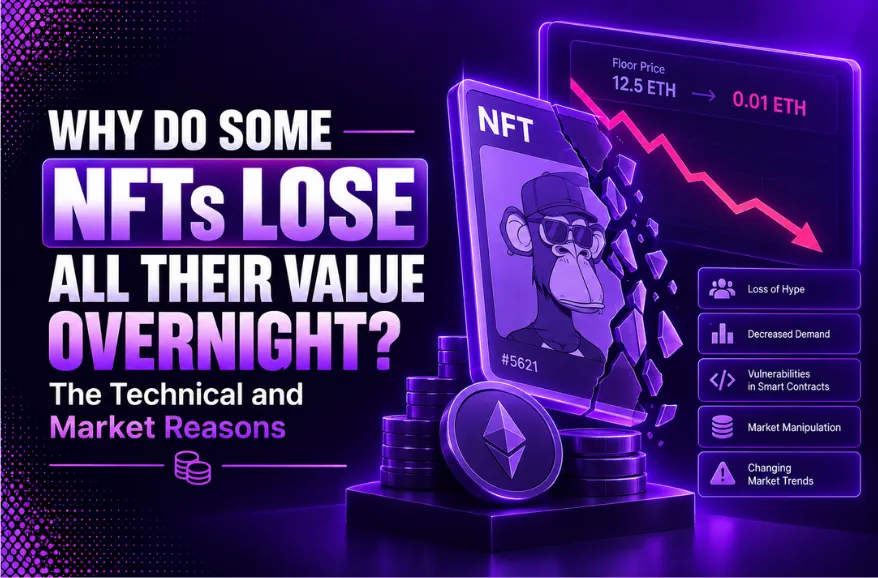
NFTs are a hot topic on the internet— an NFT can be anything from a piece of art, to profile pictures, to music, to a game item, to virtual land, you name it. During the 2021-22 craze, a handful of collections sold for millions, giving the impression that all NFTs can turn into a lucrative wager. But, if an NFT is essentially a note on a blockchain connected to the real world, it’s many times more valuable. It is dependent on demand, community support, usage, liquidity, the project’s cryptocurrency price, and trust. When combined, these can invalidate all of them, and soon an NFT will be worthless in a matter of seconds. A lot of customers will find themselves being unable to sell their token even at a lower price if they have bought the token at a high price. This considers that not all NFTs lose all their value. It means that NFTs are very volatile digital assets, meaning purchasing one requires an understanding of its technical structure and market behaviour. The data reveals that the prices fluctuate very quickly in NFT markets, depending on the market and investor sentiment.
Why NFT Values Can Rise Rapidly—and Fall Even Faster
Whether there is celebrity/social media influencer attention, a celebrity endorsement, or a feeling of scarcity, NFT prices tend to grow. The buyer is in a hurry to buy since he believes that the price on the floor will rise; the seller is holding his belongings for better returns.
The reverse of this speed works too. As excitement subsides, sellers make an attempt to sell immediately, but buyers vanish. Since each NFT comes with its specific characteristics, sellers can’t easily liquidate their token at the market price like one of the widely traded cryptocurrencies. This is an important factor of an NFTs down days.
A given collection can be worth a fortune one day and worth nothing the next. Sometimes the problem is not just the art, but a breakdown of demand, confidence and liquidity.
Why Do NFTs Lose Value?
Supply and Demand Drive NFT Prices
The arrival of this boom came with an avalanche of NFTs that created oversaturation. As there were more tokens in circulation than there were willing buyers, the prices grew less by the sheerrarity and longer term demand and more by speculation.
Lack of Real Utility
Many of the available NFTs didn’t have much to offer outside of owning digital art, music, or collectibles. The need for tangible benefits like access, rewards, or redeemable digital assets was growing. Thus investors’ interest was increasingly gaining in real world ones. However, most projects failed to provide them with.
Declining Community Interest
Trust was eroded by falling prices and scams, fake marketplaces, as well as rug pulls, in which many community members fell victim. NFTs were also closely linked with the hyper-volatile cryptocurrency marketplace, making it less attractive for the customers and lowering the confidence of the populace.
The Biggest Reasons Why NFT Prices Crash

Understanding NFT Market Volatility
Why NFT Prices Change So Quickly
NFT markets are viewed as relatively less liquid, as there are few numbers of trades that dictate prices to a great extent. This makes prices very responsive to whatever fads or hype there is, to speculation by the public and to sudden surges in purchasing interest.
The Role of Investor Sentiment
Investors’ psychology can lead to herd behaviour, as seen when people in the media and social media rush into and out of NFT buying and selling cycles, respectively. For instance, Jiang and Xia’s research reveals that investor attention can be a significant factor in sparking NFT volatility.
External Economic Factors Affecting NFTs
They may be driven by macroeconomic factors such as:
- Currency prices
- Inflation
- Geopolitical uncertainties
- Market security issues
However, a weaker, less sustainable relationship between NFT prices and the traditional economic fundamentals and norms is also observed.
NFT Market Trends Since the Boom
The Rise of Profile Picture (PFP) Collections
These PFP collections became the entry point to Web3 for culture, defining digital identity, social status and community access. In 2026, collectibles, including PFP projects, will make up 45% of the total market for NFTs. This happened as brand loyalists and community participants will want to be part of them to appreciate the exclusivity and signal to their peers.
Shift Toward Utility-Based NFTs
NFTs offer many advantages, including access to events, gaming items, rewards, authentication, and merch, that attract buyers more than ever before. Brands and businesses are also using NFTs as certificates of ownership in luxury goods, sneakers, trading cards, fashion, and real estate, among others, which drives the growth of “phygital” commerce.
Enterprise and Brand Adoption of NFTs
NFT market share in 2026 The role of NFTs for brand loyalty, branded collectibles, and enhanced customer engagement. Companies like Nike and Starbucks are now using blockchain digital assets to deepen customer engagement and open new revenue streams.
Technical Factors That Affect NFT Value
Blockchain Choice and Network Costs
An NFT is hosted on a blockchain, which influences its accessibility, security and the cost of a transaction. NFTs that are issued on popular networks like Ethereum tend to have greater exposure. Furthermore, it has less expensive chains are used to mint and trade easier. High gas fee, however, may limit; buyer interest and trading activity.
Smart Contract Quality and Security
NFTs are secured with smart contracts, and thus a well-written and safe contract is crucial to demonstrate ownership and avoid exploits. Our weak contracts can put collectors at risk of scams, untrustworthiness, unsuccessful transfers, or loss of access. Thereby, NFTs lose all their value.
Marketplace Visibility and Trading Volume
An NFT sold on official platforms attracts a larger number of collectors and the presence of bidding. Increased volume of trade is an indication of demand, enhanced liquidity and might enable greater resale value.
Royalties and Creator Incentives
Royalty systems enable creators to make royalties on secondary sales, which prompts them to continue to promote and build community. Creation-intensive involvement can maintain demand. Whereas dubious or too high royalties can put traders off.
Digital Collectible Value: What Actually Creates Long-Term Demand?
NFT Investment Risks Every Buyer Should Understand
| Risks | Description |
| Liquidity Risk | Selling an NFT quickly can be difficult because buyers must find someone willing to pay the asking price for that specific asset. Limited demand can make it challenging for investors to sell their NFTs at a fair price, particularly when market value declines. |
| Market Manipulation and Wash Trading | Anyone can mint an NFT, including by using content they do not own, creating risks of fraud and misleading listings. Wash trading involves repeatedly buying and selling assets to create the false impression of high demand or inflated prices, potentially misleading new investors. |
| Security Risks and Wallet Theft | Blockchain transactions are generally irreversible, making NFT theft difficult to recover from. Hackers may gain access to a buyer’s digital wallet or computer and steal their NFTs. Secure wallets, strong authentication, and careful handling of private keys are essential to reduce these risks. |
| Regulatory Uncertainty | Owning an NFT does not necessarily mean owning the copyright or full intellectual property rights to the underlying image, video, or audio. If a hosting platform shuts down, the associated content may become inaccessible. Evolving regulations and unclear ownership rights can also create uncertainty for investors. |
Are NFTs Still Worth Buying Today?
Although NFTs aren’t as desirable to buy, they are still worth purchasing when they’re strategically selected, not purchased for quick gains. The 2021 excitement has come to a close and the demand has encompassed the utility, the community, the game, the membership and the real world.
Evaluating Utility Before Investing
Evaluate the usefulness of an NFT before purchase; look for real-world benefits like event tickets, payouts, plays, claims, governance or genuine ownership to prove it. Well-established projects which are typically based solely on artwork or hype from social media, are often less reliable.
Long-Term Projects vs Short-Term Hype
Short-term hype projects can come and go and have short lives, and long-term projects may begin with few hype cycles, but then they tend to improve over time and have proven teams with cultural relevance. This was a market correction that proved that if you are collecting something that is not of such great quality, and if you don’t have a pump & dump scheme, you can have big losses.
Questions Every Investor Should Ask
The questions every investor should ask are:
| Key Question | What to Evaluate |
| Does the NFT address a genuine need? | Determine whether the NFT solves a real problem or offers meaningful value to its target audience. |
| Who is the promoter? | Research the promoter’s background, credibility, experience, and track record. |
| Does the community demonstrate genuine engagement? | Assess whether the community is active and engaged or relies primarily on artificial activity and hype. |
| What are the trading volumes, use cases, and long-term roadmap? | Examine trading volumes, practical applications, future development plans, and the project’s long-term potential. |
Most important, only invest what you are prepared to lose, because NFT trading is still volatile, and there are no guarantees about the investment’s return.
How to Evaluate an NFT Before Buying
Lessons Investors Can Learn from NFT Market Value Decline
The Future of NFTs Beyond Speculation
Gaming and Metaverse Assets
However, in the gaming sector, NFTs can allow players to truly own their characters, weaponry, land and collectibles, which can be monetized on various markets. In addition, dynamic NFTs can progress with the player’s advancement, and metaverse platforms function with the incorporation of tokenized lands for digital transactions and experiences.
Digital Identity and Membership Programs
NFTs have the potential to verify tamper-resistant digital credentials like degrees, licenses, or personal records. Thereby saving time and minimizing fraud. They can also drive membership-based incentives, such as:
- Content
- Event access
- P presale
- Merchandise
- Clear loyalty rewards
Tokenized Real-World Assets
NFTs can represent real estate by connecting it with smart contracts, thereby making transactions of real estate faster and allowing for fractional investing in real estate. Product passports using NFTs can also record the origin of the product and its manufacturing history, as well as the supply chain.
Enterprise and Brand Applications
NFTs can be employed in a variety of ways, such as combating counterfeit products, tracing their origins, creating event tickets, and engaging customers. Businesses can leverage NFTs to become long-term relationship and revenue tools by attaching utility. Lastly, it could be access to the VIP section or verifiable product authenticity.
Conclusion
When the three factors of demand, trust, and liquidity fade in tandem with a corresponding NFTs lose all their value. Even if a token stays on the blockchain, it’s of no monetary value if no one else wants to purchase it. The causes of this risk are speculation, oversupply, decreasing cryptocurrency prices, weak communities, poor smart contracts, and market manipulation. The moral of the story? Don’t consider NFTs a guaranteed investment; they are theoretical digital assets with high risk. Conduct research on the team, look at genuine trading, find out how to use it, and do not invest solely on the hype found on social media. While there may be further applications for NFT technology in the gaming, identity, loyalty and tokenized assets space, there is a future in the useful products and engaged communities, not just overnight price speculation. It is to be noted that when the NFT projects fail to provide any real, lasting demand, the market’s recent drop proves that NFTs lose all their value.
Frequently Asked Questions
Q1. Are NFTs still worth anything in 2026?
The speculative frenzy of NFTs is behind us, but some instances are still out there that are profitable.
Q2. Will NFTs ever go back up?
NFTs are coming back as tangible art in the digital space. However, as to the utillity, gaming, ticketing, and real-world asset tokenization emphasis of functional digital infrastructure.
Q3. Do any NFTs still hold value?
The vast majority of non-fungible tokens (NFTs) have seen the vast majority of their monetary value evaporate since 2021’s speculative peak.
Q4. Why do people hate NFTs so much?
NFTs (non-fungible tokens) are not popular because of the scams, art theft, high energy usage and extreme financial speculation they are known for.

Leave a Reply