


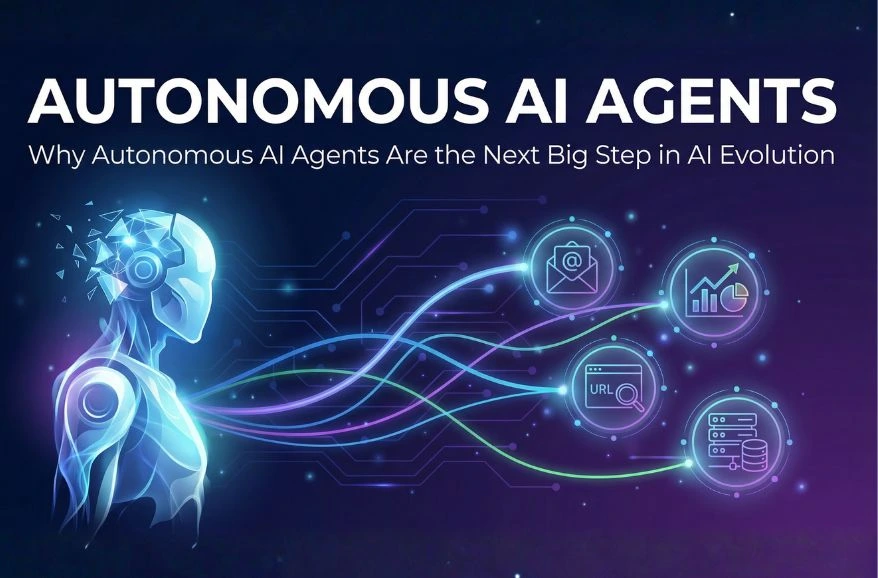
Artificial intelligence (AI) has evolved beyond simple rule-based systems to highly impressive language models that can produce human-like text. Traditional AI is excellent at solving one specific problem, such as answering questions or categorizing data, but it must have a human mind guiding it on every step. This balance is altered by autonomous AI agents who do not need constant supervision, sense environments, come up with decisions, and take actions to achieve the predetermined goals. This type of change lets us deal with problems directly and turn AI into a useful employee. Enterprises are using autonomous agents in AI for customer service, including optimization of a supply chain, and are gaining efficiency benefits unattainable in other models.
What is an autonomous AI agent?
“Agentic AI” is the name for the new class of self-governing AI systems that gather data, reason through goals, and take steps on their own without always needing to be told what to do by a person.
How Autonomous AI Systems Work
Autonomous AI systems rely on integrated components that mimic human cognition, enabling seamless operation in dynamic settings.
The process of agentic AI is based on a process of constant thinking that resembles human thinking. The process of perception, reasoning, action, and reflection is adopted by each agent in the same way. It allows them to learn and become better as time goes by. The way this works in real life is as follows:
- Perception: The AI Agent acquires context in the form of project requirements or history of past commits or bug reports in the systems it is connected with.
- Reasoning: It uses its internal logic, memory, and big language models to process this information and provide suggestions about the most appropriate next actions.
- Action: The agent does the work needed by it, such as the creation of code, testing modules, or deployments using the tools or APIs.
- Reflection: It assesses the result, works out what succeeded or did not succeed, and bases future decisions on it.
Types of Autonomous AI Agents
1. Simple Reflex Agents: This is a simple AI that responds to sensory input by simple condition-action rules. These components are:
- Sensors
- Condition-action rules
- Actuators.
- Industrial safety sensors
- Automated sprinklers
- Email auto-responders
2. Model-Based Reflex Agents: More complex agents that operate an internal world model to extrapolate observed states. These are the state tracker, world model, and reasoning component. Applications:
- Home security
- Process controls
- Home network
- Autonomous vehicles
3. Goal-Based Agents: Agents that plan their actions to accomplish certain goals with the help of search algorithms and planning algorithms. Elements among these are goal state, planning mechanism, state evaluation, and action selection. Applications:
- Smart heating system
- Inventory management system
- Project management system
- Robotic warehouse system
4. Learning Agents: AI enhances behavior by means of interaction and feedback. These are performance elements, a critic, a learning element, and a problem generator. Applications
- Factory automation
- Power management
- Quality assurance
- Chatbots
- Customer support
5. Utility-Based Agents: Agents where results are assessed to maximise the total utility. It includes a utility function, a state evaluation component, a decision-making mechanism, and an environmental model. Applications:
- Assignment of resources
- Scheduling
- Stock trading
- Robotics
- Intelligent building management
6. Agent Hierarchy: Agents are organized into a hierarchical system that deals with complicated tasks by breaking them down. Its constituents are task breaking, command organisational levels, coordination and goal delegation. The applications of autonomous AI robots are:
- Going to a factory
- Construct a building
- Build an intelligent factory
7. Multi-Agent Systems (MAS): Multi-agent systems consist of numerous autonomous agents that interact to accomplish objectives. There are cooperative, competitive, and mixed systems. There are components of resource management, coordination mechanisms, communication protocols, and rules. Applications:
- Warehouse management
- Simple manufacturing
- Resource management
- Artificial intelligence research
- Traffic management
Business Use Cases That Prove AI Autonomy Works
Finance
In July 2025, Ramp, a fintech company, launched an AI finance agent in its spend management platform, which automatically audits employee expenses by reading company policies. This innovation was widely used by businesses, saving time on manual audits and boosting compliance, helping Ramp raise half a billion dollars in funding. The efficiency of AI is also demonstrated by other financial companies, such as JPMorgan, using the technology to perform tasks like contract review and risk analysis.
Healthcare
AI agents are transforming the nature of diagnostics and administration in healthcare. They can process medical images faster than top radiologists, handle scheduling, billing, and insurance, saving the U.S. healthcare system up to 150 billion a year. Both these agents comply with privacy laws such as the HIPAA.
Logistics and retail
Walmart uses AI in logistics and retail to improve inventory management. It processes real-time data to predict demand and restock automatically. It has led to increased online sales and reduced inventory costs. AI is enhancing customer service by handling common questions and helping sales teams qualify leads, allowing human employees to focus on more complex tasks.
Key Technologies That Enable Autonomous AI
- Machine learning is like the brain for automated processes. Frameworks like TensorFlow and PyTorch are used to predict growth, find anomalies, and do self-healing operations. They also let the system make decisions in real time.
- The nervous system consists of containers and Kubernetes, which simplify microservices architecture and enable updates without downtime; additionally, Kubernetes is credited with a 40% cost reduction in cloud services for the U.S. Air Force.
- Apache Kafka and AWS Kinesis are both real-time data engines that can work like sensory organs, making it possible to respond very quickly, even blocking a DDoS attack within 0.2 seconds.
- Serverless systems such as AWS Lambda are becoming AI orchestrators, with 61% of companies using them to run AI models.
Benefits of Autonomous AI for Enterprises
- Quick Development Times: It allows developers to concentrate on strategy and innovation due to the decrease in time to deployment by a large factor, since the planning-to-deployment period is resolved by autonomous AI Agents. Code generation and bug fixes are automated operations.
- Accelerated Releases: The best autonomous AI agents are capable of automating the writing of test cases and examination of pull requests, which significantly decreases the requirements of manual labor by up to 60%, causing the go-to-market period to be more rapid.
- Smarter Decision-Making: AI autonomous agents systems study and learn in real-time, make data-driven decisions, and allocate resources in large-scale projects.
- Independent Quality Assurance: Artificial Intelligence Agents are responsible for continuous self-driven QA inspections. It improves the quality of the code and identifies anomalies or anticipates bugs. Thus, QA is proactive and not reactive.
- Scalable Collaboration: AI can coordinate tasks with dependencies among teams and synchronize updates, improving remote development efficiency.
- Predictive Maintenance: AI is used to ensure improvements in the performance of applications after deployment, where it monitors performance, the operation of the applications, and recommends improvements to the applications and bottlenecks.
- Cost Control: The level of automation helps to minimize operational costs, and smaller teams can accomplish more and invest more in innovations, which will lead to a higher ROI.
- Improved Security: AI will be integrated within the working process, where every vulnerability will be identified, and adherence to information protection principles will be ensured.
- Sustainable Innovation: Agentic AI automates the backend, meaning that developers are able to concentrate on experimentation and scaling to motivate sustained innovation and flexibility.
Comparison: Traditional AI Assistants vs Autonomous AI Agents
| Feature | AI Assistants | AI Agents |
| Autonomy | Operate only on user commands. They require direct input for every task. | Operate independently. They understand goals and execute tasks without repeated instructions. |
| Task Execution | Handle basic, isolated tasks such as reminders, queries, or scheduling. | Execute complex, multi-step tasks, like automating workflows or debugging software. |
| Interaction Model | Reactive in nature. Responds only when prompted. | Proactive. Initiate tasks, flag anomalies, and take corrective actions. |
| Learning Capability | Pre-trained or fine-tuned for limited use cases. Minimal adaptation over time. | Continuously learn and adapt based on new data, outcomes, and feedback. |
| Memory Retention | Short-term or session-based memory. | Long-term memory enables contextual understanding across interactions. |
| Decision-Making | Relies on basic rules or pre-set flows. | Capable of dynamic reasoning and making decisions based on data, logic, or priority. |
| Complexity Handling | Best for straightforward, routine interactions. | Handles ambiguity, multi-system processes, and interdependent workflows. |
| User Interfaces | Interact via voice or chat interfaces (e.g., smartphones, smart speakers). | Function across systems, often without a UI—integrated into backends, APIs, and tools. |
| External Integration | Limited to select integrations (e.g., calendars, smart devices). | Connect with APIs, databases, CRMs, ERPs, and third-party apps to act across ecosystems. |
Challenges with Autonomous AI Adoption
| AI Adoption Challenge | Why It’s a Challenge | How to Overcome It |
| 1. Data Quality and Bias | Poor-quality or biased data leads to unreliable AI outputs and erodes trust. | Establish AI governance, improve data pipelines, add human oversight. |
| 2. Insufficient Proprietary Data | Data is fragmented, siloed, or insufficient to train effective AI models. | Centralize data lakes, use augmentation, build synthetic data pipelines. |
| 3. AI Talent Shortage | Lack of in-house expertise to design, deploy, and maintain AI systems. | Upskill teams, leverage low-code tools, and partner with AI vendors. |
| 4. Unclear ROI and Business Case | Hard to prove financial value, making it difficult to get stakeholder buy-in. | Align AI with KPIs, track metrics, start with quick wins, and model ROI. |
| 5. Privacy, Security, and Compliance | AI systems raise risks around sensitive data and regulatory compliance. | Embed privacy early, apply encryption, use compliant AI platforms. |
| 6. Integration with Legacy Systems | Existing systems are outdated or incompatible with AI workflows. | Use platforms with connectors, invest in integration infrastructure. |
| 7. Organizational Resistance | Employees fear change, don’t adopt tools, or resist new AI-driven processes. | Communicate vision, invest in training, and redesign roles with input. |
Leading Tools & Companies Behind Autonomous AI Agents
- Google (Alphabet): The strategy of Google is based on a full-stack AI agent. It is based on Gemini models and Vertex AI Agent Builder in the development of the enterprise, as well as Realflow in the development of conversations.
- Microsoft: Microsoft features productivity agents, such as Copilot. It also provides the open source framework of AutoGen to create bespoke multi-agent systems in Azure.
- IBM: IBM offers the Watsonx platform. It is an enterprise AI, data, and governance tools suite. Its application is in the construction and deployment of AI agents on top of hybrid environments, particularly in regulated industries.
- OpenAI: OpenAI is a model associated with GPT-4 models and Agent APIs. These enable developers to develop combined AI agents.
- Anthropic: Anthropic is concerned with creating safe and reliable AI. It provides its Claude models and a Constitutional AI structure of agents employed in research and analysis.
How Enterprises Can Implement Autonomous AI Safely
Business AI is now more independent than just a helper, like smart chatbots, as it can handle complex tasks with minimal human input. These AI colleagues can plan, perform, and complete tasks on their own, but they report back after finishing, unlike traditional AI copilots that provide one-time help. This change aims to enhance generative and agentic AI technology, allowing large language models to act for users. AI coworkers can access databases and use reasoning loops to boost efficiency and scalability in business processes, evolving from assistants to reliable digital colleagues.
Future of AI Autonomy: From Assistants to Digital Co-Workers
Enterprise AI is becoming more autonomous than an aid, such as smart chatbots, since autonomous agents can take the complicated, multi-step processes that require little human intervention. Unlike traditional AI copilots, these AI colleagues can plan, perform, and complete tasks autonomously and report back. This change is motivated by the improvement of generative and agentic AI technology to enable large language models to take action on behalf of users. These AI colleagues are capable of accessing databases and applying reasoning loops. It allows AI coworkers to increase efficiency and scalability in business processes. Thereby, transforming them into assistants and becoming reliable digital colleagues.
Conclusion
With Goal-driven action and independent action, the evolution of AI moves autonomous AI agents to greater heights of scaled enterprise activities. Technologies are growing to mature and provide digital co-workers, promising better human capabilities, without this threat being just that. Any business that embraces them with a sustainable mindset will be at the forefront of the change because they encourage innovation without putting sustainable growth at risk.
FAQs
Why are AI agents the next big thing?
The next vulnerability is the ability to be more goal-focused and less automation-driven. AI autonomous systems utilize LLMs to comprehend the context of tasks and plan multi-step actions in systems and act autonomously. It offers:
- Massive efficiency gains
- 24/7 operation
- Enhanced personalization
- Capacity to solve complex issues
They make them transformative partners of business and individuals in such fields as healthcare, finance, and coding.
What is an autonomous agent in artificial intelligence?
Advanced AI systems that can think, reason, plan, and act upon complex goals with limited human intervention, learn and adapt over time, and autonomous AI agents are the next level of AI.
Who are the big 4 AI agents?
The big four refer to the leading developers and autonomous AI companies of the fundamental model and platform in the AI sector: OpenAI, Google, Microsoft, and the Anthropic.
What is the next big thing after AI agents?
Quantum AI, multi-agent ecosystems, Brain-Computer Interfaces (BCIs), and the integration of AI with other sciences, such as biotechnology and robotics, are the next significant ones after autonomous AI agents.

Leave a Reply