


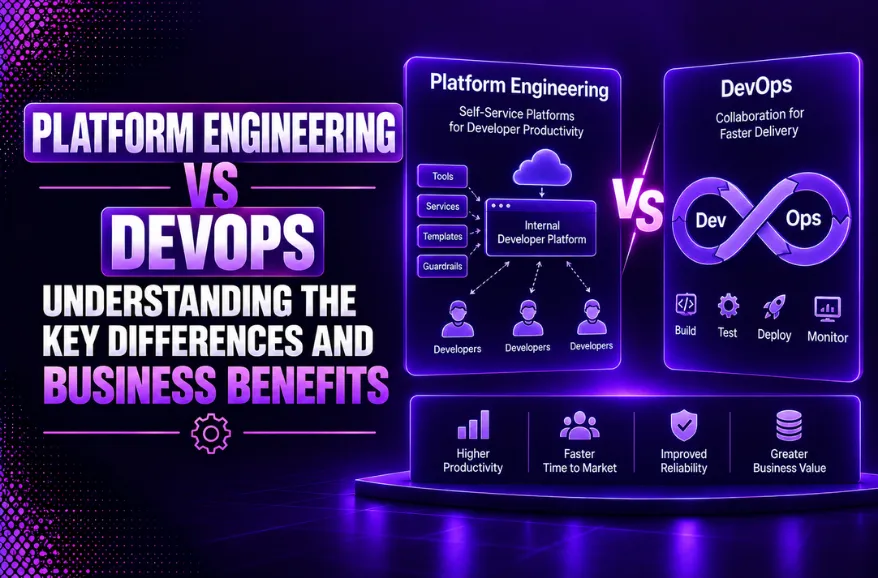
Today’s software development team needs to release reliable software quickly and keep it secure, reliable, and programmers happy. Now, the platform engineering vs DevOps part comes in. DevOps emphasizes teamwork and automation, while shifting the responsibility from development to ops and back again. Platform engineering takes these tenets further by providing internal developer platforms. It allows secure, consistent, and repeatable workflows to be self-service. Knowing the platform engineering vs devops differences can lead an enterprise to pick the right operating model. Thereby lowering the friction in the delivery process and scale up the engineering properly.
Why Platform Engineering Is Reshaping Modern DevOps
Platform engineering is changing the way modern DevOps professionals work, transforming distributed infrastructure operations into cohesive platform designs that are easy to use for the developer. The common bear-and-do trend that is creators spending more time on deployment, access rights, observability and tooling than on product, has become the norm.
Platform teams solve this by developing ‘paved roads’. It supports flows of deployment, monitoring, security, provisioning infrastructure, etc. It provides developers with a set of self-service tools, which have reliability and governance pre-built.
This leads to reduced cognitive load, faster delivery, less configuration mistakes and robust security-by-default behaviors. Platform engineering is not DevOps. It’s simply an evolution of DevOps. Redirects focus from merely automating, to more scalable developer experience and operational consistency.
What Is DevOps?
DevOps can be defined as a culture and practice. It unites software development and IT operations to deliver faster and more reliable software in a more collaborative way. It values automation, continuous integration and delivery with collective accountability on a group basis.
Core Principles of DevOps
DevOps has its basis in cooperation among the developers, testers and operations teams, automation of repetitive tasks, ongoing feedback and quick reaction to incidents. It is also provided on Infrastructure as Code as a way of sustaining the environments.
How DevOps Improves Software Delivery
DevOps practices minimize the manual error rate and slow release process by automating build, test, and deployment pipelines to CI/CD platforms. Constant monitoring also enables teams to detect bottle necks, guarantee availability and quick solutions in production.
Common DevOps Tools and Workflows
Such popular tools of DevOps are Jenkins, Docker, Kubernetes, Terraform, Ansible and GitLab. A standard workflow will take the stored code through the version control, automated testing and CI/CD pipelines to the production stage, followed by monitoring and feedback loops.
What Is Platform Engineering?
Platform engineering is concerned with creating and sustaining the infrastructure, tools, and services of interest to the development teams to construct and deploy applications effectively. It aims at building a developer friendly scalable and reliable platform.
Understanding Internal Developer Platforms
Internal developer platforms offer infrastructure, deployment pipelines, monitoring, and other tools, which are self-service. This enables the developers to write code rather than figure out complicated cloud or infrastructure configurations manually.
The Role of Platform Engineering Teams
Platform engineering teams create and operate self-service platforms, operate cloud infrastructure, automated scaling and deployment, developer tool integrations, and security controls. Their work is to make the platform swift, safe and intuitive.
Why Platform Engineering Has Gained Enterprise Adoption
Enterprises adopt platform engineering because it tends to standardize environments across development. Hence reduced overhead of using resources in operation and a higher level of developer productivity. It is the complement of DevOps, which offers the stable environment on which the DevOps operations can be conducted successfully.
Platform Engineering vs DevOps: Key Differences
| Aspects | Platform Engineering | DevOps |
| Focus | Focuses on building and maintaining platforms and infrastructure to support development. | Focuses on automating and optimizing the software delivery lifecycle. |
| Core Responsibilities | Building self-service platforms, managing infrastructure, and ensuring scalability and performance. | Automating CI/CD pipelines, collaboration between Dev and Ops, and monitoring production systems. |
| Approach | Platform-centric, optimizing the development environment and infrastructure. | Culture-centric, emphasizing collaboration and continuous delivery. |
| Primary Goal | Creating a robust platform for developers to interact with. | Enabling faster, more reliable software delivery. |
| Tools | Cloud management tools, container orchestration, Kubernetes, monitoring systems. | Jenkins, Docker, Kubernetes, Terraform, GitLab, CI/CD tools. |
| Security Focus | Ensuring platform security and infrastructure management. | Securing the software development and deployment pipeline. |
| Team Involvement | Typically involves infrastructure, network, and operations teams. | Involves developers, testers, and IT operations working together. |
How Platform Engineering Improves Developer Productivity
DevOps Automation vs Platform Engineering Automation
| Automation Area | DevOps Automation | Platform Engineering Automation |
| CI/CD Pipeline Automation | Creates and maintains CI/CD pipelines to automate code integration, testing, security assessments, and deployments. | Provides standardized, ready-to-use pipeline templates, allowing developers to deploy applications without configuring each stage individually. |
| Infrastructure as Code (IaC) | Defines infrastructure as version-controlled code to improve repeatability and reduce configuration errors. | Converts approved IaC configurations into reusable modules and templates that teams can access through an internal developer platform. |
| Automated Environment Provisioning | Automates environment setup, often requiring operational expertise to configure and manage resources. | Enables self-service provisioning through approved templates that automatically configure the required resources, settings, and security controls. |
| Continuous Monitoring and Feedback | Integrates monitoring and feedback into delivery and operations to help teams identify issues and improve releases. | Centralizes monitoring dashboards, alerts, and observability tools, providing teams with a consistent view without repetitive setup. |
Developer Experience Platform: Why It Matters
Simplifying Developer Workflows
A powerful platform standardizes development patterns. It provides automated CI/CD pipelines, self-service access to ready-to-use environments and reusable infrastructure templates. This eliminates long setup processes, minimizes errors, and enables staff to accelerate the transition of code to deployment.
Reducing Context Switching
Many detached tools are common with developers and this disrupts concentration and slows delivery. A developer experience platform centralizes the environment, deployments, and infrastructure. Lastly, it reduces tool-hopping and stores important workflows in a central location.
Improving Team Productivity and Collaboration
Better DevEx facilitates collaboration with well-documented standards, collaborative feedback loops and reply speeds. It equally enhances morale and retention by alleviating burnout and manual efforts to enable teams to produce dependable software on a timely basis.
Platform Engineering Benefits for Modern Enterprises
Faster Application Delivery
Developers spend more time coding and less time maintaining systems through achieving infrastructure friction reduction and the ability to self-service infrastructure. Automated, standardized deployment flows are fast, and enhance developer productivity.
Improved Security and Governance
Platform engineering introduces security controls and compliance checks and best practices directly into the development pipeline. Governance across teams facilitates automated reporting, and consistent environments.
Better Resource Utilization
The infrastructure-as-code, abstraction, and standardized tooling lowers repeated work and variability in the system. Shared platform services can be used effectively by the teams and enhance reliability and operational consistency.
Lower Operational Costs
Automation reduces the amount of manual processing, onboarding, and rework due to infrastructure. The outcome increases efficiency, reduces mistakes and minimizes overhead costs in long-term operations.
When Should Organizations Choose Platform Engineering?
Growing Engineering Teams
Increasing the size of a team of engineers beyond a few people, ad-hoc infrastructure and manual provisioning can often fail. Platform engineering offers self-service platforms, documentation, and golden paths that minimize or minimize onboarding and redundant support efforts.
Multi-Cloud and Kubernetes Environments
The control of various clouds, viz. Kubernetes clusters, CI/CD tools, and monitoring systems lead to tool sprawl and workflow disparities. A platform team standardizes deployment patterns, infrastructure-as-code, and observability to enable developers to work predictably in the settings.
Large-Scale Software Development
Big companies associate them with slow releases, delayed developers, and engineers who spend excessive time fighting fires. Platform engineering advances the automation of provisioning, pipelines standardization, ownership clarity, enabling teams to ship faster without compromising reliability and security.
Enterprise Digital Transformation Initiatives
Digital transformation relies on the capability to provide software on fast, secure and stable footing. Platform engineering develops the internal platform, such as secure default, templates that can be reused, and other auto-compliance controls that allow the enterprise to keep up with modernization without decelerant delivery.
Can Platform Engineering and DevOps Work Together?
How Platform Teams Support DevOps Teams
Platform teams create user-facing developer portals, automated developer workflows, and internal developer platform (IDP) and tools. These features allow developers to create environments and deploy applications without DevOps engineers to commit to CI/CD optimization, reliability, and security.
Shared Responsibilities Across Engineering Teams
All the teams possess automation, infrastructure as code, CI/CD standards, observability, and security. DevOps teams implement monitoring and feedback loops. Platform teams integrate the practices into a consistent, reusable workflow. It keeps the environments of development, operations, and cloud needs.
Building a Collaborative Engineering Culture
Effective adoption demands joint ownership as opposed to silos. Each organization must converge on developer needs, tooling should be standardized, search. Security application must be done early. Lastly, continuous feedback must be obtained to churn out quicker deployments, solid compliance, and a smoother developer workflow.
Common Challenges When Adopting Platform Engineering
| Challenges | How to Address It |
| Resistance to Organizational Change | Teams may resist new workflows due to perceived complexity, concerns about autonomy, or job security. Organizations can build trust and encourage adoption through clear communication, leadership support, and early developer involvement in the platform development process. |
| Tool Sprawl and Complexity | Fragmented tools, inconsistent standards, and siloed teams can increase operational complexity. An effective internal developer platform (IDP) should streamline workflows, standardize processes, and simplify the developer experience without introducing unnecessary restrictions. |
| Skills and Resource Gaps | Platform engineering requires expertise in infrastructure as code (IaC), CI/CD, and automation. Organizations can reduce implementation delays by upskilling existing teams, providing targeted training, and prioritizing high-impact capabilities. |
| Measuring Platform Success | Without clear metrics, teams may struggle to demonstrate the return on investment (ROI) of platform engineering. Tracking developer productivity, deployment frequency, platform adoption rates, and time saved can help measure value and guide continuous improvement. |
Best Practices for Implementing Platform Engineering

Why Enterprises Partner with Platform Engineering Experts
Internal Developer Platform Design
Experts create IDPs to offer self-service, reusable workflows to provision environments, create services, and deploy apps, without developers having to handle each detail of the infrastructure.
DevOps Modernization and Automation
Platform partners streamline DevOps through integrating automation, DevSecOps, and joint ownership of development and operation teams, enhancing the quality and decreasing manual errors.
Kubernetes and Cloud Platform Optimization
They make Kubernetes and cloud environments scalable, governable, secure, and performant-help it deliver cloud-native applications on both public, private, and hybrid infrastructure.
Developer Productivity Consulting
Consultants can contribute value to teams by enabling faster shipment by using gold paths, cataloging of services, and enhancing developer experience. It keeps operational control and measurable engineering delivery.
Conclusion
No one needs to think of one as a replacement for the other when it comes to platform engineering vs DevOps. DevOps is a culture, collaboration and automation framework to get software done. The practices are scalable at the platform level by using standardized and secure, self-service workflows. Also, becoming designers and builders of internal developer platforms. They complement each other to help enterprises deploy applications rapidly, boost developer productivity, enhance governance, and lower operational expenses.
Platform Engineering vs DevOps: Frequently Asked Questions
Q1. What is the difference between Platform Engineering and DevOps?
DevOps is a culture and operations style that brings together development and IT operations, to accelerate software delivery with automation and CI/CD. Platform Engineering is the technical discipline that scales DevOps by creating self-service and reusable “Golden Paths” and IDPs.
Q2. Is Platform Engineering replacing DevOps?
Platform engineering isn’t about replacing DevOps, but about transforming and expanding DevOps.
Q3. What is an Internal Developer Platform?
The Internal Developer Platform (IDP) is a self-service suite of tools, services, and automated workflows. It ensures that developers can build, test, and deploy using, which is curated and designed by a dedicated platform engineering team.
Q4. How does Platform Engineering improve developer productivity?
Platform engineering can help developers be more productive by creating IDPs. It enables infrastructure as a self-service product.
Q5. Which approach is better for enterprise software development?
A single ‘best’ method of enterprise software development doesn’t exist.

Leave a Reply