

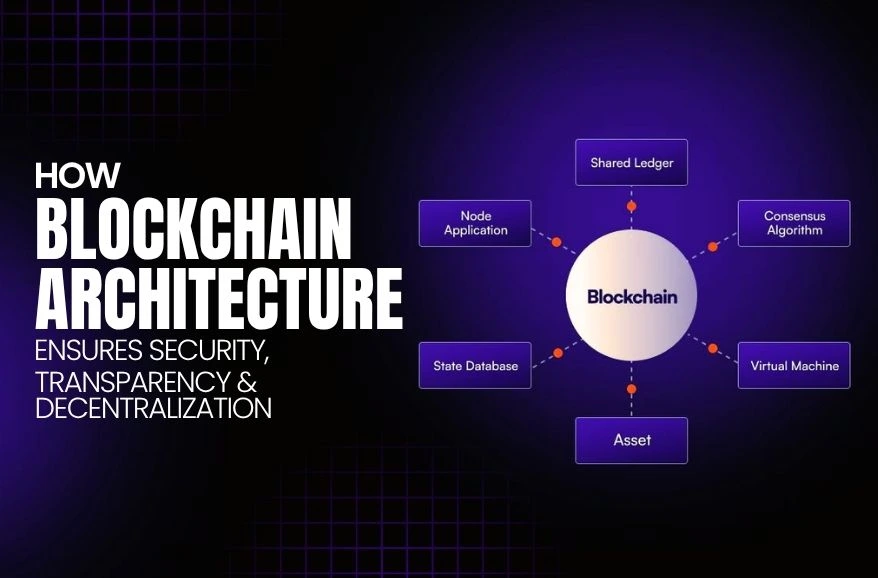
The importance of blockchain architecture lies in providing unmatched security, transparency, and decentralization for the systems of today. It allows the creation of multiple applications, such as cryptocurrencies and supply chain management. These apps can be developed on a distributed blockchain network architecture rather than a centralized one. Blockchain technology provides the creation of an immutable ledger confirmed by the total number of nodes in the network. Due to the lack of a need for a central authority, blockchain technology has become popular among companies and governments because of its high reliability and cost-efficiency.
What Is Blockchain Architecture?
Blockchain Architecture Explained in Simple Terms
The blockchain architecture is the design framework of the computer network. It operates on peer-to-peer technology that acts as a platform for applications and systems. The computer network is designed so that it functions as a single entity. But it lacks the presence of any centralized body managing its interaction.
Why Blockchain Architecture Is Important
Blockchain architecture is important as it offers a decentralized, immutable, and transparent structure. Eliminates the need for a trustworthy third party, thus ensuring maximum security and high levels of data integrity. It’s ideal for finance, supply chain, and digital identity management applications. It is because it disseminates information through a network of linked nodes to create tamper-resistant records.
Key Features of a Decentralized Blockchain System
1. Distributed Ledger Technology: People who are allowed to join the network will share a ledger (blockchain) that are unchangeable and tracks all transactions at one time. This eliminates the problem of repeated transactions in previous systems.
2. Immutable Records: If transactions occur, there is no way to modify them after that. Errors are clearly reversible by new transactions and both the old and new transactions can be seen.
3. Smart Contracts: They are contracts coded on the blockchain and with the conditions auto-executed. It helps make the process efficient since it is quickened, increases transparency, and reduces the need for intermediaries.
4. Public Key Cryptography: In these systems, two kinds of encryption technologies are applied for securing transactions to the blockchain. The public key is used for receiving the information, while the private key, which remains confidential, is used for authorization of the transaction.
How Blockchain Architecture Works
Transaction Flow in a Blockchain Network
A transaction in the blockchain network is started when a user starts a transfer from their cryptocurrency wallet into the memory pool. From there, the transaction is then selected by a miner. After that, it gets added to a block, where the block also has other transactions. The block will then be ready for mining, with each node creating its own block. These blocks are then tried to win the difficulty target through the use of nonces. This is repeated until a miner succeeds in creating a hash and winning the race.
Consensus Mechanisms Explained
A consensus mechanism is a fault-tolerant distributed algorithm for computer systems or for blockchain networks. It is designed to reach a required agreement on the value or state of the system among multiple distributed processes or within a multi-agent system.
Blockchain Network Architecture: Key Components
Nodes
These are basic blockchain infrastructure components like machines of a peer-to-peer network whose core software does the ledger updates and data exchange.
Transactions
Transactions in the decentralized registry, transfer of digital assets, or modification of smart contract states.
Decentralized Ledger
A blockchain is a list of blocks that make up a distributed database, like Bitcoin. With the help of unique information, these blogs are linked and cannot be changed.
Block
A simple unit comprising a group of transactions to be processed and checked on the common ledger.
Consensus Protocol
Regulations on how nodes interact, on the authenticity of transactions, and on the storage of data in the decentralized ledger.
Miners and Validators
There are teams that run the network. Validators check transactions with Proof of Stake, while miners use Proof of Work.
Cryptography
Secures transactions and provides authenticity which is encrypted and decrypted with the help of public and private keys.
Layers of Blockchain Architecture
Layer 0
The internet and hardware are necessary; as a result, the base layer of blockchain becomes easy for cross-chain interoperability. It can be used in networks such as Bitcoin and Ethereum.
Layer 1
Layer 0 is a development that maintains blockchain networks but can’t scale to large capacities. It has an influence on the layer 1, and is cheaper to run. Examples are Bitcoin, Ethereum, Cardano, and Ripple.
Layer 2
An example of this is a scaling solution that can get around the problems with L1 by using third-party solutions. This is widely known to fix scaling problems in POW networks and is slowly being used in business.
Layer 3
The decentralized apps (DApps) and protocols are in the application layer. It consists of two sub-layers, namely the application layer and the execution layer. These layers cooperate to enhance cross-chain functionalities and enable interoperability.
Blockchain Architecture Diagram Explained
Understanding Blockchain Architecture Diagram Step-by-Step

How Data Moves Across Layers
When data is sent from one networking layer to another, it is encapsulated at the source and decapsulated at the receiver. Control information, like tags, is added to (or taken away from) the data at each level. It goes through the OSI or TCP / IP models. It is passed from application to physical on the sender and from physical to application on the receiver.
Blockchain Security Architecture
Cryptography
Digital signatures and public/private keys let people sign a document and prove that it hasn’t been altered from the original.
Decentralization
ensures that data exists at numerous nodes and no single node on the network has the ability to change the data on the ledger.
Consensus Mechanism
These are the protocols (PoW, PoS) that make sure that all the nodes agree to the validity of the transaction before recording it.
Types of Blockchain Architecture
Public Blockchain
Accessible to anyone who manages to create a node, thus creating a sense of anonymity among its users. It rewards the participants by encouraging truthfulness via mining or staking incentives. Its strengths include higher security due to decentralization. While the weaknesses are rigidity and conflict-filled governance during the upgrade process.
Private Blockchain
This is privately owned by a particular party with complete control. Its access is restricted to the authorized members only. One of its strong points is customization, while updates are easier due to fewer stakeholders. Weaknesses include a compromised state of security, hence susceptibility to censorship.
Consortium Blockchain
Multiple entities can collaborate, with each operating a node and sharing decision-making. Typically, the participant must identify themselves and meet certain requirements, including payment of fees. The examples include Hyperledger, R3, and B3i.
Hybrid Blockchain
Hybrid blockchain is a merger of a public P2P network and a private blockchain layer. The benefit of this architecture is that it has the advantage of decentralization. Also offering the customization for the particular business needs. Hybrid Blockchains are illustrated by platforms like Polkadot and Kusama.
Benefits of Blockchain Architecture
Improved trust
The technology ensures a secure network limited only to its members, thereby guaranteeing prompt and accurate data retrieval. Confidential documents are exchanged with members who are part of the same network, promoting trustworthiness and ensuring end-to-end transparency.
Improved security
The process involves validating data accuracy by consensus of all the network members. Once validated, transactions cannot be modified or deleted, not even by the system administrator.
Increased traceability
Blockchain makes instant tracking possible with a transparent audit trail for any asset. Blockchain technology allows for the sharing of provenance information directly in sustainability-focused sectors, allowing organizations to confirm that their activities are sustainable. Blockchain may also expose inefficiencies in a supply chain, like delays.
Improved efficiency
All network participants keep and update a distributed ledger, thus eliminating the need for reconciliation of the records. These smart contracts are uploaded onto the blockchain. Therefore, this makes transactions more efficient and faster by means of automated action.
Automation of transactions
Smart contracts automate the whole process of transactions. Whenever certain conditions are fulfilled, smart contracts automatically move things forward to the next stage.
Challenges in Blockchain Architecture
| Challenge | Description |
| Scalability | Struggles with speed and efficiency as networks grow, especially in Bitcoin. |
| Integration Challenges | Overhauling existing systems for integration is costly and time-consuming. |
| High Energy Consumption | Notorious for energy-intensive Proof of Work (PoW), raising environmental concerns. |
| Complexity | Intricate nature is a barrier, requiring technical expertise for adoption. |
| Interoperability | Different blockchains struggle to communicate, limiting broader applications. |
| Uncertain Regulations | Evolving and uncertain regulations create challenges for businesses. |
| Governance Issues | Decentralization leads to governance challenges, potential forks, and lack of control. |
| High Implementation Cost | Costly setup, development, and skilled personnel contribute to high costs. |
| Private Keys | Managing private keys poses security risks, especially for non-tech-savvy users. |
| Network Security Disruption | 51% attacks compromise network integrity, especially in smaller blockchains. |
How to Build a Blockchain Architecture
1. State Security Requirements:
It is necessary to establish the demands for security based on the application scenario.
2. Select an Appropriate Technology Stack:
You need to select the blockchain technology stack that satisfies your security requirements. It can be blockchain security platforms or blockchain SIEM.
3. Plan Network Topology:
You have to plan a network topology. Make sure it has fewer vulnerabilities with enhanced security.
4. Put in place Monitoring and Auditing:
Establish a process of continuous monitoring and auditing to identify and act upon the security events, such as blockchain DDoS protection.
5. Frequent Updates and Patching:
Make sure to maintain all software elements to minimize the vulnerabilities to the known ones, as well as the ones that could compromise IBM blockchain security.
Real-World Applications of Blockchain Architecture
1. Money Transactions and International Payments: Blockchain technology has transformed the method of international payments, which has led to more unique wallet addresses. Payment solutions, such as ALTCOINS and exchanges, have advantages such as speed, cost, privacy, etc. Several new protocols have emerged, such as Ripple and Hyperledger Fabric. More than 100 countries have adopted CBDCs to enhance their cross-border payment systems.
2. Smart Contracts: This is an automated computer program that runs on a blockchain based on certain preconditions being satisfied. It increases reliability. They provide better security, reliability, and efficiency for organizations.
3. Logistics in Supply Chain Management: Blockchain technology helps in making the entire process of the logistics of the supply chain management more transparent. Blockchain keeps track of how the product has been delivered from the manufacturing unit till it reaches the consumer end in an efficient and secure manner.
4. CyberSecurity: Blockchain could improve the safety of the internet, considering it is an encrypted ledger system that provides data integrity and user anonymity. This will prevent any form of manipulation of the data stored in the system.
5. Personal Information Sharing: By using the cryptography feature in the blockchain, one can share their personal information in a secure way. It ensures that users’ privacy will not be compromised. The only person who can access such data is the intended recipient
Future of Blockchain Architecture
Supply Chain Management
Blockchain will increase transparency and efficiency in supply chains by creating a safe public data network of all partners, which will increase trust and communication.
Cybersecurity
Cryptographic encryption of blockchain provides security of data, minimizes fraud, and guarantees integrity. This is useful in organizations that require strong security.
Asset Tokenization
NFTs are a prime example of the use of blockchain, which can be managed individually and in a unique way due to digital ownership. It is possible to transfer both online and real assets, which will encourage accessibility and equity.
Secure Cloud Storage
Decentralized storage of data on the blockchain ensures a high level of data security. It makes it hard to manipulate information, as well as ensures the privacy and control of users.
Smart Contracts
These are self-executable contracts that automate the process, eliminate intermediaries, and support decentralized applications, making them more efficient in different industries.
Key Takeaways: Blockchain Architecture Simplified
The blockchain architecture is a technology in which a digital ledger stores transactions on one or more computers in a secure way. It even prohibits a slight retroactive change. Furthermore, it preserves data integrity by looking backward on each transaction.
Key blockchain components:
- Decentralized ledgers
- Data blocks holding information about transaction data
- Use of Merkle tree for quick validation of transactions
Some key functional features of blockchains are:
- Consensus mechanism
- Immutability
- Cryptography
- Smart Contracts for automated transactions
This means they’re more secure, more transparent, and more cost-efficient, without the intermediaries.
However, there are four types of blockchain: public, private, consortium, and hybrid.
These three layers comprise: the network layer, the consensus layer, and the application layer.
Conclusion
The blockchain architecture has a crucial role in data handling, and that is why the technology provides a great advantage in terms of security, transparency, and decentralization. It includes layer 2 and artificial intelligence integrations and thus creates highly efficient trustless systems compared to other technologies. When Layer 2 and AI integrations become even more popular, the use of blockchain technology will increase significantly in such industries as finance and healthcare.
FAQs
Q1. What is blockchain architecture?
The blockchain architecture is the design framework of the computer network operating on peer-to-peer technology that acts as a platform for applications and systems. The computer network is designed in such a way that it works as an entity despite lacking the presence of any centralized body managing its interaction.
Q2. How does blockchain architecture work?
The technology is structured around transactions, in blocks that are secured via cryptography and chained together.
Q3. What are the layers of blockchain architecture?
The layers of the blockchain architecture are Data Layer, Network Layer, Consensus Layer and Application Layer.
Q4. What are the components of blockchain infrastructure?
The blockchain technology has several key elements, such as nodes, distributed ledger, consensus mechanism, cryptographic techniques, and smart contracts.
Q5. Why is blockchain architecture secure?
Blockchain technology is secured with the help of decentralization, immutability, and cryptography.

Leave a Reply