

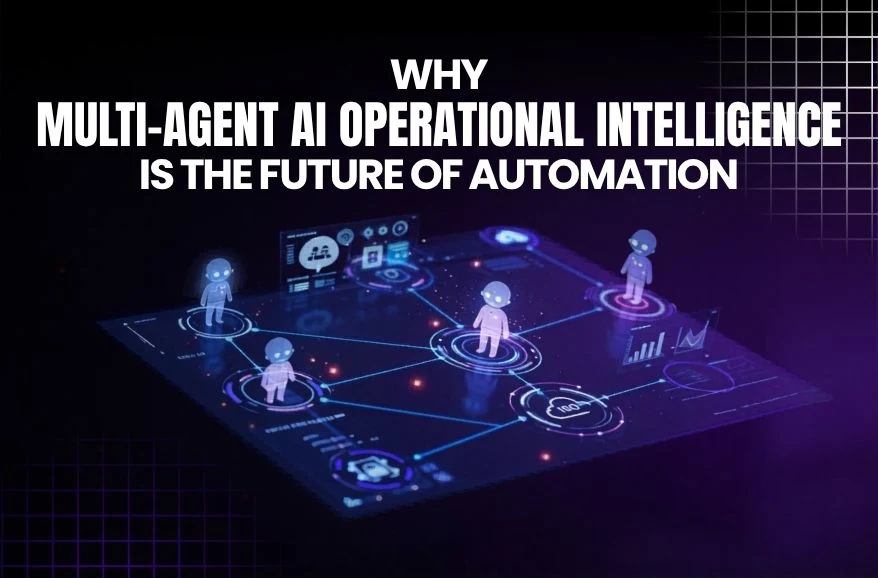
Multi-agent AI operational intelligence is a major improvement in business automation as it includes a group of specialized agents who work together in real-time. This contrasts with traditional single AI models, which cannot capture the picture of today’s immense data and complex AI workflow automation. By using multiple autonomous agents, organizations can have faster and more resilient decision-making with agents focusing on special tasks like anomaly detection, performance optimization, etc. It is a ground-breaking solution that simulates the collaborative effort of humans. It improves operational efficiency, with examples from the field showing how fast it is to recover from incidents. With enterprises getting on board this technology, it promises seamless end-to-end automation, boasting an integrated operation with existing systems.
What Is Multi-Agent AI Operational Intelligence?
Multi-Agent AI Systems Explained
A Multi-Agent AI System is an architecture of multiple AI Agents that collaborate to perform tasks. Each agent will take care of part of the problem. Thus, allowing the system to tackle problems with several aspects. These systems incorporate capabilities such as real-time adaptability, collaborative reasoning, and specialized expertise, all suited for industries that demand dynamic problem-solving capabilities.
Operational Intelligence in AI Context
OI in AI means the process of capturing and using data in real-time to improve business processes and information technology systems. OI is much more effective than a reactive dashboard because AI makes OI proactive.
How Multi-Agent AI Differs from Single-Agent Systems
| Aspect | Single-agent systems | Multi-agent systems |
| Architecture | One unified reasoning pathway | Multiple specialized agents with explicit coordination |
| Complexity | Low to moderate task complexity | High complexity with orchestration requirements |
| Debugging | Simple (everything in one place) | Complex (fragmented across multiple agents) |
| Best for | Well-defined workflows without strict security boundaries | Security boundaries, multi-domain scaling, specialized roles |
| Task completion | Adequate for straightforward tasks | Improved rates in enterprise automation |
| Performance | Consistent but bounded | Varies by task type |
| Cost | Predictable token patterns | Multiple LLM calls but can optimize well |
| Scalability | Hits complexity thresholds | Coordination overhead compounds at scale |
How Multi-Agent AI Works
A multi-agent AI operational intelligence is a distributed AI system that distributes the tasks and information to the specialized agents. They do the cooperative work towards a common goal and learn in a common context. Therefore, learning one part is essential to understanding the complications. These systems can be made in either a centralized or a decentralized network.
- For a centralized network, a central server handles all relationships and information between the AI agents, like a project manager, making it simple to communicate with everybody and make standard information, however, introducing the risk of a solitary failure.
- In contrast, a decentralized network gives AI agents direct access for their interaction, which results in a shared understanding and shared accountability among them for achieving their goals. This kind of structure makes the structure robust and scalable, but there are problems of coordination because of its complexity.
Since each architectural design carries its own degree of complexity, the choice between centralization and decentralization will necessarily depend on the demands of the project itself.
Key Components of Multi-Agent AI Systems
1. Agents: Autonomous AI agents are active entities that can make decisions on their own. These could involve software, bots, or even humans in specific roles and functions, or physical robots, drones, or sensors.
2. Environment: The shared area where the agents reside, sense, and engage with. It can be a virtual (simulated world or network) or a physical space such as a factory floor. Gives resources and restrictions, and allows indirect communication.
3. Communication protocols and languages: These are extremely significant to the communication between agents and will define such details as the message format, e.g., JSON/ XML, as well as the communication protocol, e.g., HTTP/ MQTT etc.
4. FIPA ACL: One of the main agent communication languages. It mimics human communication in that agents communicate with each other by sending messages that specify certain actions ( e.g., ” request ” or ” inform ” ) and contain information about the sender , the recipient , the action , and the content .
5. Coordination Mechanisms: Mechanisms that allow agents to resolve differences, mutualize goals, and work together efficiently, e.g., task bidding, voting, and contract nets.
Benefits of Multi-Agent AI Operational Intelligence
Flexibility
The number or capability of agents can be changed, and, therefore, the system can adapt to changing environments.
Scalability
Use multiple agents to increase information sharing. It allows more complex problems to be tackled than with single agent systems.
Domain Specialization
Multi-agent systems in AI enable each agent to specialize in how to work on a certain domain, which enhances its ability to accomplish a task.
Improved Performance
Multiple agents may synthesize information that each other lacks and, in general, outperform a single agent due to the existence of diverse action plans, a process known as cooperative learning.
Multi-Agent AI vs Traditional Automation Systems
| Feature | Multi-Agent AI Systems (MAAS) | Traditional Automation Systems |
| Adaptability | Works effectively in dynamic and unpredictable environments; can learn and adjust to changes. | Performs best in stable, repetitive, and well-defined environments. |
| Structure | Consists of multiple specialized agents collaborating to solve complex, multi-step problems. | Follows fixed rules and predefined linear processes such as RPA. |
| Data Handling | Can process unstructured or “messy” data to generate insights or trigger actions. | Requires structured and organized input data to function properly. |
| Use Cases | Customer service, strategic planning, dynamic logistics, and content creation. | Invoice processing, routine information transfers, and repetitive operational tasks. |
| Scalability | Easily scales tasks up or down by assigning work across agents based on workload. | Scaling often requires manual configuration and process adjustments. |
| Reliability | Flexible and adaptive in changing situations. | Highly reliable for repetitive and predictable tasks. |
| Limitations | May require advanced coordination and higher computational resources. | Struggles with unexpected inputs and often needs manual updates for improvements. |
Real-World Applications of Multi-Agent AI Operational Intelligence
- Smart traffic systems: They control junctions and traffic signals, and congestion patterns in some cities, such as Singapore and Los Angeles, to lessen waiting time and fuel use.
- Collaborative warehouse robots: Amazon’s robots are artificial intelligence-based, which work cooperatively and move shelves, sort products, and prepare them for delivery in real-time.
- Hospital patient flow management: AI agents can be employed in patient flow management within hospitals, such as in the ER triage system, patient room allocation, and scheduling patient visits with doctors.
Multi-Agent AI Systems in Enterprise IT Solutions

Challenges in Implementing Multi-Agent AI Systems
Agent malfunctions
Shared pitfalls can happen for multi-agent AI operational intelligence systems that are constructed on the same base models. Any of the weaknesses could result in all agents in the system failing or could allow them to be attacked adversely. This underscores the need for proper data governance in the creation of foundation models and robust training and testing procedures.
Coordination complexity
One of the biggest problems in the construction of multi-agent systems is the creation of agents that can coordinate and negotiate with each other. Such collaboration is critically needed for the smooth working of an MAS.
Unpredictable behavior
In a decentralized network, the agents can behave in conflicting and unpredictable ways. It can be challenging to discover and address problems in the overall system in such an environment.
How to Build a Multi-Agent AI Operational Intelligence System
1. Identify Operational Goals/Architecture: Know what each agent must do, no conflicts of responsibility. Determine basic requirements such as logistics management and choose the architecture model, either centralized (Orchestrator-Worker) for more control or a decentralized one. Provide real-time communications through event-based messaging system.
2. Agent roles and tool development: Specify different roles of different agents and certain agent functions (e.g., observation, reasoning and action). Provide the agents with the right tools, such online search and access to APIs.
3. Technical Infrastructure Implementation: Deploy CrewAI to orchestrate;-create an orchestrator agent; memory using vector databases.
4. Administration and Security Framework: Adopt the concept of Zero Trust, enforce human guards, use RBAC and keep records.
5. Deployment & Monitoring Infrastructure: Plan for scalability of infrastructure & Dockerizing agents during creation of these systems. Do not forget to use LLM-as-a-judge for measuring agent performance.
Future of Multi-Agent AI Operational Intelligence
The future of Multi-Agent Agentic AI looks promising, with further advancements expected in this field. There are several areas in which growth is increasing:
- Advanced Communication Protocols: Designing safe and efficient protocols for agent interaction.
- Scalability Solutions: performance constraints of larger and more complex systems.
- AI Solution Integration: Use Multiple Agentic AI, machine learning and NLP together to achieve more power in terms of solutions.
- Enhanced Agent Autonomy: Improving agents’ ability to make independent decisions, decreasing dependence on centralized control.
Key Takeaways: Multi-Agent AI Operational Intelligence Simplified
- One agent shall do one thing rather than the other: Specialization beats generalization; one AI can handle research, analysis, and coding. One must complete a specific task accurately and consistently.
- Collaborative Intelligence: Agents pass context & intermediate results to each other in specific way stations so that they can collectively solve a problem, which is too large for a single one.
- Multi-agent systems: They work in parallel, as opposed to sequential work, thus accelerating the process of tasks such as production, incident management, and data analysis.
- Scalability & Flexibility: Agents can be added or removed as per organizational demand, which can be well managed by considering the scalability & flexibility.
- Failure resilience: With one agent failing, others can do the job for it; models with a single point of failure are not nearly as robust.
Conclusion
Thus, multi-agent AI operational intelligence is reshaping the face of automation in collaborative and resilient systems by creating systems that can handle large-scale high levels of complexity. Companies that have embraced it experience faster business and cost efficiencies such as MTTRs. Grow on the solid ground of data and distinct roles to become familiar with the potential it holds. In the future, this will be combined with IoT, making it more useful.
FAQs
Q1. What is multi-agent AI operational intelligence?
Multi-agent AI operational intelligence is an AI system consisting of multiple independent AI agents communicating, coordinating and cooperating to accomplish large-scale tasks.
Q2. How do multi-agent AI systems work?
Unlike monolithic and powerful AI models, multi-agent AI is made up of multiple AI agents. It is a specialised, independent and co-dependent in the solving of more complex problems.
Q3. What are the benefits of multi-agent AI systems?
Some of the advantages are higher accuracy due to role specialization, more scalability for larger loads, higher fault tolerance for more resilience and flexibility in dynamic environments.
Q4. What industries use multi-agent AI?
Industries such as finance, manufacturing, logistics, health and ecommerce are among those that use multi-agent AI to free up time to automate complex and multilevel workflows.
Q5. How is multi-agent AI different from traditional AI?
Contrary to traditional centralized AI, Multi-agent AI is decentralized, in which each agent possesses a specific skill. All these agents communicate with each other to deal with complex problems.

Leave a Reply