


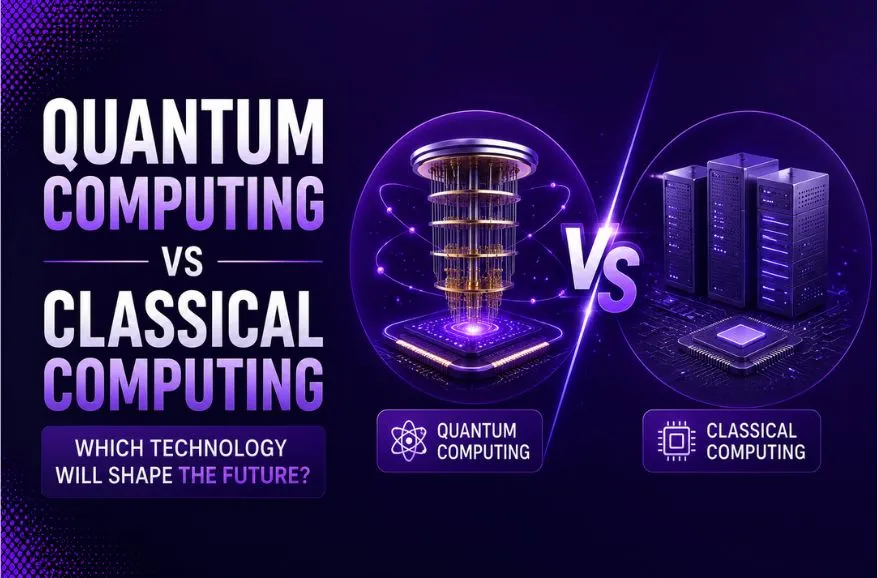
The topic of quantum computing vs classical computing is also one of the most relevant subjects of the decade as the two challenges the solutions in a very different manner. Classical computers are used daily and are fast, stable, and cheap. While quantum computing systems could be used to solve very complicated problems. It includes those in science, optimization, and security tasks that classical machines cannot perform. The distinction between quantum computing and classical computing is relevant because there’s not necessarily a single “winner” in the future. Rather, the future looks like business, research, and government utilizing classical systems for most tasks and quantum for unique advancements.
Quantum Computing vs Classical Computing – An Overview
What Is Classical Computing?
Classic computers rely on classical computers store data as bits. Bits are essentially on/off switches and hold the definite states of 0 or 1. These states refer to physical characteristics such as transistors voltages. Operations are deterministic. A two input AND gate always yields a two-bit output of the same value. While a NOT gate swaps a bit’s value in and out of the logic on each use. While using the same set of input and program, a classical computer provides the same output each time.
What Is Quantum Computing?
Qubits in quantum computers need to be in a superposition between being in the 0 and 1 states, and with a certain probability, it is one or, it is the other state.
Why Comparing These Technologies Matters
It is important to compare quantum and classical computing because they are actually competitive. However, instead of storing processed serial data as zeros or ones on a traditional computer. A quantum computer takes advantage of the fact that qubits can be in more than one state. Also, it simultaneously processes several states at once, thereby giving it remarkable processing power.
How Classical Computing Systems Work
Classical computers operate on a system of fetch-decode-execute which allows it to retrieve data from memory, perform computations on that data and store the results of computations back into memory. A key architectural principle behind classical computers is the von Neumann architecture. It is where the program and data stores in the same memory location. This has advantages for design and software as it’s a lot more flexible. Billions of instructions per second, the classical world of computers has achieved impressive speeds thanks to multi-core processors, the rise of Graphics Processing Units and distributed computing.
Limitations of Conventional Computing Architectures
1. The Von Neumann Bottleneck: The data transfer bottleneck between classical CPUs and RAM constrains processing speeds. The energy usage and the heat produced by moving data between the two makes them energy inefficient. Then creates another issue of a bottleneck for their performance scaling.
2. The Physical and Thermodynamic Limits: There are inherent physical barriers to the continuation of transistor scaling such as tunneling effect which will give a lot of problems to the dissipation of heat. High local temperature of the processor can then lead to performance throttling which require for large amount of cooling resources.
3. Processing Paradigms: A normal computer uses logic based on true and false or bit-based on booleans and has limited power to manipulate complex probabilistic data. Traditional computers need explicit instructions for what it should do. Hence limiting learning based on autonomy.
4. The Algorithmic Bottlenecks: Traditional processors aren’t well suited to extremely complex combinatorial problems. Thus, resulting in a greater amount of time needed to solve it. In turn, it will create vulnerabilities in cryptography.
Quantum Computing Explained in Simple Terms
What Are Qubits?
The status of a qubit defines as a quantum wave function without precise meaning. It happens before measuring it.
Understanding Superposition
These superpositions are used and entangled with others by quantum gates. Superpositions only show up values when measured. The output is a probability outcome and if the algorithm is repeated many times the result can be different, depending on the probability distribution of the circuit design.
The Role of Quantum Entanglement
Entanglement represents the ability of qubits to become correlated with each other. These kinds of systems have such tight linkages between qubits that by merely examining an individual one, we can reveal particulars about the remainder of the entire arrangement of entangled qubits.
Quantum Interference and Computation
Interference is crucial to powering quantum computation. Whenever these individual quantum bits enter a state of global superposition, they order information within such a structure that resembles a flow with a number that signifies each result. The amounts each result carries correlate directly to how many times it will turn up. The individual streams amplify or cancel one another when peaks correspond or are juxtaposed by troughs. The outcome: probability can either cancel or amplify itself.
How Quantum Computing Works Compared to Classical Computing
Bits vs Qubits
A classical bit (binary bit) of data can be only a definite zero or a definitive one. By contrast, a qubit or a quantum bit, utilizing quantum mechanics, can exist simultaneously in states of both one and zero. This property of quantum computing, quantum superposition, permits quantum computers to tackle vast numbers of solutions at the same time. This could help them process certain problems at an exponential speed compared to classical computers.
Sequential Processing vs Parallel Possibilities
Quantum computers harness large scale parallel processing capabilities as a replacement for classical step-by-step sequential processing. Conventional processors can carry out a computation once, while quantum computers try many possible solutions at once. It provides an exponentially faster capability to calculate problems too complex for even classical supercomputers.
Information Representation Differences
At its simplest, conventional computers calculate solutions sequentially using single-digit inputs that are either 0s or 1s. Quantum computers, however, utilize qubits, the building blocks of quantum computers, to process multiple inputs at once – 0, 1 or a combination of both.
Why Quantum Computers Solve Certain Problems Faster
1. Shor’s algorithm: This is the famous algorithm for factoring integers and discrete logs, which runs exponentially faster on a quantum computer than it does on a classical one. After building large-scale fault-tolerant quantum computers, RSA encryption becomes insecure. However, such computers are very far away.
2. Quantum Simulation: Quantum computers, in some instances, will excel in the ability to simulate quantum mechanical systems. It will be far more efficiently than their classical counterparts.
3. Unstructured Search: There exists a quantum algorithm (Grover’s algorithm) that searches an unstructured database in the sq rt of the number of elements while the best -classical algorithms take time that grows linearly. But an improvement of less than 2 orders of magnitude is not likely to justify a newclassof computer.
4. Optimization problems: In theory, a quantum computer could help us solveoptimization problems that are beyond the reach of today’s classical hardware, with a few have already demonstrated significant performance gains through what are known as hybrid classical-quantum approaches, while others have shown that they can be competitive with classical solutions.
5. Sampling from distributions: It can be shown that quantum computers perform some specific sampling tasks more efficiently than any classical algorithm. It does not rely on access to the quantum hardware itself, with applications in Monte Carlo methods or in machine learning algorithms.
Quantum vs Traditional Computing – Performance Comparison
| Feature | Traditional Computing | Quantum Computing |
| Primary Advantage | Mature, cost-effective, and highly reliable for everyday processing, business applications, and web browsing. | Provides exponential speed improvements for specific computationally intensive problems, such as molecular modeling and complex optimization. |
| Error Handling | Produces low error rates with deterministic and predictable outcomes. | Experiences high error rates and requires millions of physical qubits to create a stable logical qubit for reliable computation. |
| Operating Conditions | Operates efficiently at room temperature using conventional hardware. | Requires specialized cryogenic cooling systems operating near absolute zero to minimize decoherence and maintain qubit stability. |
| Real-World Applications | Used for software development, gaming, AI inference, database management, office productivity, and everyday computing tasks. | Applied in drug discovery, climate modeling, financial portfolio optimization, cryptography, and advanced scientific research. |
Quantum Computing Advantages Over Classical Systems
1. Massive Parallel Processing: Due to the fact that qubits exist in multiple state at any one time, they have the capability to analyse all permutations together simultaneously increasing capacity with each successive qubit.
2. Simulating physical systems: Unlike classical computers, a quantum computer is able to perfectly replicate the processes of quantum mechanics therefore significantly improving speed in for instance the development of new drugs or materials by modelling complex chemistry.
3. Optimization techniques: A quantum computer can collectively consider all variables at once. It aims to ascertain optimum solutions in applications such as the management of supply chains and the management of finances at significantly faster rates.
4. A new era of encryption: Several algorithms available for quantum computers, for example Shor’s algorithm, can factor very large numbers far more quickly than their traditional counterparts. It is making some currently widely used encryption methods obsolete whilst paving the way for new forms of quantum security.
Where Classical Computing Still Dominates
Classical computation is now the world of our personal computers, enterprise applications, data centers, cloud platforms, and online purchases. It is primarily due to these demands on speed, precision, and reliability. This have been driving the development of robust hardware for decades. There will likely continue to be a large role for classical machines in a quantum world as the workhorses for the “daily grind” in computing.
Quantum Computer Applications Across Industries
- Cryptography: The development of quantum computers has necessitated post-quantum cryptographic solutions. Many popular encoding mechanisms such as RSA and ECC, can render inefficient with the help of the Shor’s algorithm.
- Optimization: Analysts are capable of readily employing quantum computers for optimal solutions in complex scenarios such as short route problems in any supply chain or complex road network.
- Drug Discovery: With its precise simulation capabilities, researchers utilize quantum computers to carry out molecular and chemical simulations that contribute to expedited drug discovery and development.
- Quantum Simulation: Researchers havee observed that relying on quantum computing as the definitive option for simulating quantum systems. This has thus given way to developments in areas of chemistry, physics, and materials science.
- Financial Modeling: Financial analysts are capable of improving models and analyses by leveraging quantum computers, allowing them to rapidly compute intricate risk models and manage investment decisions.
Can Quantum Computers Replace Classical Computers?
Classical computers won’t be put out of business by quantum. Quantum will instead complement them by functioning as a specialized accelerator. Think of the same way that a graphics card (GPU) takes on specific tasks in addition to your general processor (CPU) and your classical computers will form the base on which these special machines will rest.
Challenges Slowing Quantum Computing Adoption
1. Scaling fidelity: The main objective is to improve the scale while keeping up with the fidelity of qubits in general.
2. Speeds of computations: Qubits can live for only a finite time therefore, it becomes crucial to speed up the gating speed of operations in order for to achieve computation.
3. Multi-qubit networking: The scale of the number of qubits to carry out quantum algorithms would depend on interconnection, with greater interconnection leading to a better performing quantum computers.
4. Coherency of individually controlled bits: The bigger the number of bits, the more challenging it becomes to control each individually.
5. Cooling and Environment: The number of cooling systems to operate at such small scales is beyond the capabilities of the present technology. Thus, its implementation becomes difficult.
6. Fabrication: Though some designs of qubits make use of already known fabrication techniques. But, others need novel fabrication processes, further needing an automated manufacturing process with tests for large numbers.
The Impact of Quantum Computing on Cybersecurity
Quantum cybersecurity uses quantum mechanics to combat quantum attacks. Quantum cybersecurity is the process of combining technologies from the field of quantum science and information technology to secure computer information. It ensures the safety of information when information security needs to withstand possible attacks carried out by quantum computers. Today, current encryption and communication based on mathematical difficulties such as the complexity of factorization, are insufficient to deal with the future impact of quantum computers.
Quantum Computing and Artificial Intelligence
Quantum computing also set to bring about changes to machine learning and artificial intelligence. In some cases this can be used to enhance processing in areas such as training the model to predict things more accurately and in greater volumes.
Major Companies Driving Quantum Innovation

Quantum Computing Future – What to Expect by 2030
1. Breakthroughs in Logical Qubits: A breakthrough was made in creating logical qubits which resulted in 22 times fewer errors than physical ones. Logical qubits would help make quantum computers more fault-tolerant.
2. Emerging Roadmaps: Different companies show credible roadmaps for big quantum systems; IBM has targets to achieve 10,000 physical qubits by 2029, previously the company felt this target was far off in the future.
3. Hybrid Systems Is Useful: In the short term, the hybrid quantum classical solutions work. P&G was using a tool in which they were improving their search times by nearly a millionth for an optimization problem. They gave us a preview of all the massive future improvements they’ll be bringing to the platform.
When Should Businesses Pay Attention to Quantum Computing?
The impact of quantum computing on industries is enormous and large investments are being made into the technology. Among other industries, finance, pharmaceutical and logistics companies are actively researching or implementing the technology for their specific needs:
- Investment in the technology for the financial sector.
- In drug discovery for the pharmaceutical industry.
The most obvious area of potential impact for quantum technology lies in its threat to classical encryption methods, where the industry must prepare for post-quantum cryptography (PQC). It’s clear that the firms and sectors that prepare their strategies for the application of quantum technologies today will have a competitive advantage. Particularly by adopting quantum-ready algorithms into their product and development stacks.
As more businesses prepare for the quantum era and to facilitate a broader reach to quantum applications. Furthermore, the market for Quantum-as-a-Service (QaaS) solutions such as the offering by IBM or Microsoft continues to grow. This makes this technology accessible to firms and startups without needing massive capital expenditures in quantum hardware.
Quantum Computing vs Classical Computing – Side-by-Side Comparison Table
| Aspect | Classical Computing | Quantum Computing |
| 1. Basic Principle | Uses bits, where each bit can have only one value at a time: 0 or 1. | Uses qubits, which can represent 0, 1, or both simultaneously through superposition. |
| 2. Information Representation | Processes information sequentially using classical bits. | Uses superposition and entanglement, allowing multiple computations to be performed in parallel. |
| 3. Computational Power | Suitable for general-purpose computing and linear processing. Solves problems one calculation at a time. | Performs certain complex calculations exponentially faster by evaluating many possibilities simultaneously, such as factoring large numbers and simulating molecules. |
| 4. Problem-Solving Capability | Ideal for routine computing tasks with simple algorithms, including software applications, arithmetic operations, and data management. | Best suited for complex optimization problems, quantum cryptography, molecular simulations, and advanced scientific research. |
| 5. Error Handling | More stable and reliable due to mature hardware and software technologies. | More prone to errors because of decoherence and environmental noise, requiring advanced quantum error correction techniques. |
| 6. Speed and Efficiency | Efficient for everyday computing tasks but slower when solving highly complex problems involving massive datasets or simulations. | Significantly faster for specific computational problems by leveraging quantum parallelism, although not faster for every type of task. |
| 7. Hardware | Built using silicon-based processors with established manufacturing technologies. | Requires specialized hardware such as superconducting circuits, trapped ions, or photonic systems, often operating at cryogenic temperatures. |
| 8. Applications | Commonly used for word processing, web browsing, gaming, business software, and everyday computing tasks. | Primarily used for scientific simulations, optimization, drug discovery, cryptography, artificial intelligence, machine learning, and advanced research. |
Common Myths About Quantum Computing
| Myth | Reality / Fact |
| Quantum computers can find all answers at the same time using superposition. | Quantum computers can represent many possible states simultaneously through superposition, but measuring the qubits collapses them into a single result. They do not reveal every possible answer at once. Instead, quantum algorithms such as Grover’s algorithm increase the probability of finding the correct solution more efficiently than classical search methods. |
| Qubits can store more information than classical bits. | Although qubits can exist in multiple states simultaneously, they do not store more classical information than a single classical bit. Due to the limits of quantum measurement, each measured qubit ultimately provides only one bit of classical information. Their advantage lies in quantum computation rather than increased data storage. |
| Entangled qubits enable instant communication. | Quantum entanglement creates strong correlations between qubits regardless of distance, but it cannot be used to send information instantly. Any meaningful communication still requires classical signals, which are limited by the speed of light. Entanglement supports quantum computing and cryptography, not faster-than-light messaging. |
| Quantum computers are still ten years away from practical use. | While fault-tolerant, general-purpose quantum computers are still under development, quantum technology is progressing rapidly. Specialized quantum computers are already used for research and specific applications, with continuous improvements in qubit stability, error correction, and scalability bringing practical quantum computing closer to reality. |
Conclusion
A quantum computer is merely another way of specialization, rather than replacement, to be understood by the story of quantum computing vs classical computing. The two types of computers will exist side by side. As the former are proven, reliable, and affordable for people. Whereas, he latter may prove to be a revolution for some specific domains that require the incredible power of the quantum. Eventually hybrid systems are likely to be in the future combining both technologies. The businesses that understand this difference will continue to be better prepared for the transition up ahead, particularly in areas like security, optimization, research and advanced analytics.
FAQs
Q1. What is the difference between quantum computing and classical computing?
The differences between quantum and classical computing is that a classical computer uses binary bits (1s and 0s) and operates serially to perform simple, daily computations. A quantum computer, on the other hand, uses quantum bits that can exist as a 1, a 0, or multiple values in between, known as superposition. This is an exponential improvement over a standard computer for very hard computations such as molecular simulation, encryption, etc.
Q2. Is quantum computing faster than classical computing?
There is no concensus among experts as to whether quantum computers will ultimately out perform conventional computers.
Q3. What industries can benefit from quantum computing?
Major application fields where quantum computing will offer tremendous advancements include, drugs, financial services, transportation and logistics, security and material science.
Q4. What are the biggest challenges in quantum computing?
Maintaining the qubits in their delicate quantum state is one of the hardest scientific and technical hurdles for quantum computer experts.
Q5. How does quantum computing affect cybersecurity?
Quantum computing is one way that will put our public-key encryption scheme out of business.

Leave a Reply