

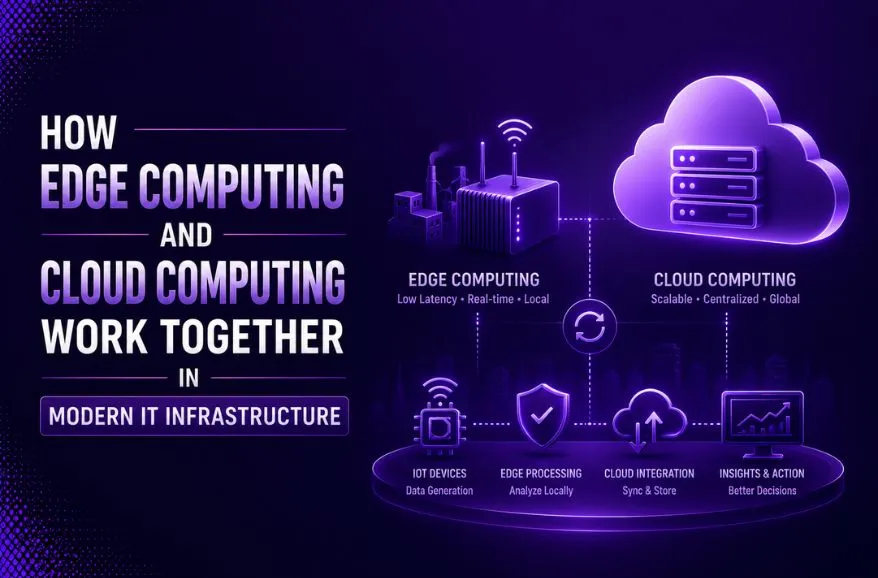
The majority of IT infrastructure today comprises centralized, unified cloud platform in combination with distributed edge infrastructure that handles various costs, performance, and compliance considerations. Edge Computing vs Cloud Computing is discussed a great deal in relation to one another, but the true power comes from leveraging these together. The cloud offers efficient, scalable data storage, global access to services, and a central point for big data analytics. While the edge brings computation, analytics, and processing closer to data sources to reduce latency and network utilization. Smart companies can use this concept of Edge Computing vs Cloud Computing to deliver hybrid IT solutions. These solutions perform operations on the most optimal layer for the application like edge devices for real-time inference, and the cloud for comprehensive analytics. In this post we go over edge and cloud computing models and how to apply these computing models for real-world use cases to provide more intelligent decision making.
Understanding Edge Computing vs Cloud Computing
What Is Cloud Computing?
Cloud computing is changing technology in the way that people, and companies, have access to computing resources such as servers, storage, databases, networking, software, analytics, and intelligence over the Internet “in the cloud”. It provide faster innovation, scalable resources and economic savings.
What Is Edge Computing?
Edge computing puts the “computing paradigm” close to where the users are for better response times and bandwidth efficiency by pushing computing power and data storage nearer the user.
Why Businesses Compare Edge and Cloud Architectures
When evaluating Edge Computing vs Cloud Computing, organizations consider the trade-off between the factors of Latency, bandwidth, cost, security and management. Both are strong options with positive attributes and the appropriate combination impacts on users and operation.
The Evolution of Modern Computing Infrastructure
- Mainframe and Client Server (1950s-1990s) era: These years marked the transition between centralized mainframes, and decentralized client-server model architecture.
- The Age of virtualisation (2000s): It provided us with the advent of virtual machines and allowed us to have On Premise with the implementation of virtualisation on multiple machines.
- Cloud Era (2000s-2010s): This phase transitioned us to on-demand computing in an all-in-one utility with the advent of various cloud models, such as IaaS, PaaS, and SaaS on cloud platforms, like AWS, azure, etc.
- Modern Cloud Native Architectures: This era defined the micro-services architecture, containerisation, Kubernetes, and DevOps practices to provide a flexible and dynamic IT environment.
- Trends for Future: There is a rise of edge computing and the use of Hybrid/multi-cloud strategy for performance, security, etc.
How Cloud Computing Infrastructure Works
Cloud is a global network of machines and data, information, applications, and databases in a cloud environment. Virtualization is the technology that enables one physical computer to host multiple “virtual” computers or virtual machines (VMs). The power of virtualization allows use of the hardware resources of numerous physical servers, including those that may be remote, for service by one or many customers or users as a single, highly scalable resource. Cloud computing’s physical hardware efficiently reduces the cost of managing and using computing hardware to meet the needs and organizations served by these machines.
What Is Edge Computing and How Does It Work?
Creating an edge network involves deploying computing power and storage onsite to locations where it can rapidly process data for nearby devices. Alternatively, data stores on memory and storage embedded in the edge devices such as sensors, smartphones, and laptops. An edge network processes and stores the majority of data on edge devices or servers rather than sending the data to a central data center or to the cloud; only selecting essential information to send to the cloud or to a central data center.
Edge Computing Architecture Explained

Edge Computing vs Cloud Computing Comparison Table
| Parameter | Edge Computing | Cloud Computing |
| Definition | Edge Computing is a distributed computing architecture that brings computing and data storage closer to the source of data. | Cloud Computing is a model for delivering information technology services over the internet. |
| Location of Processing | Processing is done at the edge of the network, near the device that generates the data. | Data Analysis and Processing are done at a central location, such as a data center. |
| Bandwidth Requirements | Low bandwidth is required, as data is processed near the source. | Higher bandwidth is required as compared to edge computing, as data must be transmitted over the network to a central location for processing. |
| Costs | Edge Computing is more expensive, as specialized hardware and software may be required at the edge. | Cloud Computing is less expensive, as users only pay for the resources they actually use. |
| Scalability | Scalability for Edge Computing can be more challenging, as additional computing resources may need to be added at the edge. | Easier, as users can quickly and easily scale up or down their computing resources based on their needs. |
| Use Cases | Applications that require low latency and real-time decision-making, are IoT devices, autonomous vehicles, and AR/VR systems. | Applications that do not have strict latency requirements, such as web applications, email, and file storage. |
| Data Security | Data security can be improved, as data is processed near the source and is not transmitted over the network. | Data Security is more challenging, as data is transmitted over the network to a central location for processing. |
| Security and compliance | Cloud providers offer built-in security and compliance features | Sensitive data can be kept local, reducing exposure and aiding data sovereignty |
| Latency and performance | Higher latency due to network hops to the cloud | Lower latency with faster response times for local processing |
Low Latency Computing and Why It Matters
Understanding Latency in Modern Applications
Low latency results in the smooth and responsive applications leading to delighted users and better engagement. Network conditions are the biggest hitters when it comes to latency, as it can cause users to be less productive and frustrated.
How Edge Computing Reduces Delays
For the IT manager, it gets the system more efficient and dependable to reduce latency. Applications can now run faster, due to quick data processing and transmission, thus increasing users’ satisfaction and their productivity.
Applications That Require Instant Responses
- Low latency is essential for maintaining smooth audio and video streaming, including synchronizing audio with video on Netflix and Spotify, as well as continuous play-back.
- For live events like sports matches or concerts, it now becomes particularly crucial to minimize latency, so as to increase the viewing experience.
- By speeding up the rate of media streaming, it also facilitates adaptive bit rate streaming, which adapts the video quality to meet network demands for an optimum experience.
- Low latency is particularly crucial in social media and financial platforms. To stay engaged and informed users rely on real-time notifications and updates.
- Low latency is more important to ensure natural conversation flow and understandings in real-time communications, such as VoIP.
Performance Advantages Over Centralized Processing
For businesses, low latency can help deliver improved customer experience, gain a competitive advantage, satisfy their customers, build loyalty, and stimulate growth.
Benefits of Edge Computing for Modern Enterprises
- Lower latency: Edge Computing allows for faster processing and analysis of data right at the source, as there will be less of a delay in sending data out and brought back from the cloud. The latency will also be especially important to businesses and technologies that require a low latency. It van be robotics, the automotive industry, industrial automation and Self-Driving vehicles.
- A Better and Secured Experience with data analysis: Security Edge computing can provide more security because there will be less sending data out and transported to the cloud for processing. Hackers would find the system harder to attack because there will be smaller surface area to hack at as fewer resources have been spreadout in cloud.
- Higher Bandwidth Efficiency: With a decrease on data transmits to the cloud because of processing and analyzing done at the edge.
Where Cloud Computing Still Excels
- Scalability and Flexibility: In cloud computing, an organization can resize its computing resources according to the needs and it supports business growth and helps it grow without making significant investment in hardware.
- Cost savings: The cost structure transfers from CapEx to OpEx, as organizations can pay as-per-use. This way they have to avoid the costly hardware maintenance and repair services.
- Disaster Recovery and Data Loss Prevention: With cloud storage, you’re given better data access as your backup can be easily available for any need. Companies can avail robust disaster recovery through data backups in case of any hardware, network failure, any cyber or physical threat, or any natural catastrophe.
Edge Computing for IoT Applications
- Remote Patient Monitoring: IoT sensors and edge computing are helping healthcare professionals to monitor patients remotely, and detecting shifts in chronic conditions. It improve patient safety and convenience and save time for them and healthcare professionals.
- Autonomous Vehicle Operation: IoT and edge computing help improve the safe, effective operation of all manner of autonomous vehicles and the ability to respond to changes in the environment in real-time, without relying on a lot of cloud computing.
- Industrial IoT (iIoT): Manufacturing – Using IoT sensors to analyse a data stream; Machine Learning used to identify improvement opportunities; Monitoring of vulnerable parts under stress that cause failure in machines.
- Smart Cities: Edge computing and IoT uses real-time data gathering in connected cities, to improve their infrastructure, such as the electric grid and traffic management.
- Optimize Supply Chains: IoT technology turns the supply chain business process into a more efficient one, as items are automatically tracked and knows when they are available or not, and where they are located as they move.
Distributed Computing Systems and Modern Infrastructure
Understanding Distributed Processing Models
Distributed computing is responsible for spreading processing and storage across independent nodes to improve relief on failure, resources utilization. It also includes scalability capabilities to handle large amount of workload without any single point of failure.
How Edge and Cloud Complement Each Other
From client–server to peer–to–peer, models vary in their consistency, latency and fault-tolerance that are extremely suited for different kinds of application.
Managing Workloads Across Multiple Locations
Orchestration, service discovery, as well as policy driven scheduling (IaC) ensures workloads run where they are most efficient, whilst remaining visible and governed.
Challenges in Distributed Environments
Issues such as coordination and consistency trade-offs, network partitions, security over heterogeneous nodes, and observability at scale continue to be prominent operational challenges in DEs.
How Edge Computing Works With Cloud
- Edge Computing brings computation to the data source to enable real time analytics and minimize the need for data to transfer to a centralized cloud computing environment.
- In this way latency can be drastically reduced and bandwidth used efficiently, which is suitable for applications that need immediate information in real-time, like AI-controlled vehicles and real-time surveillance.
- It also solves the issues faced in regions with intermittent data connectivity, where slow and expensive data movements to the Cloud.
- Edge computing offers the ability to deploy scalable systems, fully flexible, enabling companies to adopt solutions gradually and according to their demand, with no big requirements for the initial start-up.
- Edge/compute and cloud are also mutually complementary. Edge computing enhances latency, bandwidth and data privacy. They make new applications possible which depend on real-time data analysis. When coupled, they offer a solid infrastructure for today’s digital demands.
Security Considerations in Edge and Cloud Environments
| Technology | Security Consideration | Why it is a consideration |
| Edge Computing | Physical Security & Hardware Integrity | Edge nodes are often deployed in public or uncontrolled locations. Devices should use tamper-resistant enclosures, Hardware Roots of Trust (HRoT), and Trusted Platform Modules (TPMs) to enable secure boot and protect against physical attacks. |
| Resource Constraints | Since edge devices have limited computing power and memory, they require lightweight encryption techniques and secure Firmware Over-the-Air (FOTA) updates to maintain security without affecting performance. | |
| Zero Trust & Micro-segmentation | Edge environments should implement a Zero Trust architecture with continuous authentication. Micro-segmentation limits the spread of attacks by preventing a compromised edge node from accessing the rest of the network. | |
| Cloud Computing | Identity and Access Management (IAM) | IAM ensures that only authorized users and applications can access cloud resources by enforcing Multi-Factor Authentication (MFA) and the principle of least privilege. |
| Data Protection & Encryption | It protects cloud data with strong encryption both during transmission (using TLS or DTLS) and while stored to reduce the risk of data breaches. | |
| Compliance & Governance | Organizations must comply with regional data sovereignty regulations and industry standards, such as GDPR and HIPAA, because cloud data is stored on shared infrastructure. | |
| Cloud Security Posture Management (CSPM) | Automated CSPM and Cloud-Native Application Protection Platforms (CNAPP) help identify misconfigurations, monitor vulnerabilities, and strengthen security across multiple cloud environments. |
Cost Comparison – edge vs cloud computing
| Criteria | Edge Computing | Cloud Computing |
| Setup Costs | High (hardware investment) | Low (subscription-based) |
| Operational Costs | Local maintenance, energy savings | Usage-based fees, potential waste |
| Latency | 100–200 ms (faster) | 500–1,000 ms |
| Scalability | Hardware-dependent | Pay-as-you-go, virtual scaling |
| Data Transfer Costs | Lower (local processing) | Higher (remote processing) |
| Staff Requirements | Specialized, on-site | Fewer, remote |
Common Use Cases for Edge Computing
- Smart vehicles: They analyze local data to make driving decisions on behalf of the drivers. It provides recommendations for faster, safer driving routes or warning of immediate danger. For example, another car abruptly swerves out of its driving lane. Even a car backs into the lane from a side road behind you. Smart home technologies: These use local data to make decisions specific to homeowner habits (e.g., smart thermostats and smart speakers).
- Smart wearable healthcare devices: Wearable IoT for healthcare analyze biometric data, then alert the owner and (often) physicians if health indicators appear alarming.
- Smart security and surveillance: Similar to the examples above, these identify anomalous behaviors within and around a residence to warn the homeowner of threats.
- Smart retail: Smartphone apps offer location-specific discounts, targeted offers or product suggestions as you walk down a retail store’s aisles.
Common Use Cases for Cloud Computing
- IaaS: Infrastructure as a Service provides access to raw cloud infrastructure including compute, networking and storage on a pay-as-you-go basis over the Internet. It help organizations reduce costs for physical IT infrastructure. Leading IaaS providers include Amazon Web Services (AWS), Microsoft Azure, Google Cloud and IBM Cloud.
- PaaS: Platform as a Service offers a full cloud platform including infrastructure to develop, run and manage applications. PaaS simplifies complex, on-premises solutions for greater efficiency in software development, allowing a more controlled pricing structure.
- SaaS: Software as a Service is a distribution model that remotely provides a web-based on-demand software on a subscription basis. This model of accessing advanced software from virtually anywhere with an internet connection allows a company to utilize software like the Salesforce CRM.
- Hybrid Cloud: A hybrid cloud environment uses a mix of on-premises private cloud and third-party public cloud services. This offers businesses more flexibility to deploy and manage their applications and workloads at an optimum cost.
When Should Businesses Choose Edge Computing?
The best applications of an edge computing network are when speed or real-time data processing matters most. That’s a case with regard to information from a health-related device is being sent to an edge server, where doctors or medical staff may take action if it’s necessary.
When Should Businesses Choose Cloud Computing?
Cloud computing is most helpful where the user requires to access their data remotely, has unpredictable workload needs and wants to quickly deploy their digital applications and services effectively and at low cost. In fact, cloud computing can enable access to anyone who interested in working with any part of the group, no matter. They are not physically situated with you. One good example of this is sharing information between all the members of a group, even if they’re not located with you, via a database.
Future Trends in Edge and Cloud Computing
Emerging Technologies
Edge computing can assist with many emerging technologies such as 5G, AI and AR, as this form of computing will give businesses the opportunity to run timely and reactive applications by having data immediately processed.
Poaching Cloud Infrastructure
A method to complement Cloud Infrastructure that has to do with real time data analysis at edge devices and the analysis and storage at cloud level enabling both a decrease of cost and performance gains.
AI at the Edge
It’s important to have AI edge implementation to real-time processing as it allows the algoritms to compute data close to the input of real world data enabling the acceleration of an application, e.g., in predictive maintenance where the real-time problem needs immediate intervention.
Scalability and Resilience
Edge computing using the cloud design to extend the computing data processing distribution by ensuring the operation will remain even without copies in cloud instances; useful for companies to make their local networks fast and for scalable functions in case of data-intensive procedures.
Conclusion
Edge Computing vs Cloud Computing is not about choosing the cloud or the edge – instead, it is about knowing when to employ either for achieving a goal. Your central cloud environment is best utilized for the storing massive amounts of data, complex large scale analytics, and globally accessible services. Whereas edge optimizes locations to minimize network usage and latency, ensure data privacy, and handle time-sensitive processing needs. Organizations that leverage both cloud and edge compute to implement a workflow, processing. They act on critical data locally and in the cloud. For example, processing a time-sensitive request at the edge and then streaming summarized data to the cloud for further analysis. It will ultimately be able to build a more resilient, performant and less costly IT architecture and create a superior user experience.
FAQs
Q1. What is the difference between edge computing and cloud computing?
Cloud computing brings together all the computing power of multiple data centers located in a central, rather faraway data center. It leverage the global online network to achieve massive computing storage for massive amounts of data and space. Whereas, edge computing processes the generated data (IoT sensors or local servers). Thereby, reducing bandwidth usage and optimizing the real time decision-making processes.
Q2. Why is edge computing faster than cloud computing?
Edge computing overclouds cloud computing since it processes data at the “edge” of the network, that is, where it is created.
Q3. What are the benefits of edge computing?
The advantages of edge computing include real-time data visibility, significantly lowering your band usage, and the guarantee of continuing operations even if the Internet connectivity fails.
Q4. Is edge computing replacing cloud computing?
No, edge computing is not about taking place of cloud computing.
Q5. What industries benefit most from edge computing?
Manufacturing, healthcare and transportation are among the areas thriving well with the usage of edge computing.
Q6. How does edge computing support IoT devices?
The Edge computing model facilitates the Internet of Things (IoT) device by processing data within the device and/or on an on-site gateway local to the device. Instead of having the raw telemetry streams, it sent to a remote centralized cloud.

Leave a Reply