

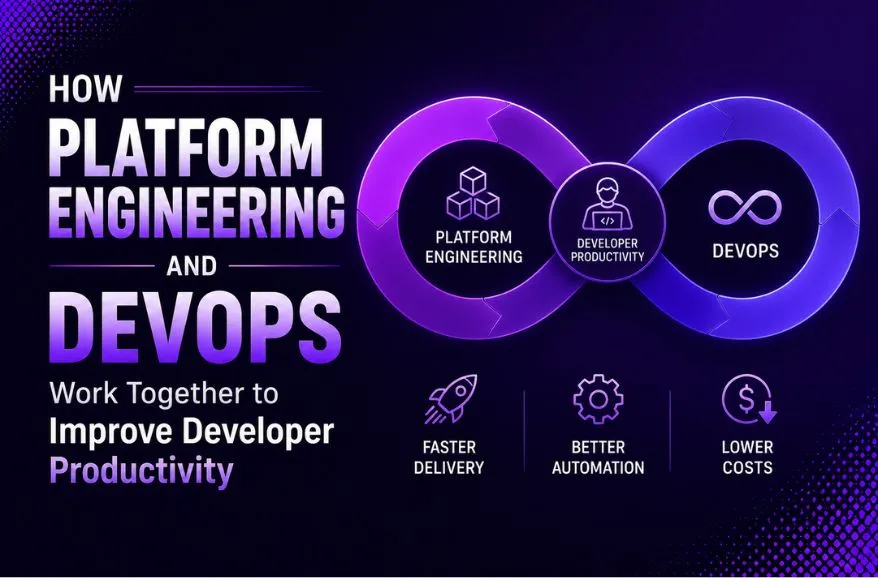
Platform Engineering vs DevOps can seem like an either/or scenario, but it isn’t; it’s the right people and tools working together to improve developer performance and accelerate time to delivery. Real world: Platform Engineering creates reusable and self-service elements. It allow developers to shift quickly. It is because DevOps promotes cross-team and cultural practices, automation, and reusable services pervasively to remove friction between build and run. Find the definitions, key differences, practical patterns and why both are needed with simple examples and actionable takeaways to implement today.
What Is Platform Engineering?
Platform engineering is an organizational practice that involves the building and upkeep of internal developer platforms for a better developer experience and increased speed in software delivery.
Why Platform Engineering Emerged
When DevOps began scaling across organizations, it resulted in the rise of platform engineering, a new approach to ease developers out of burnout. It combat the increasing cognitive burden and tool complexity. Instead, dedicated platform teams developed the software “golden paths” that enabled developers to write, test, and release software without needing to manage or even understand underlying complex infrastructure.
Core Principles Behind Platform Teams
- Software teams own the tooling and the environment.
- The team provides automation around infrastructure and manages performance and scalability.
- The team ensures an easy to consume service for developers so they don’t need to understand all of the underlying complexities.
How Platform Engineering Supports Developers
New research reveals organisations that have matured platform engineering see a 30-40% uplift in deployment frequency and lead time. IDPs allow teams to deploy several times a day and cut critical incidents by 20%. Such standards also allow less experienced developers to be productive in a matter of days. Gartner, in a record, said that IDPs make it easier to get work done by removing complexity and reducing the cognitive load. Although some experienced developers have stated that the structure will not give them the freedom that they need.
What Is DevOps?
Understanding the DevOps Philosophy
DevOps is an approach to building software, fostering a collaboration between the Dev and Ops teams to increase the delivery pace and reliability. By providing automation and optimized processes in the lifecycle of writing, deploying and operating software, the methodology can help improve cooperation. At the heart of DevOps are principles makes the entire software delivery process better. More automation-focused attitude among a single team, for example, results in shorter lead times.
Breaking Down Development and Operations Silos
The team would recover from failures quickly. It can continuously improve by eliminating manual work among multiple functionally. The divided teams manage specific tasks in the path from writing code to code being live.
Key Goals of DevOps Practices
The following components make up DevOps:
- Automation of Development Pipeline: Organizations automate their software’s building, testing, and deployment with CI/CD pipeline.
- Collaboration: Development teams connect with ops teams in real-time, shortening the path between the two teams.
- Monitoring: Teams monitor applications after they go into production and find out where the problems are.
- Infrastructure as Code (IaC): Teams are working with coding tools such as Terraform etc to automate and manage their IT resources.
- Incident Management: Teams pay attention to production difficulties and find out how to fix them. It lessens the recovery time.
Why DevOps Became Essential for Agile Teams
Speedy and accurate releases with rapid feedback are crucial to the success of Agile product development. DevOps adds the cultural glue and operating model to realize the intention of Agility in production. Absence in DevOps, velocity tends to break safety and reliability at scale.
Platform Engineering vs DevOps – Understanding the Core Differences
Developer Experience vs Process Optimisation
| Aspect | Developer Experience (DevEx) | Process Optimisation |
| Target | Individual developers and their daily workflow | Development pipeline and overall organizational workflow |
| Primary Focus | Reducing friction, minimizing cognitive load, and helping developers maintain a productive flow state | Maximizing delivery throughput, removing bottlenecks, and standardizing operational processes |
| Key Priorities | Intuitive development tools, self-service infrastructure, high-quality documentation, and faster feedback loops | Streamlined agile processes, automation of manual tasks, fewer hand-offs, and optimized delivery infrastructure |
| Core Philosophy | Satisfied developers can build better software and deliver stronger business outcomes. | The fastest and most efficient path for delivering business value comes from standardized workflows, clear guardrails, and minimal operational waste. |
Comparison Table: Devops vs Platform Engineering
| Aspect | Platform Engineering | DevOps |
| Focus | Focuses on building and maintaining platforms and infrastructure to support development. | Focuses on automating and optimizing the software delivery lifecycle. |
| Core Responsibilities | Building self-service platforms, managing infrastructure, and ensuring scalability and performance. | Automating CI/CD pipelines, collaboration between Dev and Ops, and monitoring production systems. |
| Approach | Platform-centric, optimizing the development environment and infrastructure. | Culture-centric, emphasizing collaboration and continuous delivery. |
| Primary Goal | Creating a robust platform for developers to interact with. | Enabling faster, more reliable software delivery. |
| Tools | Cloud management tools, container orchestration, Kubernetes, monitoring systems. | Jenkins, Docker, Kubernetes, Terraform, GitLab, CI/CD tools. |
| Security Focus | Ensuring platform security and infrastructure management. | Securing the software development and deployment pipeline. |
| Team Involvement | Typically involves infrastructure, network, and operations teams. | Involves developers, testers, and IT operations working together. |
Why Platform Engineering Is Not Replacing DevOps
Shared Goals Between Both Approaches
Platform engineering doesn’t kill DevOps, it’s a way to scale DevOps. DevOps was largely about establishing culture and shared operational responsibility. Platform engineering takes DevOps a step further by building centralized Internal Developer Platforms (IDPs) or “golden paths” that allow developers to implement DevOps best practices effectively and independently.
Addressing Developer Productivity Challenges
Platform engineering doesn’t replace DevOps, instead, it expands on DevOps to support scalable engineering operations. The primary cognitive load issue addresses by creating self-service tools for development engineers. A set of consistent processes, they can do the core coding they’re there for, instead of having to work on infrastructure.
Why Organisations Often Need Both
If DevOps merges development and operations teams, then platform engineering works toward automating IDPs that scale those principles. Both will be necessary for engineering leaders because DevOps will be focused on the “why” (and cooperation) behind building an application. while platform engineering will provide the “how” (standardization) for engineering leaders to achieve it.
How Platform Engineering Works in Practice
Creating Standardised Development Environments
A balanced combination of standardization and customization in platform engineering is the key. Customization supports your individual project goals and standardized platforms ensure that processes can support easily and simplifies collaboration across teams. Both can work in harmony with one another.
Building Self-Service Infrastructure Capabilities
Self-service in DevOps allows developers to use tools for self-management, promoting flexibility, yet also introducing potential inconsistencies and more work outside of coding. Platform engineering adds to this by providing a specific customer journey in which preconfigures all platforms, standardizes CI/CD pipelines, and automates compliance checks. This makes set-up easy and saves weeks by making it just a few moments, avoiding the time loss that goes with different set-ups. For example, a Terraform-Brewer command can simplify what used to be a complex process behind the scenes.
Managing Deployment Workflows
Besides writing the code, a developer needs context about how their code runs, where to find networking info. Also, what to configure for access rules, on top of pipelines and deployment processes. Having a tool in place internal reduces this mental overhead and speed up development and deployment times.
Simplifying Cloud-Native Operations
Platform engineering tends to go hand in hand with a cloud native and microservices approach to architecture. With platform engineering, teams will be able to easily integrate with cloud services, scale apps, and effectively handle microservices. It is also very flexible including the agility of microservices.
What Is an Internal Developer Platform?
With the Internal Developer Platform (IDP), developers can build, test, deploy, and monitor an application, or do virtually anything else about app development and delivery, with the idea of minimal attendant overhead. Platform engineers or platform teams develops it based upon their communication with developer and their understanding of developer’s specific problems and working flows.
Key Components of a Developer Platform
1. Development tools: Code editors, version control, these are all the tools that will contribute to improving developers’ experience (DevEx). When software delivery tools are integrated, the impact on DevEx is very important by shortening the feedback cycles.
2. Developer Portals: Internal development platforms (IDP) allow developers to implement self-service capabilities where developers can set up projects, test environments through the developer portals or the exposed APIs.
3. Integration and delivery: This sector addresses CI / CD pipeline, where teams may want to integrate with best-of-breed builders, testers, and deployers. The internal platforms are a great way to automate those aspects of development, letting developers focus on features.
4. Monitoring and Logging: Management of insights and logs of applications. Internal platforms are a way to simplify integrating observability tools and storing logs while enabling developers to change log verbosity when needed during a crisis.
5. Resource management: In internal platforms,self-service provisioning and scaling can minimize wait time and reduce the number of manual configurations. Also enable quicker experimentation and more consistent application deployments.
6. Security: These tools manage secrets, security vulnerability scanning, policy enforcement, etc. Integrating Security within an internal platform can improve compliance across the teams and make the software development process safer.
Self-Service Infrastructure and Automation
Developers can manage IT resources themselves using automated, repeatable templates through self-service infrastructure and automation. Rather than filing tickets, development teams get fast and consistent IT delivery and deploy apps much faster. At the same time, developers eliminate common misconfigurations, and IT ensures tight security and compliance with templates.
Benefits for Engineering Teams
1. Reducing context switching is one of the largest detriments to productivity in software development. Software developers switch tasks, they lose focus, and they waste time switching back to a context.
2. An Internal Developer Portal consolidates the various toolchains, infrastructure, and services that developers need, enabling them to minimize their task switching, reduce their distractions. Also reduce their administrative workload, and focus on writing code.
3. The developer portal enables teams to follow a common set of best practices. It provides a set of standard libraries, guides, and patterns that makes the “right way” the easiest way for developers to write software.
4. The internal developer portal acts as an internal repository of insights, and reusable code. It promote learning and shared knowledge across teams through a centralized repository for knowledge about standards and patterns.
DevOps Automation Tools vs Platform Engineering Platforms
Popular DevOps Tool Categories
| Platform Engineering Tools | DevOps Engineering Tools |
| Kubernetes (Container orchestration) | Jenkins (CI/CD pipeline automation) |
| Terraform (Infrastructure as Code) | Docker (Containerization) |
| AWS, Google Cloud, Azure (Cloud platforms) | GitLab (Source code repository & CI/CD pipelines) |
| Prometheus, Grafana (Monitoring & alerting) | Ansible, Chef, Puppet (Configuration management) |
| HashiCorp Consul (Service discovery) | Kubernetes (Container orchestration) |
Platform Engineering Tooling Ecosystems
Your platform engineering team’s toolchain must always be flexible and resilient. That means when there is another development tool out there that can improve development productivity in a significant way, then you should be able to slot it into the environment quickly and easily. That way, your toolchain moves at the pace of developer demands.
How Both Toolsets Complement Each Other
DevOps automation tools provide the mechanisms of moving code to production, but Platform Engineering platforms (Internal Developer Platforms) abstract and standardize those tools. Together, a “build it you run it” culture emerges—platform engineers make the reusable, self-service tools, while the developers use them on their own.
Platform Engineering Benefits for Modern Organizations
- Enhanced Developer productivity: Developers don’t have to make the context switch between complex infrastructure and the code; by abstracting away the latter they are free to focus on getting better at coding. Onboarding times new team members in improved ways, with standardized workflows and self-service portals.
- Time to Market is Increased: Deployment bottleneck is virtually removed with the CI/CD pipeline, allowing businesses to ship products and new features in record time.
- Embedded Security and Compliance: Golden Paths, coupled with inherent DevSecOps practices mean security, auth and compliance controls stay in place.
- Standardization Operations: Standard components, the portal and test automation reduce the probability of errors, and avoid inconsistencies within a business’s infrastructure.
- Cost Savings: Providing a suite of standard tools centrally and automating resource provisioning cuts unnecessary spending on the cloud and avoids the need for “just in case” idle environments.
Developer Productivity Tools and Their Role in Platform Engineering
1. CI/CD Tools: This provides the capability for developers to rapidly integrate, test, and deploy their applications, delivering features and fixes in a swift and safe way.
2. Containerization and Orchestration Tools: Packaging an application into self contained bundles of code (containers), and the capability to deploy and run these in scalable groups, known as orchestration (like K8s). It provides a highly efficient and available mechanism to run your code.
3. Internal Developer Platforms (IDPs): Developers gives self-serve tools and experience needed to fully manage their application’s life-cycle. It is from code-write through to deployment, and then on-going management of running application.
4. Infrastructure as Code (IaC) and Configuration Management Tools: Provides developers with the ability to define all the infrastructure they require for their application (e.g., servers, networks, database) as code, to ensure the repeatable deployment of this infrastructure, and for consistent, less error prone server setup.
Platform Engineering for DevOps Teams – A Practical Approach
- Do the work for developers: Ensure platforms are intuitive, consistent, and easy to use so that the developer can focus on the shipping product instead of dealing with complexity.
- Adopt secure defaults: Apply security and compliance checks where it’s most applicable and automatically at the time of the build.
- Plan for scaling and reliability: Design patterns for growth, load and failures; support and not hinder developer productivity.
- Minimize over-hand: Cut off unnecessary levels of infrastructure details in the most abstracted forms of abstraction to automate repetitive manual work, as done in templates.
- Leverage self-service and automation: Tap into safe self-service and automated workflows to get more deliveries faster and consistent.
- Recycle: Recycle where possible the proven tools some are available free for re-use. Whereas others are commercial from the areas that have a unique business value for your organisation.
- Use metrics and feedback loops: Monitor usage, performance, and developer feedback to pinpoint missed requirements and rectify them.
- Ensure observability and plan for Continuous Delivery: Standardize pipelines and have the ability to monitor them as one set with teams now able to release with confidence and solve issues rapidly.
- Build resilience patterns: In platform templates, and validate recovery strategies by injecting failure into the design. Inject failure to validate recovery strategies and design for resilience.
- Refine, improve and evolve the platform over time: Keep the platform as a product, change with new requirements, workaround technical debt over time, etc.
Platform Engineering vs DevOps vs Site Reliability Engineering (SRE)
Understanding the Role of SRE
Site reliability engineers (SREs) aim to keep applications reliable and secure, and to also guarantee their steady availability. They work closely with developers and Ops teams to build systems and infrastructure to support high reliability. SREs also perform capacity planning, scaling up infrastructure and incident management, to ensure the platforms adhere to service level objects (SLOs).
How SRE Differs From DevOps
DevOps focuses on the elimination of silos and rapid delivery of software solutions by breaking the ground through continuous integration and continuous deployment (CI/CD). On the other hand, SREs use software engineering principles in IT operations but with a dedicated attention toward system reliability and availability.
Platform Engineering’s Relationship With SRE
The distinction between the platform engineering and “SRE” is who they serve and they’s focus on. SREs interact with end users and make sure the application is reliable and accessible to end users. Platform engineers talk with internal developers and work on the developer experience of the platform. These goals differ with regard to the daily activities undertaken by the two teams.
Platform engineering offers the groundwork for fast application delivery and SREs deliver highly reliable and available applications. SREs aligns with trouble-shooting, incident response and platform engineers will be more technical with complex infrastructure and developer self-service.
Choosing the Right Operating Model
Deciding on the right operating model for your company, depends upon the specific bottlenecks you have to overcome. If you are having issues with your time-to-delivery, opt for DevOps. If your issue revolves around production up-time, pick SRE. If you are grappling with developer velocity, scalability and your infrastructure, lean into Platform Engineering.
Common Challenges in Platform Engineering Adoption
- One of the top problems is dealing with an increasingly complicated stack of technologies, including multiple tools, cloud services, and third-party integrations. If there’s no real standardization across that, instead of increasing productivity, this complexity is going to decrease productivity.
- The most well-thought-out IDPs will often fall short if they don’t really support developers on their actual work or make their daily job easier. Keeping developers involved in the planning and design phase will make the platform that more widely adopted and user friendly.
- Legacy systems and technical debt can make modernization difficult and can add to complexity of integrating these platforms with an organization. In some cases, ripping out the entire system might just not be an option because of the cost and time.
Real-World Use Cases of Platform Engineering
Spotify’s Backstage
Spotify developed Backstage to be an open-source IDP offering a common catalog to monitor all microservices, manage infrastructure, and have access to documentation.
Netflix’s Spinnaker
Netflix developed Spinnaker to be an open-source, multi-cloud continuous delivery service to control cloud resources. Regardless of provider and more complex deployment configurations such as canary release.
Key Metrics for Measuring Developer Productivity
- Measure platform reliability indicators such as percentage of platform service uptime, mean-time-to-repair platform problems, and number of incidents platform caused. Find out if the platform is the base and essential element that it says it is or irritation.
- Measure operational reduction outcomes such as the amount of manual operational workflow product teams have reduced. It has the number of tickets eliminated from operational teams to infrastructure teams. Determine the measure of the platform’s core proposition.
- Track anti-metrics that are important to watch for, like exception rates (how many times the team receives permission to go outside the golden paths), forks of platform components (when different groups extend similar platforms in different ways).
- Shadow IT such as teams building their own solutions on top of a platform, indicates a state of anti-metrics. It also shows unfulfilled needs.
Future Trends in Platform Engineering and DevOps
1. Increases Developer Productivity
Platform engineering helps developers to spend less time on operations and more time on the actual coding to ship new functionality. Self-service ITPs speed up provisioning for significantly reduced onboard time for new apps. Companies that implement platform engineering and ITPs get to market faster and with more consistent release Cadence. Platform engineering and IDPS are early high ROIS.
2. Consistent Governance and Compliance
With scale comes the need for governance. Platform engineering enables developers to maintain autonomy while building at the platform level a consistent policy layer ensures compliance across an organization. This prevents teams from making bad configuration mistakes which is critical in many highly regulated environments. Data-intensive companies need platform engineering to mitigate risk.
3. Scalability and Standardization
Platform engineering helps combat tooling sprawl by standardizing a shared infrastructure with consistent templates and CI/CD pipeline configurations. This makes onboarding teams and apps into a multi cloud environments easy. As they know what to expect regardless of which cloud they are using it is indispensable in organizations that have numerous teams or want to grow.
4. Enhanced Developer Experience
Developers spend far too much time navigating and managing underlying Infrastructure leading to significant stress, and burnout, the simpler and faster the onboarding to development environment (IDP), the better you’ll retain the most valuable employees. Thinking about your internal development platform as a product gives everyone the right feedback mechanism to improve developer experience.
5. Cost Optimization
Good platforms minimize duplicate work and over-consumption of underlying resources thereby providing savings, a platform that helps teams leverage common cloud constructs through standardized toolchains and pipelines significantly reduce overall cloud spend for an organization.
When Should Organizations Invest in Platform Engineering?
1. Scaling Limitations: Problems with scaling applications clearly signal a requirement for a platform with underlying infrastructure and tooling in place.
2. Repetitive Problems: If teams (dev or ops) are constantly solving the same problem again and again in every new application and every new project, it’s time to centralize common problems and implement them as reusable patterns.
3. Different Types of Workloads: Don’t reinvent the infrastructure for different kinds of workloads – leverage platform engineering to provide a shared infrastructure to handle various applications.
4. Team Collaboration: Teams inevitably get bigger.
Collaboration should improve over time with larger teams, not devolve. Using shared repositories, version control, and internal tools as part of a platform improves team efficiency and the quality of outputs.
5. Manageability & Stability: As if scaling wasn’t a enough of a pain, there are times where the systems get so chaotic it makes managing the application more like navigating an operating nightmare. This could also lead to angry clients and operational churn that costs an arm and a leg.
6. Cost Efficiencies: Well designed platforms enable better cost optimization, and with the rise of serverless technologies and the cost savings of managing infrastructure as code, there has never been a better time.
7. Security and compliance: Platforms can ease the burden on the compliance and security requirements. These can reduce errors made by users and ensure essential controls are set in place.
Best Practices for Combining Platform Engineering and DevOps
- Treat the Product team as the engine that powers the platform – platform has users, requirements, has a roadmap.
- Encourage adoption through making the platform appealing not required.
- Make common workflows golden, and support senseful defaults (opinionated).
- Evaluate the platform by how many people are adopting it, how productive it is for engineering and not by the number of features it has.
- Permit teams to forgo golden paths, specifically setting forth trade-offs in support of a platform.
- Collect developer experience data via surveys or DORA-style instrumentation.
- Determine if there are improvements in speed, reduction of work hours, and user satisfaction among engineers.
- Collect data around the effectiveness of the platform and if it is providing for the promised benefit.
Conclusion
Platform Engineering vs DevOps should be considered as complementary skills. DevOps provides the cultural and process pillars and Platform Engineering extends and scales those by providing internal platforms or a self-service platform. When paired together, they not only help ease the cognitive burden, but also increase deployment frequency and reliability, winning measurable gains. This result in a quicker time-to-market and satisfied engineering teams. In the face of scale and complexity, the logical answer for an organization is to invest in a platform. At the same time, staying true to DevOps concepts and maintaining the developer productivity they’ve become accustomed to.
FAQs
Q1. What is the difference between Platform Engineering and DevOps?
DevOps is a culture of mindset and practice to blend software development and IT operations. Whereas platform engineering is a dedicated technical specialization that building self-service reusable Internal Developer Platforms (IDPs) to scale the DevOps culture.
Q2. Is Platform Engineering replacing DevOps?
No, platform engineering does not replace DevOps.
Q3. How does Platform Engineering improve developer productivity?
Platform engineering improves the developer experience by using Internal Developer Platforms (IDPs) with automated workflows, that gives developers self-service and on-demand workflows.
Q4. How does Platform Engineering relate to SRE?
Platform engineering produces the reusable self-service tools and internal platforms to developers where they can perform code deployment tasks.
Q5. When should a company adopt Platform Engineering?
Companies muse embrace platform engineering. In case, their development teams are experiencing too much cognitive load, have difficulties with deployment blockers. It even includes suffering from excessive tool sprawl.
Q6. What are the benefits of combining Platform Engineering and DevOps?
When the two work together, Platform Engineering and DevOps cuts down repetitive setup work, enables faster software delivery and reduces time to market while enabling tighter security and compliance.

Leave a Reply