


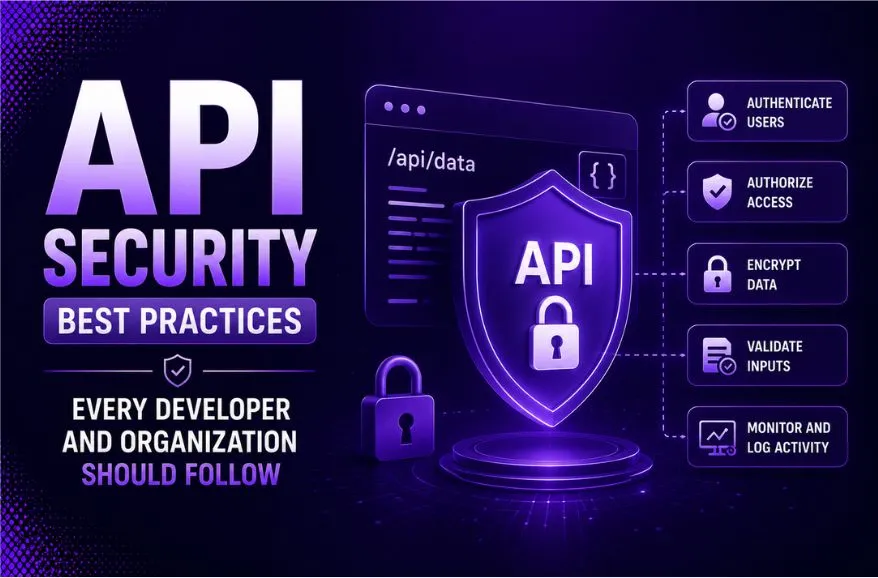
Contemporary applications are run through APIs (mobile applications, web services, partner platforms, 3rd-party integration and microservices), which allow access to those applications, to gain some business value and mitigate against a possible risk. Organizations are using the API security best practices in order to preserve availability and prevent data loss. Therefore, maintain trust of their clients and partners. It is imperative to apply some practices continuously (from design to monitoring), not just on a one-time bases and protect your APIs at all costs. This article outlines some best practices designed to protect your applications and systems, minimize potential surface attacks, and prevent data breaches.
What Is API Security and Why Does It Matter?
Understanding API Security in Modern Applications
API security is a set of processes and methods to protect APIs from data theft, data breaches, unauthorized access, and malicious use. Authentication, encryption, validation, rate limiting, monitoring, and secure coding practices ensure that sharing data is safe and secure between applications.
Why APIs Are Attractive Targets for Attackers
Cyber criminals have been exploiting the backend for the direct, raw, unsecured access to their valuable information, along with the system’s basic functionality. Such a process carries out in order to automate assaults to take advantage of scale, mass data extraction, and to simply navigate IT environment.
Business Risks Associated With Insecure APIs
These organizations often access the system by integrating third party APIS( like payment and messaging systems). Such third parties also provide gateways to these networks. It allows cybercriminals to break through an organization’s network through the APIs without directly compromising its system.
The Growing Importance of API-Driven Architectures
Organizations are rapidly modernizing and transforming the applications. They offer to connect their systems and services, particularly within cloud-native and microservices environments. Given the increasing demand on and adoption of APIs, it also presents a whole new threat landscape and the need for API security.
The State of Application Security Report by Indusface states that the threat landscape surrounding APIs is evolving quickly, in fact:
- API attacks in India jumped by over 3000% year-on-year in the July to September period, totaling 271 million in one quarter.
- Organisations are 85% more likely to be subjected to API-based DDoS attacks than website based DDoS attacks.
- Attacks on the back of bots attempting to compromise APIs increased by 145%, totalling 215 million incidents in Q3.
- Almost 30% of organizations had outstanding and critical API security vulnerabilities for more than 6 months.
Common API Security Threats Organizations Face
- Vulnerability exploit: An attacker inputs maliciously crafted data to abuse any flaws in your web application or API to obtain data they should not have.
- There is a comprehensive OWASP top 10 list that breaks down various API vulnerability issues, with examples including SQL Injection and Security Misconfiguration. The threat with a Zero-day is its ability to strike any unknown exploit you don’t even know about. Zero-day vulnerabilities can be some of the toughest API threats to defend against.
- Authentication-based attacks: You need a client to authenticate with you in some manner before being able to connect and send requests to the API server. Without it, it’s very difficult for your API server to ensure only authorized clients are making requests. A client could get access to a legitimate customer’s login details by intercepting a client’s authentication token, or even by using a compromised API key.
- Authorization flaws: This refers to controlling the specific level of access each of your users have. Without carefully considering how users are authorized, clients may be allowed to access data they should not, leading to the increased likelihood of data breaches.
- DoS and DDoS attacks: If a lot of users start making requests at your API, you could start to experience delays in responses. Some attackers, however, take this to the next level by flooding your API with an overwhelming amount of requests. They do it to attempt to block other users from getting access through DoS (Denial-of-Service) and DDoS (Distributed Denial-of-Service) attacks.
API Security Best Practices Every Team Should Implement

Secure API Development Starts With Design
- Access and Identity: It means who uses your API, and to what extent they have access to.
- Data Loss Prevention: You prevent sensitive data from being stored or transmitted insecurely.
- Input and Output validation: You validate data entering or leaving your API.
- Traffic management: You manage the use of your API so it can not be overloaded.
- Development practices: You implement controls on the testing of the security for APIs in use in order to protect sensitive company data and systems.
API Authentication Methods and Identity Verification
Why Authentication Is the First Line of Defense
Authentication in your APIs helps verify the identity of users requesting to access your APIs. Anyone you authorize to access the API should be a user that you authenticate. This means no outside parties or anonymous users. You shouldn’t be granting them access to your API! API authentication helps form the bedrock of cybersecurity within your system by ensuring that it only opens its API doors to actual users.
API Keys and Their Limitations
API key authentication helps secure your API from security flaws found in shared credentials, such as what’s in the HTTP Basic authentication method. API key authentication works by authenticating users with a given API key, often called a “bearer token.” A user needs this token in their authentication credentials in order to access the API.
OAuth 2.0 Authentication Framework
OAuth 2.0 It’s a widely-adopted authentication protocol for protecting and securing APIs with the permission of end-users. OAuth 2.0 can provide a more secure way of granting your third-party applications access to your customers’ accounts without necessarily sharing user’s credentials. The protocol just use access tokens as temporary credential in replacement for the user’s credential. It also helps manage user credentials safely while improving usability by streamlining mobile and web API interactions with authorized users.
OpenID Connect for Identity Management
OpenID Connect (OIDC) is an identity layer built on top of the OAuth 2.0 protocol and the specification standardize identity management. It allows clients to verify the identity of end-users based on authentication performed by an authorization server. It provides for end-user session information and attribute information about the end-user, without giving the clients sensitive information like their passwords. OIDC standardizes Single Sign-On (SSO) between applications without individual applications needing to know the users’ passwords.
Multi-Factor Authentication for Sensitive APIs
Multi-factor authentication (MFA) takes authentication to the next level by implementing a second verification step to authenticate users in place of traditional passwords. It helps you significantly reduce your risk. Unfortunately, most multi-factor authentication types are not immune. Most of push-based MFA are and SMS OTPs are vulnerable to phishing. While FIDO2-based MFA presents benefits in phishing prevention and continues to gain adoption as the current MFA best practice, it may present an increased challenge for the end user or administrator.
API Authorization Best Practices for Access Control
Authentication vs Authorization Explained
| Aspect | Authentication | Authorization |
| Definition | Authentication is the process of verifying the identity of a user or application that wants to access an API. | Authorization determines the actions or resources an authenticated user or application is permitted to access. |
| Key Question Answered | Who are you? | What are you allowed to do? |
| Purpose | Confirms that the user or application is genuine before granting access. | Defines the level of access and permissions after identity has been verified. |
| Common Methods | User-Based Authentication: Verifies user credentials such as usernames and passwords. Token-Based Authentication: Uses JWTs (JSON Web Tokens) or API keys issued after successful login to identify users or developers accessing the API. | Role-Based Authorization: Grants permissions based on user roles, such as administrator or standard user. Scope-Based Authorization: Grants access based on scopes assigned during the OAuth token exchange process. |
Role-Based Access Control (RBAC)
RBAC is a commonly applied authorization method that grants access on the basis of the roles that you have allocated to individuals or entities on your systems. It is used in various systems, especially API, to grant secure access control.
Attribute-Based Access Control (ABAC)
The system dynamically assesses access permissions against the attributes of a user, environment and resource as opposed to giving the user static roles.
Implementing Least Privilege Permissions
Principle of Least Privilege (PoLP) limits consumers, users, applications and services for minimum access when using your APIs.
Preventing Privilege Escalation Risks
Enforce the Principle of Least Privilege, validates all inputs to prevent API privilege escalation, use token-based authentication, constantly check for anomalies, and implement rate limiting to stop potential invaders.
OWASP API Security Guidelines Developers Should Know
API1:2023 Broken Object Level Authorization: This is when an attacker alters an object ID to get into the application and pull some data. They weren’t meant to get in simply because access wasn’t controlled at an object level.
API2:2023 Broken Authentication: The app’s authentication system gets compromised and attackers gain unauthorised access.
API3:2023 Broken Object Property Level Authorization: Similar to API1:2023, it specifically exploits access controls of individual properties within an object.
API4:2023 Unrestricted resource consumption: The API will block user’s access and exhaust the server resources. (DoS).
API5:2023 Broken Function Level Authorization: An API does not apply function level permissions for user, attackers will gain access to forbidden functions.
API6:2023 Unrestricted Access to Sensitive Business Flows: The API provides access to sensitive business logic that does not consider whether the requesting user is authorized to do so.
API7:2023 Server Side Request Forgery (SSRF): A malicious user tricks the server-side application into fetching and then returning some external data back to them. It allows the application to send requests to external sites or external resources as the attacker.
API8:2023 Security Misconfiguration: It generally refers to improper configuration and security settings. Default configurations or less strict controls result in API exposures.
API9:2023 Improper Inventory Management: It’s when you do not know what’s up and running in your system; if an asset is vulnerable, you won’t know.
API10:2023 Unsafe Consumption of APIs: This API flaw pertains to applications using APIs and the vulnerabilities that come with such consumption. Especially when these APIs consume data in unsafe way. The consuming API for example, doesn’t validate any of the sent data into it.
Input Validation and Threat Prevention Techniques
Why Input Validation Matters
Input validation ensures that the data entered into any system satisfies all the defined requirements. It is a protective measure to ensure that only valid input data reaches the system. It avoids accidental or malicious data to breach the security or to corrupt the data of the system. It’s basically a process like checking our work again and again before sending it. The main goal is to make data secure and ensure the integrity of the data.
Threat Prevention Techniques
1. Client-side Validation: Client-side input validation performs on the browser side when the user enters the input. It directly validates input and notifies the user of wrong data entries. This is the fast process, but user can be bypass it easily.
2. Server-side Validation: Server-side validation is performed on the server to secure system. Data is passed to the server if client-side validations passed to perform again validation by the server as to make sure no harmful or corrupted data enters the system.
3. Regular Expressions: Regular expressions are used for searching a string of text that matches the given patterns. The regex engine provides many features to find patterns of characters within the text.
4. Whitelisting: It is a type of validation process where you explicitly define the input values you are allowing. This means any input not found on the whitelist is invalid.
5. Blacklisting: Blacklisting involves refusing the defined specific patterns by the system.
API Rate Limiting and Traffic Management
Understanding Rate Limiting and Its Importance
Rate limiting is a technique to enforce an upper limit on the amount of traffic to a resource that is permitted during a given period. This method improves the security and the performance of applications deployed at scale.
How Does Rate Limiting Work?
It prevents the exhausts system from DOS attacks, optimize the use of resources, supports operational expenses reduction and incentivizes customers to subscribe for higher plans. It enforces limits on operations; any operation request that is beyond a predefined limit can then be denied by the underlying system. It could be done on a client, middleware or even on the server side.
API traffic management Explained
Manages and monitors traffic request/response between application by the use of gateways, load balancers and policy engines. It involves use of rate limiting and throttling.
It uses mechanisms for preventing server overloads, stabilizing applications and protecting the application from malicious attacks.
Monitoring, Logging, and API Threat Detection
Importance of Real-Time Monitoring
When you monitor APIs, you keep an eye on how they perform, notice abnormal trends, and record relevant performance indicators like how quickly they return information and how many are failing.
Security Event Logging Best Practices
Logging records all API requests and their corresponding responses, as well as other important API information that can help you debug problems and investigate events.
Detecting Suspicious API Activity
To detect the threat of something suspicious about API traffic, you will want to examine API requests as they occur to find anomalies, illicit activity, or unauthorized access. Some of the suspicious behavior includes requests with unusually high numbers of errors and high levels of exposure. It is important to monitor the requests that are sent through your system so that they may be protected from unauthorized use.
Building Incident Response Workflows
The purpose of an incident response plan is to define a series of specific security measures taken by an organization in the event of a security incident. The plan explains the process used in responding to such an incident. It sets out the specific steps to take and ensures alignment with an organization’s objectives and requirements. These requirements list all actions, participants’ roles, communication methods, and evaluation criteria.
API Security Testing Throughout the Development Lifecycle

API Security Guidelines for Cloud-Native Applications

How to Secure an API in Production Environments
Regular Vulnerability Assessments
Make use of automated scanning devices to find out security risks and security vulnerability assessments. Security audits or penetration tests reveal and eliminate risks, start with a penetration tester and perform penetration tests.
Updating and Patching Dependencies
Ensure your APIs and backend services are kept up to date with recent security patches and updates in order to guard against known vulnerabilities.
Continuous Compliance Monitoring
Apply security practices like the OWASP API Security Top 10 list to minimize vulnerabilities. These top 10 provide an excellent resource as well as the current security considerations for securing any public API. Also, a personal API that you use in order to prevent security compromises.
Common API Security Mistakes Organizations Make
Injection attacks: When attacked during an injection attack, malicious data or code inserts into an API request.
- When an attacker sends malicious SQL code in a request, the threat will be to unauthorized database access when an attack such as SQL injection takes place.
- Injection attacks occur when an attacker inserts malicious code into an existing web page to make the API vulnerable as seen in XSS.
Broken authentication and session management: As it would imply by its name, this is one of the methods that allow an attacker to access an API without authentication or when proper session management procedures aren’t followed by a company. An attacker may attempt to guess a user password or to steal an API session cookie and other such means for identity theft.
Insecure communication: The communication process between the API and a client needs to encrypt. Otherwise if the connection used is an unencrypted one, an attacker can eavsdropped any communication, who can listen in and modify the data. Thus compromise the security. MITM is an attack that comes under this, where one can read and modify data, while another comes under eavesdropping attacks, where the attacker may just passively listen to the traffic.
DDoS attacks: Exposed API receives too many requests at once, the API server gets overwhelm and thus go down making it inaccessible. For example, in a DDoS attack, the hacker floods the API with requests until it collapses.
Misuse of API keys: API keys are secret and sharable unique strings to certain systems and users. A user who may get access to an API key may use it to make their own requests through the API to gain authorization.
API Security for Compliance and Regulatory Requirements
1. GDPR: A set of rules imposed by the EU to protect the consumers’ personally identifiable information (PII). It dictates that businesses become “data custodians,” holding personal data for consumers with care and a high sense of responsibility for the data.
2. Consumers’ Rights For EU: Consumers and companies must responsibly protect their PII and understand the nature of the data in their possession. As a final step, the request is to remove this information to satisfy the “right to be forgotten” for the user.
3. Comparison to Comparison: The California Consumer Privacy Act (CCPA): CCPA is a similar role to GDPR, it protects consumer privacy rights in the US.
4. PCI DSS or Payment Card Industry Data Security Standards: It helps companies securely process, store and protect their customers’ credit card information.
5. HIPAA or Health Insurance Portability and Accountability Act: The HIPAA law provides the security to protect the personal health information (PHI) of patients. Therefore, organizations should take steps to ensure that they are HIPAA Compliant with the necessary policies and procedures.
6. ISO / IEC 27001: Companies may use ISO / IEC 27001 to provide a comprehensive set of guidelines for their information security processes and to show proof of compliance.
7. SOC reports: SOC reports help clients prove that they have effective controls for processing, and storing, sensitive information, based on their strict examination process.
Future Trends in API Security
1. Behavioral Analytics and Anomaly Detection
Using AI and behavioral analytics to track and detect threats contextually from API activity-going beyond mere signature-based detection.
2. Transition to SaaS
Companies are moving to SaaS and away from traditional on-premises API security products, leveraging enhanced AI and machine learning capabilities with fast deployments.
3. Analysis of Larger Time Windows
Keeping the security team from constantly updating WAF policies, and taking a long-term perspective on API activity to better detect anomalies and automatically tune WAF policies.
4. DevSecOps Integration
Enabling your teams to understand the importance of and integrate non-security individuals into your API security plan, such as developers, is paramount.
5. API-Enabled Security
Providing developers with on-demand access to your API security data to improve threat hunting,incident response and to build API security best practices.
API Security Checklist for Developers and Organizations
1. Proper Authentication and authorization: It must follow OAuth 2.0 and OpenID connect for secure authentication, and JWT for token-based access, implement multi factor authentication(MFA) and then restrict access according to their respective role of the users.
2. An API gateway and rate limiting: The organizations can use an API gateway to regulate traffic and apply a rate limit to discourage any kind of attack. At the same time, keeping the systems unhindered for users. Log the activities on this network to check for any malacious activity.
3. Transmit Secure data: Organizations ensure the proper data transmission by the usage of encryption and protocols like HTTPS with TLS 1.2. Also encrypt data by means of algorithms, especially in a rested state with AES-256. Implement certificate pinning in order to protect the data.
4. Input Validation and Sanitization: Organizations can prevent any sort of injection in to the systems by validating, sanitizing all the input, using parameterized query. Restricting input of specific type and checking contents of the input in question.
5. Secure API Endpoints: Limit the number of people or organizations that can access the endpoints of the API with authentication. Implement an IP Whitelisting for your internal communications by the use of a private API.
6. Monitor and Log Activities: Full logging, SIEM solution, and setting up real time alerts can help detect quickly and mitigate unusual activities. It also include suspicious traffic on the API network as it is very important for organizations.
7. API Security Testing checklist: Security of the API network is not one-time. Organizations must perform continuous SAST, DAST, Pentesting and Fuzz testing on their network.
8. Limit Data Exposure: Do not allow the API responses to carry any extra data and if possible limit responses to only those pieces of information needed by the requestors, restrict any PII and financial details and data masking.
9. Store keys and tokens secure: Secure storing, rotation and expiring of the keys and tokens is important. An organization should be very particular with secure handling of keys and tokens.
10. Safe Handling of Errors: Do not disclose information on the backend when the system throws an error. Have a standard generic error responses. Store the logs internally.
11. Safeguard against DoS Attacks: Organisations should reduce risks of DoS by Rate limiting, CAPTCHA, Load balancer.
12. Update And Patch APIs Frequently: Organisation should patch the APIs quickly, maintain latest Dependencies, deprecate older APIs.
Conclusion
Organizations implement API security best practices in their daily routines-this is an everyday job rather than an event. With minimum data exposure designs, tight authentication, input validations, and thorough monitoring, makes organizations achieve significant risk reduction. API best practices can be applied to whole development process – from the design to its’ on-going monitoring phase. Keeping these best practices will improve your team performance and will help protect client’s personal data while enabling more complex business processes.
FAQs
Q1. What is API security?
API security is the practice of protecting APIs against hacking attempts, data loss, and illegal access.
Q2. Why are APIs vulnerable to cyberattacks?
Many cyberattacks launch at APIs since they have programmatic direct access to your back-end systems and carry out high volumes of sensitive information.
Q3. What are the most important API security best practices?
Best practice of API security – ensuring all of your endpoints have proper authentication and tough authorization.
Q4. What is the difference between authentication and authorization?
Authentication and authorization check who you are, respectively what you can do.
Q5. How often should APIs undergo security testing?
Each code deployment should be a trigger for the continuous security test to evaluate each of the APIs.

Leave a Reply